


Denmark
Power & telecom standards in Denmark
Connectivity Overview
Tempest Telecom offered dial-up internet access, WiFi hotspot access, toll-free dial-up access and broadband ethernet access in Denmark. We also offered Iridium satellite Internet and Voice access in Denmark for communications in rural areas without infrastructure.
Denmark uses 230V at 50Hz. Power outlets are type C, E, F, K and telephone jacks are RJ-11 / Danish.
Dial-up Internet Access
Tempest Telecom provided local dial-up access numbers in Denmark at $0.115/minute. Toll-free numbers were also available at $.17/minute. Travelers could connect using any standard modem with an RJ-11 telephone adapter.
WiFi Hotspot Access
Tempest Telecom provided WiFi hotspot access in Denmark at $19.95/day for unlimited browsing.
Adapters & Power
Travelers from North America will need a power plug adapter. European Type C/F adapters are widely compatible.
A RJ-11 / Danish to RJ-11 adapter may be required for connecting a standard modem.
Denmark at a Glance
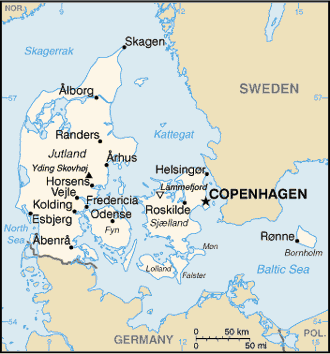
- Capital
- Copenhagen
- Phone Code
- +45
- Voltage
- 230V / 50Hz
- Power Plug
- C, E, F, K
- Phone Jack
- RJ-11 / Danish
- Currency
- Krone
- Dial-up
- $0.115/min
- WiFi
- $19.95/day
About connectivity in Denmark
Denmark uses 230V/50Hz with the Danish Type K outlet (a unique half-moon ground pin) plus Type C and Type F for some installations. The phone jack is RJ-11 in modern installations; older buildings may retain the Danish Krone-style connector. KTAS, the historic Copenhagen Telephone Company, merged with the other Danish regional operators in 1990 to form TeleDanmark, later TDC, with structural separation in 2019 splitting the wholesale Nuuday from the network infrastructure. Telia Denmark, Telenor Denmark, and 3 Denmark compete in mobile and broadband.
Denmark's academic DENet opened the country's first international Internet connection in 1988-1989 from the University of Copenhagen, with the .dk ccTLD assigned the same year. Commercial dial-up began through 1993-1995 with Tele Danmark Internet, Cybercity (later Telenor), DK-Online, Sonofon Internet, and a long list of regional ISPs. Per-minute metered access through KTAS / Tele Danmark PSTN was the norm through the late 1990s. The Tele Danmark / TDC ADSL service rolled out from 1999-2001 and consumer dial-up was largely displaced by the mid-2000s. Denmark has consistently ranked among the European top tier for broadband penetration since the mid-2000s, with extensive municipal-utility fiber networks (Fibia, EnergiMidt, TDC NetDesign) competing alongside the major retail operators.
KTAS introduced Danish cardphone units in the late 1980s, with chip-card cardphones following from the mid-1990s. The Danish payphone fleet was iconic for its grey-and-burgundy KTAS / TeleDanmark kiosks placed densely across Copenhagen, Aarhus, Odense, and the regional railway stations through the 1990s. The TDC commemorative phonecard collector market developed substantially through the cardphone era, with thousands of distinct issues over two decades. The prepaid international calling-card market through the 1990s and 2000s served Denmark's historic Polish, Turkish, Pakistani, Lebanese, Iraqi, Bosnian, and Somali immigrant communities, plus the post-2015 Syrian and Eritrean refugee populations. TDC payphone fleets across the country were progressively decommissioned through the 2000s and early 2010s; the last Danish payphones were retired in 2017.
Tempest Telecom served Denmark through dial-up POPs in Copenhagen, Aarhus, and Odense, with WiFi at $19.95/day as Kastrup Airport and Danish State Railways (DSB) rolled out wireless. Greenlandic and Faroese customers — geographically remote from terrestrial networks — were particularly important Iridium satphone subscribers.
Modern Denmark has near-universal FTTH and 5G, consistently ranking among the European leaders for broadband speed and quality.
Tempest's services across Denmark, 1997–2012
Tempest Telecommunications operated international connectivity services in Denmark between 1997 and 2012 under a unified prepaid account that absorbed multiple service types onto a single customer credential. Customers in Denmark drew from the same balance for pre-paid international voice calling, RADIUS-authenticated dial-up Internet roaming, metered Wi-Fi hotspot access, Iridium satellite voice, and Inmarsat BGAN data terminals. The PATN kiosk-card clearinghouse (Tempest's TITAN kiOSK, incorporated 2000) extended the same card-and-PIN model to public Internet terminals but did not reach scale.
Iridium satellite voice was available in Denmark from approximately 2001 (post-bankruptcy relaunch). Thuraya coverage did not extend to Denmark; Inmarsat BGAN data terminals filled the broadband gap from late 2005.
Nearby countries in Europe
Bulgaria · Croatia · Cyprus · Czech Republic · Estonia · Faroe Islands · Finland · France