


Bulgaria
Power & telecom standards in Bulgaria
Connectivity Overview
Tempest Telecom offered dial-up internet access, WiFi hotspot access and broadband ethernet access in Bulgaria. We also offered Iridium satellite Internet and Voice access in Bulgaria for communications in rural areas without infrastructure.
Bulgaria uses 230V at 50Hz. Power outlets are type C, F and telephone jacks are RJ-11.
Dial-up Internet Access
Tempest Telecom provided local dial-up access numbers in Bulgaria at $0.155/minute. Travelers could connect using any standard modem with an RJ-11 telephone adapter.
WiFi Hotspot Access
Tempest Telecom provided WiFi hotspot access in Bulgaria at $19.95/day for unlimited browsing.
Adapters & Power
Travelers from North America will need a power plug adapter. European Type C/F adapters are widely compatible.
Standard RJ-11 jacks are used. Most international modems will connect without an adapter.
Bulgaria at a Glance
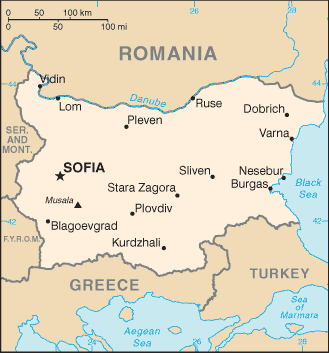
- Capital
- Sofia
- Phone Code
- +359
- Voltage
- 230V / 50Hz
- Power Plug
- C, F
- Phone Jack
- RJ-11
- Currency
- Lev
- Dial-up
- $0.155/min
- WiFi
- $19.95/day
About connectivity in Bulgaria
Bulgaria uses 230V/50Hz with Type C and Type F outlets, identical to the European mainstream. The phone jack is RJ-11 in modern installations, with some legacy buildings retaining the Bulgarian connector. Vivacom (the post-1992 successor to the Bulgarian PTT, formerly BTC) was privatized progressively through the 2000s. Yettel Bulgaria (formerly Telenor Bulgaria, now Czech PPF-owned), A1 Bulgaria (formerly Mobiltel, now Austrian Telekom Austria-owned), and a long list of regional cable operators compete.
Bulgaria's academic ISTF network opened the country's first international Internet connection in 1993. Commercial dial-up emerged through 1995-1997 with BTC's service, plus private operators including Spectrum Net, Digital Systems, BOL.bg, and a long list of regional ISPs. Per-minute metered dial-up through BTC PSTN dominated the late 1990s. The Bulgarian broadband story is unusual — the country's dense Soviet-era apartment-block (panelka) housing stock paired naturally with neighborhood entrepreneur-built ethernet-LAN operators who ran Cat-5 cabling through stairwells and rooftops, producing one of Europe's densest competitive broadband markets through the 2000s. By the mid-2000s, dozens of micro-ISPs competed within individual Sofia neighborhoods, with fiber-to-the-building infrastructure rolling out faster than in most Western European peers; Bulgarian retail broadband prices have been among the lowest in the EU.
BTC introduced cardphone units in the early 1990s with chip-card cardphones becoming standard from the mid-1990s. The grey-and-burgundy Bulgarian payphone kiosks rolled out across Sofia, Plovdiv, Varna, Burgas, and the major regional centers. The Bulgarian commemorative phonecard collector market was substantial through the cardphone era. The prepaid international calling-card market through the 2000s served the substantial post-2007 EU-accession Bulgarian migration to the UK, Germany, Italy, Spain, and Greece. Vivacom payphone fleets across the major cities have been almost entirely decommissioned through the 2010s.
Tempest Telecom served Bulgaria through dial-up POPs in Sofia, Plovdiv, and Varna, with WiFi at $19.95/day across the Black Sea tourism zones at the major hotel chains. The Stara Planina mountain ranges, the Rhodope highlands, and the Black Sea maritime industry were a meaningful Iridium satphone market.
Modern Bulgaria has aggressive FTTH coverage in Sofia, Plovdiv, Varna, and Burgas with 5G from Vivacom, Yettel, and A1 maturing across the country.
Tempest's services across Bulgaria, 1997–2012
Tempest Telecommunications operated international connectivity services in Bulgaria between 1997 and 2012 under a unified prepaid account that absorbed multiple service types onto a single customer credential. Customers in Bulgaria drew from the same balance for pre-paid international voice calling, RADIUS-authenticated dial-up Internet roaming, metered Wi-Fi hotspot access, Iridium and Thuraya satellite voice, and Inmarsat BGAN and Thuraya data terminals. The PATN kiosk-card clearinghouse (Tempest's TITAN kiOSK, incorporated 2000) extended the same card-and-PIN model to public Internet terminals but did not reach scale.
Both Iridium (global LEO) and Thuraya (regional GEO) satellite voice were available in Bulgaria from approximately 2001, alongside global BGAN data from late 2005.
Nearby countries in Europe
Austria · Belarus · Belgium · Bosnia-Herzegovina · Croatia · Cyprus · Czech Republic · Denmark