


Greece
Power & telecom standards in Greece
Connectivity Overview
Tempest Telecom offered dial-up internet access, WiFi hotspot access, toll-free dial-up access and broadband ethernet access in Greece. We also offered Iridium satellite Internet and Voice access in Greece for communications in rural areas without infrastructure.
Greece uses 230V at 50Hz. Power outlets are type C, F and telephone jacks are RJ-11.
Dial-up Internet Access
Tempest Telecom provided local dial-up access numbers in Greece at $0.115/minute. Toll-free numbers were also available at $.17/minute. Travelers could connect using any standard modem with an RJ-11 telephone adapter.
WiFi Hotspot Access
Tempest Telecom provided WiFi hotspot access in Greece at $19.95/day for unlimited browsing.
Adapters & Power
Travelers from North America will need a power plug adapter. European Type C/F adapters are widely compatible.
Standard RJ-11 jacks are used. Most international modems will connect without an adapter.
Greece at a Glance
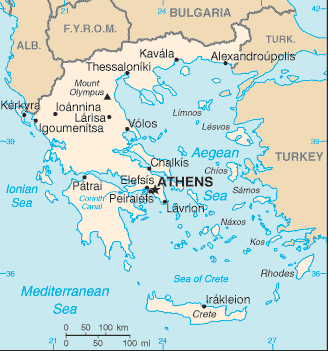
- Capital
- Athens
- Phone Code
- +30
- Voltage
- 230V / 50Hz
- Power Plug
- C, F
- Phone Jack
- RJ-11
- Currency
- Euro
- Dial-up
- $0.115/min
- WiFi
- $19.95/day
About connectivity in Greece
Greece uses 230V/50Hz with Type C and Type F outlets. The phone jack is RJ-11 in modern installations, with some legacy buildings retaining the Greek connector. OTE (Hellenic Telecommunications Organization, Greek: ΟΤΕ), founded in 1949, was privatized progressively from 1996 onward, with Deutsche Telekom acquiring a controlling stake in 2008. Cosmote (the OTE-Deutsche Telekom mobile brand) is the dominant mobile operator alongside Vodafone Greece, Wind Hellas (now Nova), and Forthnet (now part of Nova).
Greece's academic ARIADNE-T opened the country's first international Internet connection in 1989. Commercial dial-up began through 1993-1995 with FORTHnet (founded 1990 as a research-network spinoff), Compulink, Acropolis Net, HOL (Hellas On-Line), and OTEnet (OTE's consumer ISP launched 1996). Per-minute metered access through OTE PSTN was the norm through the late 1990s, with the relatively high prices keeping Greek Internet penetration behind Western European peers. ADSL rollout from OTE's Conn-x service began in 2003 and broadband adoption accelerated through the mid-2000s. EU broadband-coverage programs and the Athens 2004 Olympics infrastructure push drove additional investment.
OTE introduced its Telekarta chip-based cardphone system in 1989 — one of the earlier national chip-card deployments in Southern Europe following France's 1984 lead. Standard denominations and prolific commemorative issues over three decades built a substantial Greek collector market. The prepaid international calling-card market through the 1990s and 2000s served the historically large Greek diaspora — Greek-American (particularly Astoria, Chicago, and Tarpon Springs), Greek-Australian (Melbourne in particular hosts one of the largest Greek-speaking populations outside Greece), Greek-Canadian, and Greek-German — plus the post-1990 Albanian, Pontic Greek repatriate, and post-2015 Syrian refugee populations in Greece. OTE payphone fleets, distinctively grey-and-blue, were progressively decommissioned through the 2010s.
Tempest Telecom served Greece through dial-up POPs in Athens, Thessaloniki, Patras, and Heraklion, with WiFi at $19.95/day as airports and hotel chains in the Athens and Aegean tourism zones deployed wireless. Greek-flag shipping and Aegean island operations were a sustained Iridium satphone market — the maritime industry's reliance on satellite communications has remained constant from the 1990s to today.
Modern Greece has rapidly expanding FTTH coverage under EU broadband programs, with 5G rollout led by COSMOTE (the OTE/T-Mobile brand) starting in 2020.
Tempest's services across Greece, 1997–2012
Tempest Telecommunications operated international connectivity services in Greece between 1997 and 2012 under a unified prepaid account that absorbed multiple service types onto a single customer credential. Customers in Greece drew from the same balance for pre-paid international voice calling, RADIUS-authenticated dial-up Internet roaming, metered Wi-Fi hotspot access, Iridium and Thuraya satellite voice, and Inmarsat BGAN and Thuraya data terminals. The PATN kiosk-card clearinghouse (Tempest's TITAN kiOSK, incorporated 2000) extended the same card-and-PIN model to public Internet terminals but did not reach scale.
Both Iridium (global LEO) and Thuraya (regional GEO) satellite voice were available in Greece from approximately 2001, alongside global BGAN data from late 2005.
Nearby countries in Europe
Finland · France · Germany · Gibraltar · Hungary · Iceland · Ireland · Italy