


Ireland
Power & telecom standards in Ireland
Connectivity Overview
Tempest Telecom offered dial-up internet access, WiFi hotspot access, toll-free dial-up access and broadband ethernet access in Ireland. We also offered Iridium satellite Internet and Voice access in Ireland for communications in rural areas without infrastructure.
Ireland uses 230V at 50Hz. Power outlets are type G and telephone jacks are RJ-11 / BT.
Dial-up Internet Access
Tempest Telecom provided local dial-up access numbers in Ireland at $0.115/minute. Toll-free numbers were also available at $.17/minute. Travelers could connect using any standard modem with an RJ-11 telephone adapter.
WiFi Hotspot Access
Tempest Telecom provided WiFi hotspot access in Ireland at $19.95/day for unlimited browsing.
Adapters & Power
A Type G (British 3-pin) adapter is required for travelers from North America, Europe, and most of Asia.
A British Telecom (BT) to RJ-11 adapter is required for connecting a standard modem.
Ireland at a Glance
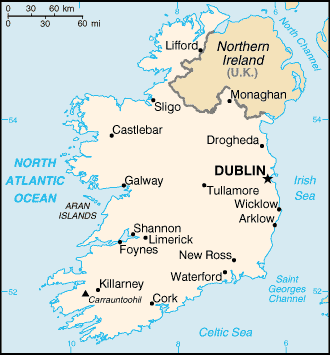
- Capital
- Dublin
- Phone Code
- +353
- Voltage
- 230V / 50Hz
- Power Plug
- G
- Phone Jack
- RJ-11 / BT
- Currency
- Euro
- Dial-up
- $0.115/min
- WiFi
- $19.95/day
About connectivity in Ireland
Ireland uses 230V/50Hz with the Type G (BS 1363) three-pin plug, shared with the United Kingdom. The phone jack is RJ-11, with some legacy installations retaining the BT-style connector inherited from earlier British telecom standards. Telecom Éireann was renamed Eircom on privatization in 1999 (subsequently passing through several ownership changes including Vodafone/Babcock & Brown, Singapore Technologies Telemedia, and a 2012 examinership), and trades today as eir. Mobile operators include Vodafone Ireland, Three Ireland, and eir's own mobile brand.
Commercial dial-up Internet in Ireland began through Telecom Éireann alongside private ISPs including Indigo (one of the earliest), Esat Net (later acquired by BT and rebranded BT Ireland), Ireland On-Line (IOL), and Eircom Net. Per-minute metered dial-up through Telecom Éireann's PSTN dominated the late 1990s. The Esat Digifone mobile launch in 1997 helped drive broader telecom competition. ADSL rollout from Eircom and BT Ireland over the early 2000s displaced dial-up across the urban areas first; rural Ireland retained meaningful dial-up subscriber bases into the mid-to-late 2000s due to slower ADSL coverage. The National Broadband Plan, agreed in 2019, addresses the long-tail rural-coverage gap.
Telecom Éireann issued the Callcard from 1988 onward — one of the longer-running national prepaid card programs in Europe. Magnetic-stripe initially, then chip-card from the mid-1990s, the Callcard sat in newsagents and post offices nationwide and developed a substantial commemorative-design collector market over its lifespan. Ireland's historically large outbound diaspora calling market (particularly to the UK, US, Canada, and Australia) sustained a vigorous prepaid international calling-card sector through the late 1990s and 2000s. The Eircom public payphone fleet was largely decommissioned through the 2010s as mobile coverage saturated even rural areas.
Tempest Telecom served Ireland through dial-up POPs in Dublin and Cork. Dublin's strong business-travel base, multinational technology-sector tenants (Microsoft, Google, Facebook, and others established European HQ operations in Ireland through the 1990s and 2000s), and active calling-card market made Ireland a sustained Tempest-services market. Iridium satphones served the West Atlantic seaboard and offshore Atlantic operations.
Modern Ireland has expanding FTTH coverage under the National Broadband Plan, with mature 5G in Dublin, Cork, Galway, and Limerick. Mobile coverage is universal in populated areas.
Tempest's services across Ireland, 1997–2012
Tempest Telecommunications operated international connectivity services in Ireland between 1997 and 2012 under a unified prepaid account that absorbed multiple service types onto a single customer credential. Customers in Ireland drew from the same balance for pre-paid international voice calling, RADIUS-authenticated dial-up Internet roaming, metered Wi-Fi hotspot access, Iridium satellite voice, and Inmarsat BGAN data terminals. The PATN kiosk-card clearinghouse (Tempest's TITAN kiOSK, incorporated 2000) extended the same card-and-PIN model to public Internet terminals but did not reach scale.
Iridium satellite voice was available in Ireland from approximately 2001 (post-bankruptcy relaunch). Thuraya coverage did not extend to Ireland; Inmarsat BGAN data terminals filled the broadband gap from late 2005.
Nearby countries in Europe
Gibraltar · Greece · Hungary · Iceland · Italy · Latvia · Liechtenstein · Lithuania