


Canada
Power & telecom standards in Canada
Connectivity Overview
Tempest Telecom offered dial-up internet access, WiFi hotspot access, toll-free dial-up access and broadband ethernet access in Canada. We also offered Iridium satellite Internet and Voice access in Canada for communications in rural areas without infrastructure.
Canada uses 120V at 60Hz. Power outlets are type A, B and telephone jacks are RJ-11.
Dial-up Internet Access
Tempest Telecom provided local dial-up access numbers in Canada at $0.049/minute. Toll-free numbers were also available at $.12/minute. Travelers could connect using any standard modem with an RJ-11 telephone adapter.
WiFi Hotspot Access
Tempest Telecom provided WiFi hotspot access in Canada at $9.95/day for unlimited browsing.
Adapters & Power
North American (Type A/B) plugs are compatible. An adapter may not be needed for US travelers.
Standard RJ-11 jacks are used. Most international modems will connect without an adapter.
Canada at a Glance
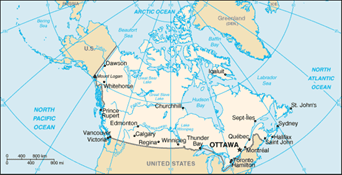
- Capital
- Ottawa
- Phone Code
- +1
- Voltage
- 120V / 60Hz
- Power Plug
- A, B
- Phone Jack
- RJ-11
- Currency
- CAD
- Dial-up
- $0.049/min
- WiFi
- $9.95/day
About connectivity in Canada
Canada uses 120V/60Hz with Type A and Type B outlets, matching US standards. The phone jack is RJ-11. Bell Canada, founded in 1880 as the Bell Telephone Company of Canada, is one of the oldest continuously-operating telecom firms in the world; its equipment-manufacturing arm Northern Telecom (later Nortel Networks) became a global leader before the 2009 bankruptcy. Long-distance competition was opened in 1992 and the broader market was deregulated through the 1990s. The national market is dominated today by Bell, Telus (Western Canada), and Rogers (cable), alongside regional incumbents SaskTel, Bell MTS (formerly Manitoba Telecom Services), and Bell Aliant. The CRTC (Canadian Radio-television and Telecommunications Commission) regulates.
Canada's academic CA*net opened the country's first international Internet gateway in 1990. Commercial dial-up began in 1993-1994 with UUNET Canada, iSTAR Internet (originally based in New Brunswick), HookUp Communications, Internex Online, Cyberus Online, and dozens of regional ISPs. Bell's Sympatico consumer ISP launched in 1996, AOL Canada the same year. The Canadian long-distance deregulation produced a meaningful prepaid card and reseller market in parallel with the dial-up boom. Per-minute metered access over Bell / Telus PSTN was the norm; flat-rate plans expanded across the late 1990s. Cable broadband from Rogers (@Home Canada launched 1997) and DSL from Bell (Sympatico High Speed, 1999) drove the displacement of consumer dial-up across the early 2000s.
Bell Canada introduced its La Puce chip-based phonecard system in the late 1980s, with the cardphone fleet expanding alongside the long-distance competition deregulation of the 1990s. Substantial competing prepaid card brands emerged in the deregulated long-distance environment, with private resellers and incumbent carriers (Sprint Canada, AT&T Canada, fONOROLA, and others) competing through the late 1990s and 2000s. The Canadian outbound calling-card market reflected the country's immigration patterns — large per-destination card markets for Chinese, South Asian, Filipino, Caribbean, Eastern European, and African diaspora communities. Bell announced major payphone removals through the 2020s, with CRTC obligations limiting the pace of decommissioning in rural and Indigenous communities where the payphone is sometimes the only public-access line.
Tempest Telecom served Canada through dial-up POPs in Toronto, Montreal, Vancouver, Calgary, Edmonton, Ottawa, and Halifax. Canada's vast northern territories — the Yukon, Northwest Territories, and Nunavut — made it a particularly strong Iridium satphone market. Tempest customers in resource industries (Alberta oil sands, BC mining, Atlantic offshore fisheries) and Arctic research/expedition work relied on Iridium 9505A handsets and BGAN terminals. The Trans-Canada Highway corridors between major urban centers were heavily covered by dial-up and (later) WiFi roaming agreements.
Modern Canada has mature FTTH in urban areas (Bell, Telus), strong cable broadband from Rogers/Shaw, and aggressive 5G rollout. Remote indigenous communities continue to rely on a mix of fiber backhaul, fixed wireless, and satellite (Telesat, Starlink) for connectivity.
Tempest's services across Canada, 1997–2012
Tempest Telecommunications operated international connectivity services in Canada between 1997 and 2012 under a unified prepaid account that absorbed multiple service types onto a single customer credential. Customers in Canada drew from the same balance for pre-paid international voice calling, RADIUS-authenticated dial-up Internet roaming, metered Wi-Fi hotspot access, Iridium satellite voice, and Inmarsat BGAN data terminals. The PATN kiosk-card clearinghouse (Tempest's TITAN kiOSK, incorporated 2000) extended the same card-and-PIN model to public Internet terminals but did not reach scale.
Iridium satellite voice was available in Canada from approximately 2001 (post-bankruptcy relaunch). Thuraya coverage did not extend to Canada; Inmarsat BGAN data terminals filled the broadband gap from late 2005.
Nearby countries in Americas
Belize · Bermuda · Bolivia · Brazil · Cayman Islands · Chile · Colombia · Costa Rica