


Brazil
Power & telecom standards in Brazil
Connectivity Overview
Tempest Telecom offered dial-up internet access, WiFi hotspot access, toll-free dial-up access and broadband ethernet access in Brazil. We also offered Iridium satellite Internet and Voice access in Brazil for communications in rural areas without infrastructure.
Brazil uses 127/220V at 60Hz. Power outlets are type C, N and telephone jacks are RJ-11.
Dial-up Internet Access
Tempest Telecom provided local dial-up access numbers in Brazil at $0.155/minute. Toll-free numbers were also available at $.30/minute. Travelers could connect using any standard modem with an RJ-11 telephone adapter.
WiFi Hotspot Access
Tempest Telecom provided WiFi hotspot access in Brazil at $19.95/day for unlimited browsing.
Adapters & Power
Travelers from North America will need a power plug adapter. European Type C/F adapters are widely compatible.
Standard RJ-11 jacks are used. Most international modems will connect without an adapter.
Brazil at a Glance
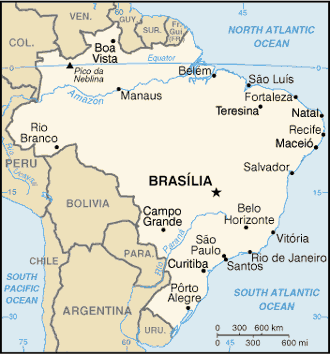
- Capital
- Brasilia
- Phone Code
- +55
- Voltage
- 127/220V / 60Hz
- Power Plug
- C, N
- Phone Jack
- RJ-11
- Currency
- Real
- Dial-up
- $0.155/min
- WiFi
- $19.95/day
About connectivity in Brazil
Brazil uses 127V or 220V (varies by region) at 60Hz — nominally dual-voltage — with Type C and the Brazilian Type N (NBR 14136) outlet. The phone jack is RJ-11. Telebrás, the state holding company that controlled essentially the entire Brazilian telecom market, was broken up and privatized in 1998 through one of the largest single-day privatizations in global history. The resulting companies have consolidated over two decades into Vivo (now controlled by Telefónica), Claro (América Móvil), TIM Brasil, and Oi (which entered judicial recovery in 2016).
Brazil's academic Rede Nacional de Pesquisa (RNP) opened the country's first international Internet connection in 1992. Commercial dial-up service began in 1995-1996 with Embratel's Internet operations, IBASE (a non-profit early provider), UOL (Universo Online, launched 1996, becoming Brazil's dominant portal-ISP combination), Terra (a joint Brazilian-Spanish project that grew to operate across Latin America and Spain), and a long list of regional providers. Per-minute metered access through Telebrás and its post-1998 concession holders dominated the late 1990s. ADSL rollout from Telefónica's Speedy service (2000), Brasil Telecom Turbo, and competitor offerings began the broadband transition; consumer dial-up faded across the 2000s. Mobile data and 4G/5G eventually surpassed fixed broadband in subscriber count by a wide margin.
Telebrás introduced its cartão telefônico magnetic-induction prepaid cardphone system in 1992, distinctively using inductive (non-contact) cards rather than the magnetic-stripe or chip standards more common elsewhere. The blue-and-orange Brazilian phone booths and their cardphone units became a visual icon across the 1990s and 2000s, particularly the "orelhão" (big-ear) ergonomic outdoor design. Brazil developed one of Latin America's most active commemorative phonecard collector markets, with thousands of distinct issues produced over the cardphone era. Outbound prepaid international calling-card activity through the 2000s was substantial, particularly for diaspora calls to Portugal, the United States, and Japan — Brazil hosts one of the world's largest Japanese-descended populations outside Japan and a large outbound migration to Portugal that intensified through the 2000s. Cardphone fleets across the major operator territories were decommissioned through the 2010s.
Tempest Telecom served Brazil through dial-up POPs in São Paulo, Rio de Janeiro, Brasília, Salvador, Belo Horizonte, and Porto Alegre. Brazil's vast Amazon, Pantanal, and Northeast interior made it a major Iridium satphone market — agricultural operators, mining, NGOs, and expedition crews all relied on Tempest's Iridium voice and data.
Modern Brazil has aggressive FTTH deployment in metro markets, with regional altnets joining the major incumbents. 5G rollout began in 2022 and is expanding rapidly in major cities.
Tempest's services across Brazil, 1997–2012
Tempest Telecommunications operated international connectivity services in Brazil between 1997 and 2012 under a unified prepaid account that absorbed multiple service types onto a single customer credential. Customers in Brazil drew from the same balance for pre-paid international voice calling, RADIUS-authenticated dial-up Internet roaming, metered Wi-Fi hotspot access, Iridium satellite voice, and Inmarsat BGAN data terminals. The PATN kiosk-card clearinghouse (Tempest's TITAN kiOSK, incorporated 2000) extended the same card-and-PIN model to public Internet terminals but did not reach scale.
Iridium satellite voice was available in Brazil from approximately 2001 (post-bankruptcy relaunch). Thuraya coverage did not extend to Brazil; Inmarsat BGAN data terminals filled the broadband gap from late 2005.
Nearby countries in Americas
Barbados · Belize · Bermuda · Bolivia · Canada · Cayman Islands · Chile · Colombia