


Spain
Power & telecom standards in Spain
Connectivity Overview
Tempest Telecom offered dial-up internet access, WiFi hotspot access, toll-free dial-up access and broadband ethernet access in Spain. We also offered Iridium satellite Internet and Voice access in Spain for communications in rural areas without infrastructure.
Spain uses 230V at 50Hz. Power outlets are type C, F and telephone jacks are RJ-11.
Dial-up Internet Access
Tempest Telecom provided local dial-up access numbers in Spain at $0.115/minute. Toll-free numbers were also available at $.17/minute. Travelers could connect using any standard modem with an RJ-11 telephone adapter.
WiFi Hotspot Access
Tempest Telecom provided WiFi hotspot access in Spain at $19.95/day for unlimited browsing.
Adapters & Power
Travelers from North America will need a power plug adapter. European Type C/F adapters are widely compatible.
Standard RJ-11 jacks are used. Most international modems will connect without an adapter.
Spain at a Glance
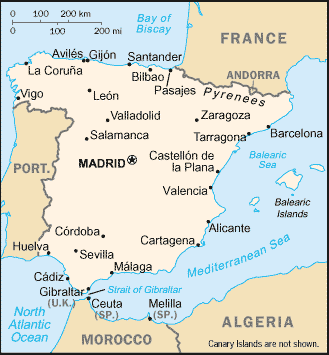
- Capital
- Madrid
- Phone Code
- +34
- Voltage
- 230V / 50Hz
- Power Plug
- C, F
- Phone Jack
- RJ-11
- Currency
- Euro
- Dial-up
- $0.115/min
- WiFi
- $19.95/day
About connectivity in Spain
Spain uses 230V/50Hz with Type C and Type F outlets, the standard continental European pairing. The phone jack is RJ-11. Telefónica de España, founded in 1924 and historically state-controlled, was privatized progressively between 1995 and 1999 in a series of staged Madrid Bolsa flotations. The company now competes with its own Movistar retail brand, Vodafone España, Orange España, MásMóvil/Yoigo, and a long tail of regional and altnet operators.
Spain's Internet history runs through the academic network RedIRIS, which opened the country's first international connection in 1990. Commercial ISP service began in 1995 with Servicom and Goya Servicios Telemáticos. Telefónica's InfoVía (1995-1998) was an unusual closed-network experiment — a Telefónica-owned IP backbone that subscribers reached over the regular telephone line at metered rates, with Spanish ISPs piggybacking on the InfoVía backbone for connectivity. InfoVía was retired by 1998 in favor of the open Internet model and Telefónica's Terra portal/ISP, with Wanadoo España (later Orange), Tiscali Spain, Jazztel, and YA.com competing in the dial-up era. ADSL rollout from 1999-2002 displaced consumer dial-up rapidly across the metropolitan areas; rural Spain retained meaningful dial-up subscriber bases into the mid-2000s.
Telefónica introduced its tarjeta telefónica magnetic-stripe cardphone system in the late 1980s and early 1990s, with chip-card cardphones following from the mid-1990s. The Spanish phone-card market reflected the country's unusual dual-direction migration story: substantial outbound calling-card use through the 20th century driven by post-Civil War Spanish migration to Argentina, Mexico, France, Switzerland, and Germany, and significant inbound calling-card use through the 2000s as immigration from Ecuador, Colombia, Morocco, Romania, and Sub-Saharan Africa intensified. Telefónica's public payphone fleet, including the distinctive blue-and-white kiosks in plazas and rail stations, has been almost entirely decommissioned since the early 2010s. The Telefónica universal service obligation for payphones formally ended in 2018.
Tempest Telecom served Spain through metered dial-up POPs in Madrid, Barcelona, Valencia, Seville, and Bilbao, with WiFi hotspot access at $19.95/day as the AVE high-speed rail, Renfe stations, and major hotel chains rolled out wireless. Spanish customers in maritime industries (the Canary Islands shipping lanes, the Bay of Biscay fishing fleet) were Iridium satphone subscribers; Tempest also provided BGAN terminals to expedition and media crews working in the Pyrenees and the Spanish North African enclaves.
Modern Spain has aggressive FTTH deployment — among Europe's highest fiber penetration rates — and mature 5G coverage in metro areas.
Tempest's services across Spain, 1997–2012
Tempest Telecommunications operated international connectivity services in Spain between 1997 and 2012 under a unified prepaid account that absorbed multiple service types onto a single customer credential. Customers in Spain drew from the same balance for pre-paid international voice calling, RADIUS-authenticated dial-up Internet roaming, metered Wi-Fi hotspot access, Iridium satellite voice, and Inmarsat BGAN data terminals. The PATN kiosk-card clearinghouse (Tempest's TITAN kiOSK, incorporated 2000) extended the same card-and-PIN model to public Internet terminals but did not reach scale.
Iridium satellite voice was available in Spain from approximately 2001 (post-bankruptcy relaunch). Thuraya coverage did not extend to Spain; Inmarsat BGAN data terminals filled the broadband gap from late 2005.
Nearby countries in Europe
Russia · Serbia and Montenegro · Slovakia · Slovenia · Sweden · Switzerland · Ukraine · United Kingdom