


Sweden
Power & telecom standards in Sweden
Connectivity Overview
Tempest Telecom offered dial-up internet access, WiFi hotspot access, toll-free dial-up access and broadband ethernet access in Sweden. We also offered Iridium satellite Internet and Voice access in Sweden for communications in rural areas without infrastructure.
Sweden uses 230V at 50Hz. Power outlets are type C, F and telephone jacks are RJ-11.
Dial-up Internet Access
Tempest Telecom provided local dial-up access numbers in Sweden at $0.115/minute. Toll-free numbers were also available at $.17/minute. Travelers could connect using any standard modem with an RJ-11 telephone adapter.
WiFi Hotspot Access
Tempest Telecom provided WiFi hotspot access in Sweden at $19.95/day for unlimited browsing.
Adapters & Power
Travelers from North America will need a power plug adapter. European Type C/F adapters are widely compatible.
Standard RJ-11 jacks are used. Most international modems will connect without an adapter.
Sweden at a Glance
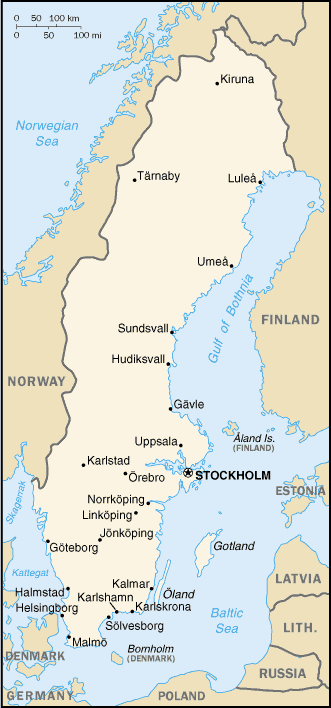
- Capital
- Stockholm
- Phone Code
- +46
- Voltage
- 230V / 50Hz
- Power Plug
- C, F
- Phone Jack
- RJ-11
- Currency
- Krona
- Dial-up
- $0.115/min
- WiFi
- $19.95/day
About connectivity in Sweden
Sweden uses 230V/50Hz with Type C and Type F outlets. The phone jack is RJ-11 in modern installations. Televerket, the Swedish state telecom monopoly, was corporatized as Telia in 1993, partially privatized in a 2000 IPO, and merged with Finland's Sonera in 2002 to form TeliaSonera (renamed Telia Company in 2016). Tele2, founded in 1981 by Jan Stenbeck's Kinnevik Group, was Sweden's pioneering competitive operator and became one of Europe's most influential challenger telecoms. Telenor Sweden, 3 (Hi3G Access), and a long list of altnet fiber operators compete in the modern market.
Sweden's academic SUNET opened the country's first international Internet connection in 1988, making Sweden one of the earliest non-US Internet nodes. Commercial dial-up began in 1993 with Tele2's SwipNet operation, Algonet (later acquired by Telia, then Bahnhof), KTHNOC, and Telia Internet. The Stockholm city-owned dark-fiber utility Stokab, founded in 1994, became an internationally-studied model for how a municipal fiber network can seed competitive broadband markets. Per-minute metered dial-up faded faster in Sweden than in most European markets as flat-rate ADSL rolled out from 1999-2001 and FTTH coverage expanded aggressively across the 2000s. Sweden has consistently ranked among the global top-tier markets for broadband penetration and speed since the mid-2000s.
Televerket introduced the Swedish Telefonkort magnetic-induction cardphone system in the late 1980s, with chip-card cardphones following from the mid-1990s. The Swedish commemorative phonecard collector market developed substantially through three decades of issues. The prepaid international calling-card market through the 1990s and 2000s served Sweden's distinctive refugee-and-immigration population: Finnish (the largest historic migrant group), Iranian (post-1979), Iraqi (post-1991 and post-2003), Somali, ex-Yugoslav, Polish, Chilean, Eritrean, and Syrian communities all sustained per-destination card brands sold through neighborhood shops. The Telia / TeliaSonera payphone fleet was retired progressively through the 2000s; the last remaining Telia payphones were decommissioned in 2015.
Tempest Telecom served Sweden through dial-up POPs in Stockholm, Gothenburg, Malmö, and Uppsala, with WiFi hotspot access at $19.95/day at Arlanda Airport, SJ rail stations, and Stockholm hotel chains. Norrland's vast forests and Arctic regions were a strong Iridium satphone market for forestry, energy, and tourism customers. Södertälje's “Little Baghdad” Iraqi community sustained one of Europe's densest prepaid international calling-card retail markets, with Tempest's unified prepaid card serving customers who travelled between Sweden and Iraq during the post-2003 reconstruction era.
Modern Sweden has near-universal FTTH and is consistently ranked among the world's fastest broadband markets. Mobile 5G coverage is mature across populated areas.
Tempest's services across Sweden, 1997–2012
Tempest Telecommunications operated international connectivity services in Sweden between 1997 and 2012 under a unified prepaid account that absorbed multiple service types onto a single customer credential. Customers in Sweden drew from the same balance for pre-paid international voice calling, RADIUS-authenticated dial-up Internet roaming, metered Wi-Fi hotspot access, Iridium satellite voice, and Inmarsat BGAN data terminals. The PATN kiosk-card clearinghouse (Tempest's TITAN kiOSK, incorporated 2000) extended the same card-and-PIN model to public Internet terminals but did not reach scale.
Iridium satellite voice was available in Sweden from approximately 2001 (post-bankruptcy relaunch). Thuraya coverage did not extend to Sweden; Inmarsat BGAN data terminals filled the broadband gap from late 2005.
Nearby countries in Europe
Russia · Serbia and Montenegro · Slovakia · Slovenia · Spain · Switzerland · Ukraine · United Kingdom