


Switzerland
Power & telecom standards in Switzerland
Connectivity Overview
Tempest Telecom offered dial-up internet access, WiFi hotspot access, toll-free dial-up access and broadband ethernet access in Switzerland. We also offered Iridium satellite Internet and Voice access in Switzerland for communications in rural areas without infrastructure.
Switzerland uses 230V at 50Hz. Power outlets are type C, J and telephone jacks are RJ-11 / Swiss.
Dial-up Internet Access
Tempest Telecom provided local dial-up access numbers in Switzerland at $0.115/minute. Toll-free numbers were also available at $.17/minute. Travelers could connect using any standard modem with an RJ-11 telephone adapter.
WiFi Hotspot Access
Tempest Telecom provided WiFi hotspot access in Switzerland at $19.95/day for unlimited browsing.
Adapters & Power
Travelers from North America will need a power plug adapter. European Type C/F adapters are widely compatible.
A RJ-11 / Swiss to RJ-11 adapter may be required for connecting a standard modem.
Switzerland at a Glance
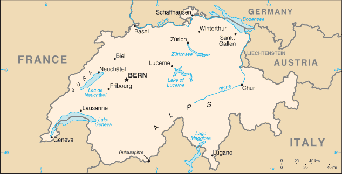
- Capital
- Bern
- Phone Code
- +41
- Voltage
- 230V / 50Hz
- Power Plug
- C, J
- Phone Jack
- RJ-11 / Swiss
- Currency
- CHF
- Dial-up
- $0.115/min
- WiFi
- $19.95/day
About connectivity in Switzerland
Switzerland uses 230V/50Hz with the Swiss Type J (SEV 1011) outlet, plus Type C for ungrounded devices. The phone jack is RJ-11 in modern installations; older buildings retain the Swiss Reichle TT89 connector. Swisscom — originally Swiss PTT, fully separated from postal operations in 1997 and partially privatized in 1998 — competes with Salt (the rebranded former Orange Switzerland) and Sunrise UPC (the 2020 merger of Sunrise Communications and Liberty Global's UPC Switzerland).
Switzerland's academic SWITCH network opened the country's first international Internet connection in 1990. Commercial dial-up emerged through 1993-1995 with Swiss Online, IronNet, Internet Provider AG, and a wave of cantonal and city-level ISPs. Swisscom's Bluewin consumer ISP launched in 1996. Per-minute metered access over Swisscom PTT lines dominated the late 1990s. Swisscom's ADSL service rolled out from 2000-2001, and the Swiss broadband market matured early as the country's high purchasing power and dense valley-floor population made FTTC/FTTH economics attractive. Consumer dial-up faded across the mid-2000s.
Switzerland was a comparatively early adopter of prepaid card-phone technology. Swiss PTT introduced the Taxcard magnetic-induction cardphone system in 1982 — among the earliest such national deployments anywhere, only a few years behind the UK's BT Phonecard and France's télécarte trials. Chip-card cardphones followed from the late 1980s and early 1990s. The Swiss commemorative phonecard collector market was substantial, with PTT/Swisscom issuing thousands of distinct designs over three decades. The Swiss prepaid international calling-card market through the 1990s and 2000s served the country's historic Italian, Spanish, Portuguese, and ex-Yugoslav migrant communities, plus the post-1991 Albanian and Sri Lankan Tamil populations — per-destination card brands sold through kiosks (Kiosk AG, Valora) and convenience stores nationwide. The Swisscom payphone fleet (the orange Telefonkabine kiosks) was almost entirely decommissioned by 2019.
Tempest Telecom served Switzerland through dial-up POPs in Zurich, Geneva, Basel, and Bern, with WiFi hotspot access at $19.95/day as Swiss Federal Railways (SBB) and major hotel chains deployed wireless. The Alpine regions and ski-resort areas were particularly reliant on Iridium satphones for off-grid emergency communications.
Modern Switzerland has near-universal gigabit FTTH coverage and mature 5G across the country, despite the topographic challenges of valley-and-mountain terrain.
Tempest's services across Switzerland, 1997–2012
Tempest Telecommunications operated international connectivity services in Switzerland between 1997 and 2012 under a unified prepaid account that absorbed multiple service types onto a single customer credential. Customers in Switzerland drew from the same balance for pre-paid international voice calling, RADIUS-authenticated dial-up Internet roaming, metered Wi-Fi hotspot access, Iridium satellite voice, and Inmarsat BGAN data terminals. The PATN kiosk-card clearinghouse (Tempest's TITAN kiOSK, incorporated 2000) extended the same card-and-PIN model to public Internet terminals but did not reach scale.
Iridium satellite voice was available in Switzerland from approximately 2001 (post-bankruptcy relaunch). Thuraya coverage did not extend to Switzerland; Inmarsat BGAN data terminals filled the broadband gap from late 2005.
Nearby countries in Europe
Russia · Serbia and Montenegro · Slovakia · Slovenia · Spain · Sweden · Ukraine · United Kingdom