


Portugal
Power & telecom standards in Portugal
Connectivity Overview
Tempest Telecom offered dial-up internet access, WiFi hotspot access and broadband ethernet access in Portugal. We also offered Iridium satellite Internet and Voice access in Portugal for communications in rural areas without infrastructure.
Portugal uses 230V at 50Hz. Power outlets are type C, F and telephone jacks are RJ-11.
Dial-up Internet Access
Tempest Telecom provided local dial-up access numbers in Portugal at $0.115/minute. Travelers could connect using any standard modem with an RJ-11 telephone adapter.
WiFi Hotspot Access
Tempest Telecom provided WiFi hotspot access in Portugal at $19.95/day for unlimited browsing.
Adapters & Power
Travelers from North America will need a power plug adapter. European Type C/F adapters are widely compatible.
Standard RJ-11 jacks are used. Most international modems will connect without an adapter.
Portugal at a Glance
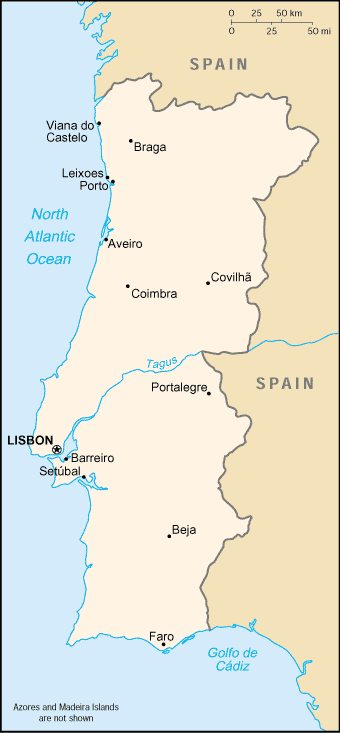
- Capital
- Lisbon
- Phone Code
- +351
- Voltage
- 230V / 50Hz
- Power Plug
- C, F
- Phone Jack
- RJ-11
- Currency
- Euro
- Dial-up
- $0.115/min
- WiFi
- $19.95/day
About connectivity in Portugal
Portugal uses 230V/50Hz with Type C and Type F outlets. The phone jack is RJ-11 in modern installations, with some legacy buildings retaining the Portuguese PT connector. Portugal Telecom (PT) was created in 1994 by merging CTT-T, TLP (Lisbon), and TDP into a single national operator, then progressively privatized through five share offerings from 1995 to 2000. Altice France acquired PT's Portuguese operations in 2014 and rebranded the consumer business as MEO. NOS (a 2013 merger of ZON Multimédia and Optimus), Vodafone Portugal, and Digi Portugal (the Romanian Digi's 2022 entrant) compete in mobile and broadband.
Portugal's academic Rede da Comunidade Científica Nacional (RCCN) opened the country's first international Internet connection in 1991. Commercial dial-up emerged in 1995-1996 through Telepac (PT's data brand), Eunet Portugal, Mediapt (later Clix), and Esoterica. PT's Sapo portal launched in 1995 and became the dominant Portuguese-language portal-ISP combination. Per-minute metered access through PT PSTN dominated the late 1990s. ADSL rollout from PT's Sapo ADSL service began in 2000-2001, with cable broadband from Cabovisão (later acquired by Altice) competing across the early 2000s. Consumer dial-up faded across the mid-2000s.
Portugal Telecom introduced its Credifone chip-based phonecard system in the late 1980s, with Portugal among the earliest European countries to deploy chip-card cardphones following France's 1984 lead. The orange-and-grey Credifone cardphone kiosks were ubiquitous across Lisbon, Porto, Coimbra, Faro, and the major regional centers through the 1990s and 2000s, and the Portuguese commemorative phonecard collector market was substantial. The prepaid international calling-card market through the 2000s served Portugal's large outbound diaspora — Portuguese migrants and their descendants in France (1.5+ million), Luxembourg (concentrated population), Switzerland, the United States (particularly the Northeast and California), Canada, Venezuela, and South Africa — alongside inbound communities from Brazil, Cape Verde, Angola, Mozambique, Guinea-Bissau, São Tomé, and East Timor. The MEO/Altice cardphone fleet was almost entirely decommissioned through the 2010s.
Tempest Telecom served Portugal through dial-up POPs in Lisbon, Porto, and Faro. Iridium satphones served the Atlantic-coast maritime industry, the Azores and Madeira island operations, and the Lisbon-area broadcast and media customer base.
Modern Portugal has high FTTH penetration — one of Europe's most aggressively deployed fiber markets — with 5G from MEO, NOS, and Vodafone Portugal mature across metro areas.
Tempest's services across Portugal, 1997–2012
Tempest Telecommunications operated international connectivity services in Portugal between 1997 and 2012 under a unified prepaid account that absorbed multiple service types onto a single customer credential. Customers in Portugal drew from the same balance for pre-paid international voice calling, RADIUS-authenticated dial-up Internet roaming, metered Wi-Fi hotspot access, Iridium satellite voice, and Inmarsat BGAN data terminals. The PATN kiosk-card clearinghouse (Tempest's TITAN kiOSK, incorporated 2000) extended the same card-and-PIN model to public Internet terminals but did not reach scale.
Iridium satellite voice was available in Portugal from approximately 2001 (post-bankruptcy relaunch). Thuraya coverage did not extend to Portugal; Inmarsat BGAN data terminals filled the broadband gap from late 2005.
Nearby countries in Europe
Monaco · Netherlands · Norway · Poland · Romania · Russia · Serbia and Montenegro · Slovakia