

Serbia and Montenegro
Power & telecom standards in Serbia and Montenegro
Connectivity Overview
Tempest Telecom offered dial-up internet access, WiFi hotspot access and broadband ethernet access in Serbia and Montenegro. We also offered Iridium satellite Internet and Voice access in Serbia and Montenegro for communications in rural areas without infrastructure.
Serbia and Montenegro uses 230V at 50Hz. Power outlets are type C, F and telephone jacks are RJ-11.
Dial-up Internet Access
Tempest Telecom provided local dial-up access numbers in Serbia and Montenegro at $0.155/minute. Travelers could connect using any standard modem with an RJ-11 telephone adapter.
WiFi Hotspot Access
Tempest Telecom provided WiFi hotspot access in Serbia and Montenegro at $19.95/day for unlimited browsing.
Adapters & Power
Travelers from North America will need a power plug adapter. European Type C/F adapters are widely compatible.
Standard RJ-11 jacks are used. Most international modems will connect without an adapter.
Serbia and Montenegro at a Glance
- Capital
- Belgrade
- Phone Code
- +381
- Voltage
- 230V / 50Hz
- Power Plug
- C, F
- Phone Jack
- RJ-11
- Currency
- Dinar
- Dial-up
- $0.155/min
- WiFi
- $19.95/day
About connectivity in Serbia and Montenegro
Serbia uses 230V/50Hz with Type C and Type F outlets, identical to the European mainstream. The phone jack is RJ-11 in modern installations, with some legacy buildings retaining the Yugoslav connector. The Serbian telecom landscape was reorganized progressively after the 1990s Yugoslav-wars era: Telekom Srbija (founded 1997 from the federal PTT's Serbian operations) was partially privatized in stages from 1997, with Italy's STET (later Telecom Italia) and Greece's OTE taking minority positions. MTS (Telekom Srbija's consumer brand), Yettel Serbia (formerly Telenor Serbia, now Czech PPF-owned), and A1 Srbija (formerly VIP Mobile, now Telekom Austria-owned) compete in mobile and broadband.
Serbia's academic SANU network provided early Internet connectivity from the early 1990s, though the 1990s Yugoslav wars and the 1999 NATO bombing campaign disrupted backbone infrastructure repeatedly. Commercial dial-up emerged in 1996-1998 with Yu.net, BeotelNet, Tesla's ISP operations, and EUnet Yugoslavia. Per-minute metered dial-up through Telekom Srbija PSTN was the norm through the early 2000s. The 2000 fall of the Milošević government opened the country to expanded telecom investment; ADSL rolled out from 2003 onward and broadband adoption accelerated through the EU-pre-accession framework. Mobile data dominates current Serbian Internet access.
Telekom Srbija introduced cardphone units in the mid-1990s with chip-card cardphones becoming standard. The post-Yugoslav cardphone collector market in Serbia produced thousands of commemorative issues over two decades. The prepaid international calling-card market through the 1990s and 2000s served the very large Serbian and Yugoslav-era outbound diaspora — the historic Serbian-German, Serbian-Austrian, Serbian-Swiss, Serbian-French, Serbian-Swedish (substantial post-1990s refugee community), Serbian-American (concentrated in Chicago, Detroit, and New York), Serbian-Canadian (Toronto and Vancouver), and Serbian-Australian (Melbourne and Sydney) populations all sustained per-destination card brands. The post-1999 Kosovo refugee outflow and the 2000s economic-migration wave added further volume. Telekom Srbija payphone fleets have been progressively decommissioned through the 2010s.
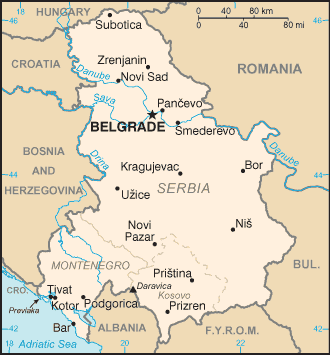
Tempest Telecom served Serbia and Montenegro through dial-up POPs in Belgrade. Iridium satphones served the substantial international broadcast, NGO, and humanitarian customer base operating during and after the 1990s Yugoslav wars and Kosovo conflict; BGAN terminals were a meaningful market for media coverage of regional events. The Adriatic coast (Montenegrin Bar and Kotor) supported a separate maritime Iridium customer base.
Modern Serbia has expanding FTTH coverage in Belgrade, Novi Sad, and Niš with 5G from Telekom Srbija, Yettel, and A1 maturing. Montenegro, which formally separated from Serbia in 2006, operates with its own Crnogorski Telekom (Telekom Austria-controlled) and One Crna Gora (formerly Telenor) operators.
Tempest's services across Serbia and Montenegro, 1997–2012
Tempest Telecommunications operated international connectivity services in Serbia and Montenegro between 1997 and 2012 under a unified prepaid account that absorbed multiple service types onto a single customer credential. Customers in Serbia and Montenegro drew from the same balance for pre-paid international voice calling, RADIUS-authenticated dial-up Internet roaming, metered Wi-Fi hotspot access, Iridium satellite voice, and Inmarsat BGAN data terminals. The PATN kiosk-card clearinghouse (Tempest's TITAN kiOSK, incorporated 2000) extended the same card-and-PIN model to public Internet terminals but did not reach scale.
Iridium satellite voice was available in Serbia and Montenegro from approximately 2001 (post-bankruptcy relaunch). Thuraya coverage did not extend to Serbia and Montenegro; Inmarsat BGAN data terminals filled the broadband gap from late 2005.
Nearby countries in Europe
Poland · Portugal · Romania · Russia · Slovakia · Slovenia · Spain · Sweden