


Poland
Power & telecom standards in Poland
Connectivity Overview
Tempest Telecom offered dial-up internet access, WiFi hotspot access and broadband ethernet access in Poland. We also offered Iridium satellite Internet and Voice access in Poland for communications in rural areas without infrastructure.
Poland uses 230V at 50Hz. Power outlets are type C, E and telephone jacks are RJ-11.
Dial-up Internet Access
Tempest Telecom provided local dial-up access numbers in Poland at $0.155/minute. Travelers could connect using any standard modem with an RJ-11 telephone adapter.
WiFi Hotspot Access
Tempest Telecom provided WiFi hotspot access in Poland at $19.95/day for unlimited browsing.
Adapters & Power
Travelers from North America will need a power plug adapter. European Type C/F adapters are widely compatible.
Standard RJ-11 jacks are used. Most international modems will connect without an adapter.
Poland at a Glance
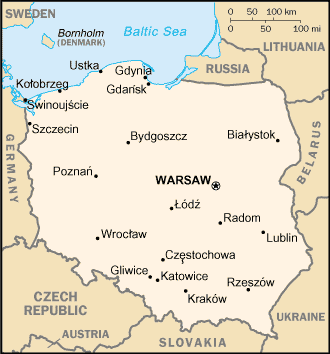
- Capital
- Warsaw
- Phone Code
- +48
- Voltage
- 230V / 50Hz
- Power Plug
- C, E
- Phone Jack
- RJ-11
- Currency
- Zloty
- Dial-up
- $0.155/min
- WiFi
- $19.95/day
About connectivity in Poland
Poland uses 230V/50Hz with Type C and Type E outlets. The phone jack is RJ-11 in modern installations. Telekomunikacja Polska (TPSA), the post-1991 successor to the PRL-era Państwowy Przedsiębiorstwo Połączonych Południowych, was partially privatized through 1998-2000 with France Télécom taking the controlling stake. The company rebranded to Orange Polska in 2012 and now competes with Play (now part of UPC Polska / iliad), T-Mobile Polska, Plus, and a long list of regional cable + fiber operators.
Poland's academic NASK opened the country's first international Internet connection in 1991. Commercial dial-up service began through TPSA's TPNet in the mid-1990s, alongside private operators including Internet Polska, IDEA Net, Polbox, and a wave of regional ISPs. Per-minute metered access over TPSA PSTN dominated the late 1990s. Neostrada (TPSA's ADSL service) launched in 2001 and triggered the rapid displacement of consumer dial-up; the Polish broadband market became unusually dynamic from the mid-2000s onward with multiple competing cable operators (Multimedia Polska, UPC Polska, Vectra) and an aggressive long tail of altnet fiber operators. Post-2004 EU accession accelerated investment from Western European telecom incumbents.
TPSA introduced its first magnetic-stripe karta telefoniczna in 1991, with chip-card cardphones following from the late 1990s. The Polish phone-card market exploded in step with the broader post-1989 Central European pattern — thousands of commemorative card designs were produced over two decades and a dedicated Polish collector market (with active dealer networks and reference catalogues) developed. The prepaid international calling-card market through the 2000s was substantial, driven by the post-2004 EU accession migration wave that brought roughly 2 million Polish workers to the United Kingdom, Ireland, Germany, and the Netherlands; private card brands competed with TPSA's own cards in Polish-grocery and convenience-store networks across the receiving countries. The TPSA / Orange Polska payphone fleet was almost entirely decommissioned through the 2010s.
Tempest Telecom served Poland through dial-up POPs in Warsaw, Kraków, Wrocław, Poznań, and Gdańsk. Post-1989 economic liberalization made Poland a particularly strong dial-up roaming market through the 2000s for Western European business travelers. WiFi hotspot access at $19.95/day expanded with PKP rail station deployments and hotel chains. Iridium satphones served engineering and energy-sector customers operating in remote regions.
Modern Poland is one of Central Europe's leading broadband markets, with strong FTTH and FWA (fixed wireless access) coverage. 5G rollout began in 2020 from major operators.
Tempest's services across Poland, 1997–2012
Tempest Telecommunications operated international connectivity services in Poland between 1997 and 2012 under a unified prepaid account that absorbed multiple service types onto a single customer credential. Customers in Poland drew from the same balance for pre-paid international voice calling, RADIUS-authenticated dial-up Internet roaming, metered Wi-Fi hotspot access, Iridium and Thuraya satellite voice, and Inmarsat BGAN and Thuraya data terminals. The PATN kiosk-card clearinghouse (Tempest's TITAN kiOSK, incorporated 2000) extended the same card-and-PIN model to public Internet terminals but did not reach scale.
Both Iridium (global LEO) and Thuraya (regional GEO) satellite voice were available in Poland from approximately 2001, alongside global BGAN data from late 2005.
Nearby countries in Europe
Moldova · Monaco · Netherlands · Norway · Portugal · Romania · Russia · Serbia and Montenegro