


Netherlands
Power & telecom standards in Netherlands
Connectivity Overview
Tempest Telecom offered dial-up internet access, WiFi hotspot access, toll-free dial-up access and broadband ethernet access in Netherlands. We also offered Iridium satellite Internet and Voice access in Netherlands for communications in rural areas without infrastructure.
Netherlands uses 230V at 50Hz. Power outlets are type C, F and telephone jacks are RJ-11.
Dial-up Internet Access
Tempest Telecom provided local dial-up access numbers in Netherlands at $0.115/minute. Toll-free numbers were also available at $.17/minute. Travelers could connect using any standard modem with an RJ-11 telephone adapter.
WiFi Hotspot Access
Tempest Telecom provided WiFi hotspot access in Netherlands at $19.95/day for unlimited browsing.
Adapters & Power
Travelers from North America will need a power plug adapter. European Type C/F adapters are widely compatible.
Standard RJ-11 jacks are used. Most international modems will connect without an adapter.
Netherlands at a Glance
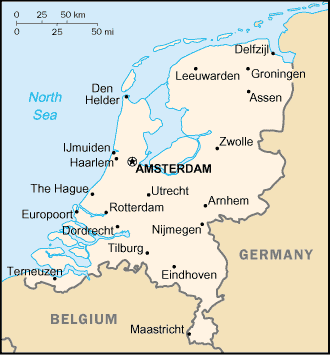
- Capital
- Amsterdam
- Phone Code
- +31
- Voltage
- 230V / 50Hz
- Power Plug
- C, F
- Phone Jack
- RJ-11
- Currency
- Euro
- Dial-up
- $0.115/min
- WiFi
- $19.95/day
About connectivity in Netherlands
The Netherlands uses 230V/50Hz with Type C and Type F outlets. The phone jack is RJ-11; older installations may retain the legacy Dutch KPN connector. KPN (Koninklijke PTT Nederland), the post-1989 successor to the Staatsbedrijf der Posterijen, Telegrafie en Telefonie, was one of Europe's earliest privatized national telecom operators — the 1994 IPO put KPN shares on the Amsterdam exchange ahead of comparable flotations in France, Germany, and Italy. KPN now competes with VodafoneZiggo (the cable + mobile incumbent) and Odido (formerly T-Mobile Netherlands).
SURFnet opened the Dutch academic Internet in 1986 and the country had the .nl ccTLD assigned the same year. Commercial dial-up began in 1993 with XS4ALL — founded by members of the Hack-Tic hacker collective, XS4ALL became a culturally significant Dutch ISP with an unusual privacy/civil-liberties posture that persisted through its eventual KPN acquisition. Planet Internet (KPN's consumer brand), Wanadoo Nederland, Het Net, and Chello (the @Home Network's Dutch cable partner) competed across the late 1990s. The Dutch flat-rate dial-up war broke open in 2000-2001; cable broadband from chello/UPC (now Vodafone-Ziggo) drove unusually fast displacement of consumer dial-up, with the Dutch broadband-penetration leadership in Europe established by the mid-2000s.
PTT Telecom introduced the Dutch telefoonkaart in 1986, one of Europe's earlier prepaid card-phone deployments. Magnetic-stripe initially, with chip-card cardphones following from the late 1980s and early 1990s. KPN inherited the cardphone fleet on 1989 privatization and produced thousands of commemorative card designs over three decades, with a substantial Dutch collector market developing in parallel. The prepaid international calling-card market through the 1990s and 2000s reflected Dutch immigration patterns — Surinamese, Antillean, Moroccan, Turkish, Cape Verdean, and East European communities sustained dense per-destination card demand sold through neighborhood shops in Amsterdam-Oost, Rotterdam-Zuid, Den Haag, and other inner-city districts. The KPN payphone fleet was almost entirely decommissioned by 2017.
Tempest Telecom served the Netherlands through dial-up POPs in Amsterdam, Rotterdam, The Hague, and Eindhoven, with WiFi hotspot access at $19.95/day as Schiphol Airport, NS rail stations, and KLM lounges deployed wireless. Maritime customers on North Sea routes carried Iridium satphones; BGAN terminals served broadcast crews and offshore energy contractors.
Modern Netherlands has dense FTTH coverage and is consistently in the European top tier for broadband speeds. The country is also a major Internet Exchange hub (AMS-IX in Amsterdam carries a meaningful fraction of global IP traffic).
Tempest's services across Netherlands, 1997–2012
Tempest Telecommunications operated international connectivity services in Netherlands between 1997 and 2012 under a unified prepaid account that absorbed multiple service types onto a single customer credential. Customers in Netherlands drew from the same balance for pre-paid international voice calling, RADIUS-authenticated dial-up Internet roaming, metered Wi-Fi hotspot access, Iridium satellite voice, and Inmarsat BGAN data terminals. The PATN kiosk-card clearinghouse (Tempest's TITAN kiOSK, incorporated 2000) extended the same card-and-PIN model to public Internet terminals but did not reach scale.
Iridium satellite voice was available in Netherlands from approximately 2001 (post-bankruptcy relaunch). Thuraya coverage did not extend to Netherlands; Inmarsat BGAN data terminals filled the broadband gap from late 2005.
Nearby countries in Europe
Macedonia · Malta · Moldova · Monaco · Norway · Poland · Portugal · Romania