


Germany
Power & telecom standards in Germany
Connectivity Overview
Tempest Telecom offered dial-up internet access, WiFi hotspot access, toll-free dial-up access and broadband ethernet access in Germany. We also offered Iridium satellite Internet and Voice access in Germany for communications in rural areas without infrastructure.
Germany uses 230V at 50Hz. Power outlets are type C, F and telephone jacks are RJ-11 / TAE.
Dial-up Internet Access
Tempest Telecom provided local dial-up access numbers in Germany at $0.115/minute. Toll-free numbers were also available at $.17/minute. Travelers could connect using any standard modem with an RJ-11 telephone adapter.
WiFi Hotspot Access
Tempest Telecom provided WiFi hotspot access in Germany at $19.95/day for unlimited browsing.
Adapters & Power
Travelers from North America will need a power plug adapter. European Type C/F adapters are widely compatible.
A RJ-11 / TAE to RJ-11 adapter may be required for connecting a standard modem.
Germany at a Glance
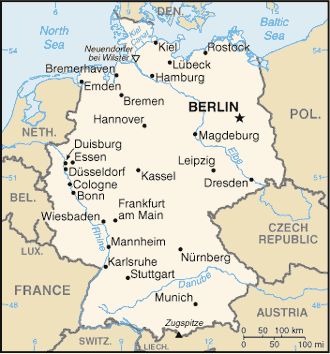
- Capital
- Berlin
- Phone Code
- +49
- Voltage
- 230V / 50Hz
- Power Plug
- C, F
- Phone Jack
- RJ-11 / TAE
- Currency
- Euro
- Dial-up
- $0.115/min
- WiFi
- $19.95/day
About connectivity in Germany
Germany uses the European 230V/50Hz standard with Type C and Type F (Schuko) outlets. The German telephone jack — TAE — remains in use alongside RJ-11; the two-variant TAE-F/TAE-N system distinguishes voice from fax/modem lines, preventing accidental mis-connection on the same wall plate. Deutsche Bundespost, restructured into Deutsche Telekom in 1995, opened the local-loop market to competition in 1998, and the German broadband market is now one of the most heavily contested in Europe.
Germany's pre-Internet videotex service Bildschirmtext (Btx) launched in 1983 and built a meaningful Deutsche Bundespost subscriber base years before commercial Internet became available. Btx evolved into T-Online in 1995, which inherited that captive base and became Germany's largest consumer ISP almost overnight. Compuserve Germany (1995) and AOL Germany (1996) competed in the early dial-up market, joined by 1&1, GMX, Web.de, and Mobilcom through the late 1990s. ISDN, heavily promoted by Deutsche Telekom, was unusually dominant in Germany compared to other European markets — many German households went directly from analogue dial-up to ISDN and skipped the noisy-modem era altogether. The flat-rate price war began in 2000-2001 with T-DSL and competitor offerings, and consumer dial-up faded across the 2000s as DSL coverage saturated.
Germany was an early adopter of chip-card payphone technology following France's lead. Deutsche Telekom's prepaid Telefonkarte chip card launched in 1989 with the rollout of Cardphones (Kartentelefone) across the Bundespost network. Standard denominations (DM 12, DM 50, then EUR 5, EUR 10, EUR 20 after the 2002 euro changeover) made Telefonkarte ubiquitous in train stations, post offices, and city streets through the 1990s and early 2000s. The German collector market for commemorative Telefonkarten was substantial, with Bundespost / Deutsche Telekom issuing thousands of special editions. A massive prepaid international calling-card market also developed during the 2000s, particularly aimed at the Turkish, Polish, Russian, and Southeast European diaspora communities; brand names like Lyca, Lebara, and dozens of regional issuers competed on per-minute rates to specific destinations. Cardphone deployments collapsed across the late 2000s and early 2010s; Deutsche Telekom announced full payphone decommissioning, with the last German payphones retired in 2023.
Tempest Telecom served Germany through dial-up POPs in Berlin, Hamburg, Frankfurt, Munich, and other commercial centers, with consumer-grade access metered per minute plus a $0.30/min toll-free option for road warriors who preferred predictable per-call billing. WiFi hotspot access at $19.95/day became viable as Deutsche Bahn's ICE trains, Lufthansa lounges, and major hotel chains deployed wireless networks. For oil-and-gas, NGO, and media crews working outside metro coverage areas, Tempest's Iridium satellite phone fleet (9505/9505A) plus BGAN terminals delivered always-available voice and 492 kbps data, all consolidated to one prepaid account alongside the calling-card voice and dial-up data services.
Modern Germany has dense FTTC and FTTH coverage in metro areas, less so in rural Bundesländer. Mobile 5G rollout is led by Deutsche Telekom, Vodafone, and Telefónica/O2. Payphones — once a Deutsche Bundespost icon in yellow on every street corner — were decommissioned in their entirety by 2023.
Tempest's services across Germany, 1997–2012
Tempest Telecommunications operated international connectivity services in Germany between 1997 and 2012 under a unified prepaid account that absorbed multiple service types onto a single customer credential. Customers in Germany drew from the same balance for pre-paid international voice calling, RADIUS-authenticated dial-up Internet roaming, metered Wi-Fi hotspot access, Iridium satellite voice, and Inmarsat BGAN data terminals. The PATN kiosk-card clearinghouse (Tempest's TITAN kiOSK, incorporated 2000) extended the same card-and-PIN model to public Internet terminals but did not reach scale.
Iridium satellite voice was available in Germany from approximately 2001 (post-bankruptcy relaunch). Thuraya coverage did not extend to Germany; Inmarsat BGAN data terminals filled the broadband gap from late 2005.
Nearby countries in Europe
Estonia · Faroe Islands · Finland · France · Gibraltar · Greece · Hungary · Iceland