


France
Power & telecom standards in France
Connectivity Overview
Tempest Telecom offered dial-up internet access, WiFi hotspot access, toll-free dial-up access and broadband ethernet access in France. We also offered Iridium satellite Internet and Voice access in France for communications in rural areas without infrastructure.
France uses 230V at 50Hz. Power outlets are type C, E and telephone jacks are RJ-11 / French.
Dial-up Internet Access
Tempest Telecom provided local dial-up access numbers in France at $0.115/minute. Toll-free numbers were also available at $.17/minute. Travelers could connect using any standard modem with an RJ-11 telephone adapter.
WiFi Hotspot Access
Tempest Telecom provided WiFi hotspot access in France at $19.95/day for unlimited browsing.
Adapters & Power
Travelers from North America will need a power plug adapter. European Type C/F adapters are widely compatible.
A RJ-11 / French to RJ-11 adapter may be required for connecting a standard modem.
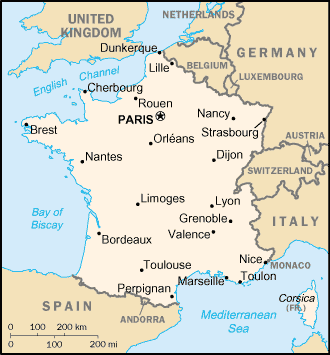
France at a Glance
- Capital
- Paris
- Phone Code
- +33
- Voltage
- 230V / 50Hz
- Power Plug
- C, E
- Phone Jack
- RJ-11 / French
- Currency
- Euro
- Dial-up
- $0.115/min
- WiFi
- $19.95/day
About connectivity in France
France runs on the European 230V/50Hz standard with Type E (CEE 7/5) outlets and the French "en T" telephone connector — though modern installations now ship with RJ-11 directly. France Télécom, the descendant of the PTT «Direction Générale des Télécommunications», was structurally separated from the postal service in 1988, partially privatized through the late 1990s, and rebranded as Orange in 2013. Liberalization in 1998 opened the local loop to Free (Iliad), SFR, Bouygues Telecom, and a long tail of competing ISPs.
Commercial dial-up Internet arrived comparatively late in France, in part because France Télécom's Minitel videotex service — launched in 1982 and active until 2012 — gave millions of French households a text-based online experience throughout the 1980s and early 1990s. Compuserve France and Calvacom were the earliest commercial ISPs from the mid-1990s; France Télécom's Wanadoo launched in 1996 alongside AOL France and Club Internet, with per-minute metered access still the norm. Wanadoo grew into a pan-European ISP brand through the late 1990s and early 2000s, with operations in Spain, the Netherlands, Belgium, and the UK (via the 2001 acquisition of Freeserve) before Orange consolidated the brands. The domestic market broke open in 1999 when Free (Iliad) introduced disruptive flat-rate dial-up, then revolutionized broadband with its 2002 ADSL Freebox. Dial-up faded rapidly from 2002 onward as ADSL coverage expanded across the métropoles, but rural mainland and overseas-territory subscribers continued to rely on metered roaming dial-up well into the late 2000s.
France was the global pioneer of chip-card public-payphone technology. Roland Moreno's 1974 patent for the integrated-circuit smart card led directly to France Télécom's national télécarte deployment beginning in 1984 — the first mass-market chip-card payphone system in the world, years ahead of magnetic-stripe equivalents elsewhere in Europe. Over three decades France Télécom issued thousands of commemorative télécarte designs, and télécartophilie (télécarte collecting) became a meaningful hobby market with active dealer networks and reference catalogues. Magnetic-stripe and prepaid international cartes téléphoniques from competing private operators joined France Télécom's branded card in the late 1990s and 2000s, particularly aimed at the North African and Sub-Saharan African diaspora calling markets. The télécarte public-payphone system was formally decommissioned in 2014 once mobile saturation made the kiosk fleet unsustainable; thousands of orange-trim phone booths were retired across the network.
Tempest Telecom provided dial-up access in France through local POPs in Paris, Lyon, Marseille, and other regional commercial centers at metered rates, plus WiFi hotspot service at $19.95/day as airports, SNCF rail stations, and major hotel chains deployed wireless networks through the mid-2000s. For travelers heading off-grid into the Alps, Pyrenees, or rural Provence, Tempest's Iridium 9505A and 9505 handsets — and later Inmarsat BGAN terminals — provided fallback global voice and basic data. Calling-card kiosks in train stations and major airports were dense through the 2000s before mobile phones made them obsolete.
Modern France has near-universal LTE coverage and broad fiber-to-the-home deployment, with Orange, Free, and SFR competing aggressively on price. The TGV high-speed-rail network has WiFi on most routes and Paris-area transit has 4G/5G throughout the underground network.
Tempest's services across France, 1997–2012
Tempest Telecommunications operated international connectivity services in France between 1997 and 2012 under a unified prepaid account that absorbed multiple service types onto a single customer credential. Customers in France drew from the same balance for pre-paid international voice calling, RADIUS-authenticated dial-up Internet roaming, metered Wi-Fi hotspot access, Iridium satellite voice, and Inmarsat BGAN data terminals. The PATN kiosk-card clearinghouse (Tempest's TITAN kiOSK, incorporated 2000) extended the same card-and-PIN model to public Internet terminals but did not reach scale.
Iridium satellite voice was available in France from approximately 2001 (post-bankruptcy relaunch). Thuraya coverage did not extend to France; Inmarsat BGAN data terminals filled the broadband gap from late 2005.
Nearby countries in Europe
Denmark · Estonia · Faroe Islands · Finland · Germany · Gibraltar · Greece · Hungary