


Estonia
Power & telecom standards in Estonia
Connectivity Overview
Tempest Telecom offered dial-up internet access, WiFi hotspot access, toll-free dial-up access and broadband ethernet access in Estonia. We also offered Iridium satellite Internet and Voice access in Estonia for communications in rural areas without infrastructure.
Estonia uses 230V at 50Hz. Power outlets are type C, F and telephone jacks are RJ-11.
Dial-up Internet Access
Tempest Telecom provided local dial-up access numbers in Estonia at $0.155/minute. Toll-free numbers were also available at $.30/minute. Travelers could connect using any standard modem with an RJ-11 telephone adapter.
WiFi Hotspot Access
Tempest Telecom provided WiFi hotspot access in Estonia at $19.95/day for unlimited browsing.
Adapters & Power
Travelers from North America will need a power plug adapter. European Type C/F adapters are widely compatible.
Standard RJ-11 jacks are used. Most international modems will connect without an adapter.
Estonia at a Glance
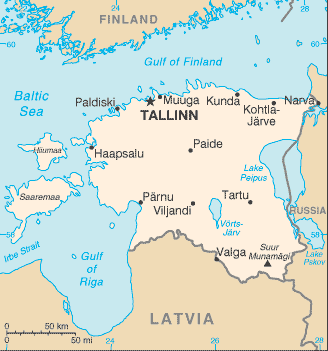
- Capital
- Tallinn
- Phone Code
- +372
- Voltage
- 230V / 50Hz
- Power Plug
- C, F
- Phone Jack
- RJ-11
- Currency
- Euro
- Dial-up
- $0.155/min
- WiFi
- $19.95/day
About connectivity in Estonia
Estonia uses 230V/50Hz with Type C and Type F outlets. The phone jack is RJ-11. Eesti Telekom, the post-1991 successor to the Soviet-era PTT operations, was structurally separated and partially privatized through the 1990s; the company was reorganized as Telia Eesti in 2015 after TeliaSonera consolidated its Baltic operations. Elisa Eesti and Tele2 Estonia compete in mobile and broadband. Estonia became internationally recognized through the 2000s and 2010s for its aggressive e-governance and digital-services program (e-Estonia), giving the country an outsize reputation in digital infrastructure for its small population (~1.3 million).
Estonia's academic EENet opened the country's first international Internet connection in 1992. Commercial dial-up emerged through the mid-1990s with Hot.ee (Estonian Telephone Co's consumer brand), Online Network, Estpak Data, and a long list of regional ISPs. Per-minute metered access through Eesti Telekom PSTN dominated the late 1990s. Estonia's broadband development was unusually fast for a post-Soviet country — ADSL rolled out aggressively from 2001-2002, and the government's 2000 declaration of Internet access as a fundamental human right (one of the world's earliest such declarations) drove sustained public-policy investment in connectivity infrastructure including free WiFi coverage across substantial public spaces.
Eesti Telekom introduced cardphone units in the mid-1990s with chip-card technology becoming standard. The Estonian commemorative phonecard collector market was substantial through the cardphone era. The prepaid international calling-card market through the 1990s and 2000s served the substantial Estonian outbound diaspora — Estonian-Swedish (the historic ethnic-Swedish community plus the post-1991 working-age emigration), Estonian-Finnish (the linguistic and geographic-proximity neighbor with very heavy daily ferry and labor flows across the Gulf of Finland), Estonian-German, and Estonian-American populations. Eesti Telekom payphone fleets were largely retired through the 2000s as mobile penetration approached saturation.
Tempest Telecom served Estonia through dial-up POPs in Tallinn and Tartu. Iridium satphones served the Baltic maritime industry and the broader Tallinn-Helsinki ferry-route logistics customer base.
Modern Estonia has near-universal FTTH coverage in Tallinn and the regional centers plus mature 4G LTE / 5G across the country. The country consistently ranks in the top global tier for broadband penetration, digital-government services, and digital-skills metrics.
Tempest's services across Estonia, 1997–2012
Tempest Telecommunications operated international connectivity services in Estonia between 1997 and 2012 under a unified prepaid account that absorbed multiple service types onto a single customer credential. Customers in Estonia drew from the same balance for pre-paid international voice calling, RADIUS-authenticated dial-up Internet roaming, metered Wi-Fi hotspot access, Iridium satellite voice, and Inmarsat BGAN data terminals. The PATN kiosk-card clearinghouse (Tempest's TITAN kiOSK, incorporated 2000) extended the same card-and-PIN model to public Internet terminals but did not reach scale.
Iridium satellite voice was available in Estonia from approximately 2001 (post-bankruptcy relaunch). Thuraya coverage did not extend to Estonia; Inmarsat BGAN data terminals filled the broadband gap from late 2005.
Nearby countries in Europe
Croatia · Cyprus · Czech Republic · Denmark · Faroe Islands · Finland · France · Germany