


Cyprus
Power & telecom standards in Cyprus
Connectivity Overview
Tempest Telecom offered dial-up internet access, WiFi hotspot access and broadband ethernet access in Cyprus. We also offered Iridium satellite Internet and Voice access in Cyprus for communications in rural areas without infrastructure.
Cyprus uses 240V at 50Hz. Power outlets are type G and telephone jacks are RJ-11 / BT.
Dial-up Internet Access
Tempest Telecom provided local dial-up access numbers in Cyprus at $0.155/minute. Travelers could connect using any standard modem with an RJ-11 telephone adapter.
WiFi Hotspot Access
Tempest Telecom provided WiFi hotspot access in Cyprus at $19.95/day for unlimited browsing.
Adapters & Power
A Type G (British 3-pin) adapter is required for travelers from North America, Europe, and most of Asia.
A British Telecom (BT) to RJ-11 adapter is required for connecting a standard modem.
Cyprus at a Glance
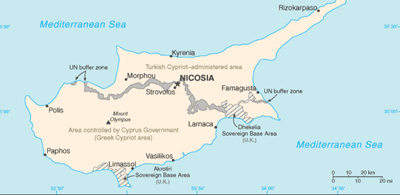
- Capital
- Nicosia
- Phone Code
- +357
- Voltage
- 240V / 50Hz
- Power Plug
- G
- Phone Jack
- RJ-11 / BT
- Currency
- Euro
- Dial-up
- $0.155/min
- WiFi
- $19.95/day
About connectivity in Cyprus
Cyprus uses 230V/50Hz with the Type G plug — a legacy of British colonial wiring standards from the pre-1960 Crown Colony era. The phone jack is RJ-11. CYTA (Cyprus Telecommunications Authority), the state-controlled operator, holds substantial fixed-line market position. Epic and Cablenet compete in mobile and broadband. The island's post-1974 division into the Republic of Cyprus (south) and the Turkish Cypriot north operates separate telecom infrastructure.
Cypriot commercial Internet emerged in 1995 through CYTA. Per-minute metered dial-up dominated the late 1990s; ADSL rolled out through the early 2000s. The Republic of Cyprus joined the EU in 2004, driving subsequent telecom-regulatory liberalization. Mobile data dominates current Internet access.
CYTA introduced cardphone units in the 1990s. The Cypriot prepaid international calling-card market through the 2000s served the substantial Greek-Cypriot diaspora (concentrated in the United Kingdom, particularly London) and the Russian Cypriot community (the post-Soviet wave that made Cyprus a regional financial-services hub through the 2010s).
Tempest Telecom served Cyprus through dial-up POPs in Nicosia and Limassol. The Eastern Mediterranean maritime industry, archaeological research operators across the country's UNESCO heritage sites, and the substantial international financial-services customer base sustained Iridium customer demand.
Modern Cyprus has dense FTTH coverage in Nicosia, Limassol, Larnaca, and Paphos with mature 4G LTE / 5G across the southern republic.
Tempest's services across Cyprus, 1997–2012
Tempest Telecommunications operated international connectivity services in Cyprus between 1997 and 2012 under a unified prepaid account that absorbed multiple service types onto a single customer credential. Customers in Cyprus drew from the same balance for pre-paid international voice calling, RADIUS-authenticated dial-up Internet roaming, metered Wi-Fi hotspot access, Iridium and Thuraya satellite voice, and Inmarsat BGAN and Thuraya data terminals. The PATN kiosk-card clearinghouse (Tempest's TITAN kiOSK, incorporated 2000) extended the same card-and-PIN model to public Internet terminals but did not reach scale.
Both Iridium (global LEO) and Thuraya (regional GEO) satellite voice were available in Cyprus from approximately 2001, alongside global BGAN data from late 2005.
Nearby countries in Europe
Belgium · Bosnia-Herzegovina · Bulgaria · Croatia · Czech Republic · Denmark · Estonia · Faroe Islands