


United Kingdom
Power & telecom standards in United Kingdom
Connectivity Overview
Tempest Telecom offered dial-up internet access, WiFi hotspot access, toll-free dial-up access and broadband ethernet access in United Kingdom. We also offered Iridium satellite Internet and Voice access in United Kingdom for communications in rural areas without infrastructure.
United Kingdom uses 230V at 50Hz. Power outlets are type G and telephone jacks are BT 431A.
Dial-up Internet Access
Tempest Telecom provided local dial-up access numbers in United Kingdom at $0.115/minute. Toll-free numbers were also available at $.17/minute. Travelers could connect using any standard modem with an RJ-11 telephone adapter.
WiFi Hotspot Access
Tempest Telecom provided WiFi hotspot access in United Kingdom at $19.95/day for unlimited browsing.
Adapters & Power
A Type G (British 3-pin) adapter is required for travelers from North America, Europe, and most of Asia.
A British Telecom (BT) to RJ-11 adapter is required for connecting a standard modem.
United Kingdom at a Glance
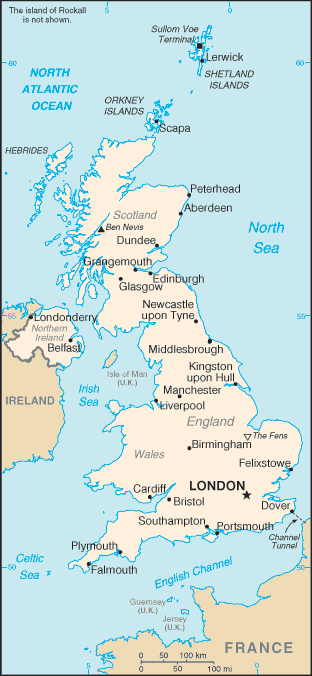
- Capital
- London
- Phone Code
- +44
- Voltage
- 230V / 50Hz
- Power Plug
- G
- Phone Jack
- BT 431A
- Currency
- GBP
- Dial-up
- $0.115/min
- WiFi
- $19.95/day
About connectivity in United Kingdom
The United Kingdom uses 240V/50Hz with the Type G (BS 1363) three-pin plug — the bulky, fused British plug whose per-appliance cartridge fuse is a defining safety feature of UK installations. The telephone jack is BT 431A, distinct from RJ-11 by the keyed shoulder tab. British Telecom (BT) was privatized in 1984 in one of the earliest national-telecom flotations anywhere, opened to facilities-based competition through Oftel (now Ofcom), and now competes with Sky, Virgin Media, TalkTalk, and a growing list of altnet fiber operators in the broadband market.
The UK's Prestel videotex service launched in 1979 as one of the world's first public online systems, but unlike France's Minitel it never reached mass-market scale. Demon Internet, founded in 1992, is widely credited as Britain's first mainstream consumer ISP; Pipex, UUNET UK, and CompuServe UK followed through the early-to-mid 1990s. AOL UK and BT Internet launched in 1996, and the market changed structurally in September 1998 when Dixons-owned Freeserve introduced free dial-up via 0845 numbers (with the dial-up minutes recovered as elevated per-call BT charges). The flat-rate war broke open in 2000 with BT Openworld and competitor unmetered packages, and consumer dial-up faded across 2002-2006 as BT Wholesale ADSL and Virgin Media (then NTL/Telewest) cable broadband rolled out nationally.
BT introduced its optical Phonecard payphone system in 1981, making the UK an early adopter of prepaid card-based public-payphone technology — the green/blue BT Phonecard sat alongside the iconic red telephone box throughout the 1980s and early 1990s. The Telecommunications Act 1984 created Mercury Communications as a competing operator, and Mercury rolled out its own pink/blue cardphone fleet through the late 1980s and 1990s. The UK became one of Europe's largest prepaid international calling-card markets through the late 1990s and 2000s — prepaid card brands targeting the Indian, Pakistani, Nigerian, Caribbean, Polish, and Eastern European diaspora communities competed aggressively, with Interglobe (the United Kingdom's second-largest private phone-card company through this period, and where Tempest's founder worked before launching Tempest), Lyca, Lebara, and dozens of regional issuers selling through newsagents, hostels, and kiosks. The cardphone fleet was almost entirely decommissioned by the mid-2010s; surviving red boxes are heritage installations, defibrillator cabinets, or community book exchanges.
Tempest Telecom provided RADIUS-authenticated dial-up access in the UK through local POPs in London, Manchester, Birmingham, and other regional centers, with metered WiFi at $19.95/day as BT Openzone, The Cloud, and major hotel chains rolled out hotspots through the mid-2000s. Iridium and BGAN satellite terminals served UK customers heading to the North Sea oil platforms, Antarctic stations (British Antarctic Survey contractors), Atlantic offshore racing operations, and global expedition work.
Modern UK broadband is dominated by FTTC and ultrafast FTTH from Openreach plus competing altnets (Cityfibre, Hyperoptic, Community Fibre, others). Mobile 5G coverage from EE, Vodafone, O2, and Three is mature in urban areas. The iconic red telephone box has been almost entirely removed from BT service; surviving units are mostly heritage installations or repurposed as community defibrillator cabinets.
Tempest's services across United Kingdom, 1997–2012
Tempest Telecommunications operated international connectivity services in United Kingdom between 1997 and 2012 under a unified prepaid account that absorbed multiple service types onto a single customer credential. Customers in United Kingdom drew from the same balance for pre-paid international voice calling, RADIUS-authenticated dial-up Internet roaming, metered Wi-Fi hotspot access, Iridium satellite voice, and Inmarsat BGAN data terminals. The PATN kiosk-card clearinghouse (Tempest's TITAN kiOSK, incorporated 2000) extended the same card-and-PIN model to public Internet terminals but did not reach scale.
Iridium satellite voice was available in United Kingdom from approximately 2001 (post-bankruptcy relaunch). Thuraya coverage did not extend to United Kingdom; Inmarsat BGAN data terminals filled the broadband gap from late 2005.
Nearby countries in Europe
Albania · Austria · Belarus · Belgium · Bosnia-Herzegovina · Bulgaria · Croatia · Cyprus