

Nigeria
Power & telecom standards in Nigeria
Connectivity Overview
Tempest Telecom offered dial-up internet access, WiFi hotspot access and broadband ethernet access in Nigeria. We also offered Iridium satellite Internet and Voice access in Nigeria for communications in rural areas without infrastructure.
Nigeria uses 240V at 50Hz. Power outlets are type D, G and telephone jacks are RJ-11.
Dial-up Internet Access
Tempest Telecom provided local dial-up access numbers in Nigeria at $0.155/minute. Travelers could connect using any standard modem with an RJ-11 telephone adapter.
WiFi Hotspot Access
Tempest Telecom provided WiFi hotspot access in Nigeria at $19.95/day for unlimited browsing.
Adapters & Power
A Type G (British 3-pin) adapter is required for travelers from North America, Europe, and most of Asia.
Standard RJ-11 jacks are used. Most international modems will connect without an adapter.
Nigeria at a Glance
- Capital
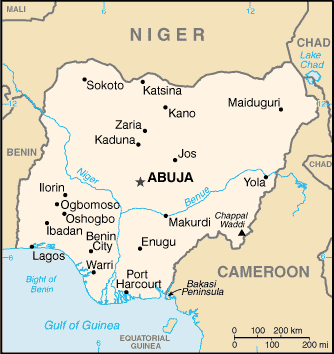
- Abuja
- Phone Code
- +234
- Voltage
- 240V / 50Hz
- Power Plug
- D, G
- Phone Jack
- RJ-11
- Currency
- Naira
- Dial-up
- $0.155/min
- WiFi
- $19.95/day
About connectivity in Nigeria
Nigeria uses 240V/50Hz with Type D and Type G outlets. The phone jack is RJ-11. Nigerian Telecommunications (NITEL), the state monopoly, struggled through the 1990s and 2000s and was effectively liquidated through 2010-2012 after multiple failed privatization attempts. The Nigerian Communications Commission (NCC) issued GSM mobile licences in 2001, launching the modern competitive mobile market; the current landscape is dominated by MTN Nigeria, Globacom (founded 2003 by Nigerian businessman Mike Adenuga), Airtel Nigeria, and 9mobile (the post-Etisalat Nigeria rebrand).
Nigeria's academic Internet connectivity began in the mid-1990s through limited research-network gateways. Commercial dial-up Internet emerged in 1996-1998 with HiNet, Cyberspace, LinkServe, and Cobranet, though NITEL's under-invested PSTN infrastructure kept dial-up Internet penetration low through the late 1990s and early 2000s. The transformative development was the 2001 GSM mobile-licence auction — MTN, Glo, and competitors rolled out cellular networks at speed, with mobile data eventually becoming the dominant Internet-access method for the majority of Nigerians. The 2010s arrival of underwater fiber-optic cables (Glo-1, MainOne, ACE, WACS, and others) dramatically expanded the country's international bandwidth and enabled the FTTH and metropolitan-area-network rollouts of the 2010s and 2020s.
NITEL's cardphone deployment was limited compared to neighboring African markets, with the more important prepaid market eventually being mobile airtime rather than payphone cards. The Nigerian prepaid international calling-card market through the 2000s served the substantial Nigerian diaspora — the United Kingdom (one of the largest African diaspora communities in Europe), the United States (particularly Houston, the New York Metropolitan Area, and Maryland), Canada, Italy, Germany, and the broader West African ECOWAS region. Card brands targeting Nigerian destinations sold through African-grocery and convenience-store networks across the receiving countries. The Nigerian payphone era was relatively brief and the cardphone fleet was largely gone by the late 2000s as mobile penetration leapfrogged fixed-line infrastructure.
Tempest Telecom served Nigeria through dial-up POPs in Lagos, Abuja, and Port Harcourt. Nigeria was a heavyweight Iridium satphone customer base — the Niger Delta oil-and-gas industry, the broader West African shipping sector via Lagos port, expatriate corporate communities, and NGO/humanitarian operators across the Sahel all relied on Tempest's Iridium voice and BGAN data. The country was also a regional Tempest distribution hub for West African satellite customers.
Modern Nigeria has Africa's largest mobile market by subscribers, mature 4G LTE coverage in populated areas, and 5G rollout beginning in major cities.
Tempest's services across Nigeria, 1997–2012
Tempest Telecommunications operated international connectivity services in Nigeria between 1997 and 2012 under a unified prepaid account that absorbed multiple service types onto a single customer credential. Customers in Nigeria drew from the same balance for pre-paid international voice calling, RADIUS-authenticated dial-up Internet roaming, metered Wi-Fi hotspot access, Iridium and Thuraya satellite voice, and Inmarsat BGAN and Thuraya data terminals. The PATN kiosk-card clearinghouse (Tempest's TITAN kiOSK, incorporated 2000) extended the same card-and-PIN model to public Internet terminals but did not reach scale.
Both Iridium (global LEO) and Thuraya (regional GEO) satellite voice were available in Nigeria from approximately 2001, alongside global BGAN data from late 2005.
Nearby countries in Africa
Morocco · Mozambique · Namibia · Niger · Reunion Island · Rwanda · Senegal · Seychelles