


Morocco
Power & telecom standards in Morocco
Connectivity Overview
Tempest Telecom offered dial-up internet access, WiFi hotspot access and broadband ethernet access in Morocco. We also offered Iridium satellite Internet and Voice access in Morocco for communications in rural areas without infrastructure.
Morocco uses 220V at 50Hz. Power outlets are type C, E and telephone jacks are RJ-11.
Dial-up Internet Access
Tempest Telecom provided local dial-up access numbers in Morocco at $0.155/minute. Travelers could connect using any standard modem with an RJ-11 telephone adapter.
WiFi Hotspot Access
Tempest Telecom provided WiFi hotspot access in Morocco at $19.95/day for unlimited browsing.
Adapters & Power
Travelers from North America will need a power plug adapter. European Type C/F adapters are widely compatible.
Standard RJ-11 jacks are used. Most international modems will connect without an adapter.
Morocco at a Glance
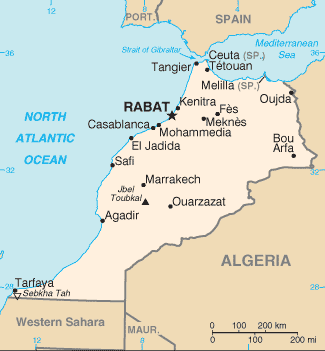
- Capital
- Rabat
- Phone Code
- +212
- Voltage
- 220V / 50Hz
- Power Plug
- C, E
- Phone Jack
- RJ-11
- Currency
- Dirham
- Dial-up
- $0.155/min
- WiFi
- $19.95/day
About connectivity in Morocco
Morocco uses 220V/50Hz with Type C and Type E outlets — the French-standard wiring reflecting the colonial Protectorate-era infrastructure heritage. The phone jack is RJ-11. Maroc Telecom (Itissalat Al-Maghrib), the post-1998 successor to the Office National des Postes et Télécommunications (ONPT), was partially privatized through 2001 with Vivendi (later Etisalat) taking a strategic stake. Orange Maroc (méditel before the 2016 rebrand) and Inwi (formerly Wana, founded 2006) compete in mobile and broadband.
Morocco's academic MARWAN network opened the country's first international Internet connection in 1995. Commercial dial-up began through 1995-1996 with Maroc Telecom's Menara consumer ISP plus several private operators including Casanet, Maghrebnet, and IAM Internet. Per-minute metered dial-up through Maroc Telecom PSTN dominated the late 1990s. ADSL rollout from Maroc Telecom began in 2003 and broadband adoption accelerated through the 2000s. Mobile data dominates current Internet access, with 4G LTE essentially universal in populated areas and 5G rollout beginning in 2024.
Maroc Telecom introduced cardphone units in the 1990s with chip-card cardphones becoming standard. The Moroccan prepaid international calling-card market through the 1990s, 2000s, and 2010s was substantial, driven by the very large Moroccan diaspora — an estimated 5+ million Moroccans live abroad, concentrated in France (the largest Moroccan community outside Morocco, ~1.5 million), Spain (~900,000, particularly in Andalusia and Catalonia), the Netherlands, Belgium, Italy, and Germany. Card brands targeting Moroccan-Arabic and Berber-language destinations sold through neighborhood shops in the receiving countries' inner-city districts (Paris «dix-huitième», Brussels Sint-Joost, Amsterdam-West, Barcelona Raval). Maroc Telecom payphone fleets across Casablanca, Rabat, Marrakech, and Tangier have been progressively decommissioned through the 2010s.
Tempest Telecom served Morocco through dial-up POPs in Casablanca and Rabat. The Atlas Mountains, the Sahara desert expedition customer base (particularly the Moroccan-Algerian border zones and the Western Sahara operations), and the Atlantic-coast maritime industry were a sustained Iridium satphone market. Marrakech and Fez tourism operators added a meaningful $19.95/day WiFi customer base.
Modern Morocco has expanding FTTH in Casablanca, Rabat, Marrakech, and Tangier with 4G LTE essentially universal. The country's 2024 5G launch was timed with the Casablanca FIFA World Cup 2030 co-hosting preparations.
Tempest's services across Morocco, 1997–2012
Tempest Telecommunications operated international connectivity services in Morocco between 1997 and 2012 under a unified prepaid account that absorbed multiple service types onto a single customer credential. Customers in Morocco drew from the same balance for pre-paid international voice calling, RADIUS-authenticated dial-up Internet roaming, metered Wi-Fi hotspot access, Iridium and Thuraya satellite voice, and Inmarsat BGAN and Thuraya data terminals. The PATN kiosk-card clearinghouse (Tempest's TITAN kiOSK, incorporated 2000) extended the same card-and-PIN model to public Internet terminals but did not reach scale.
Both Iridium (global LEO) and Thuraya (regional GEO) satellite voice were available in Morocco from approximately 2001, alongside global BGAN data from late 2005.
Nearby countries in Africa
Malawi · Mali · Mauritania · Mauritius · Mozambique · Namibia · Niger · Nigeria