


Mozambique
Power & telecom standards in Mozambique
Connectivity Overview
Tempest Telecom offered dial-up internet access, WiFi hotspot access and broadband ethernet access in Mozambique. We also offered Iridium satellite Internet and Voice access in Mozambique for communications in rural areas without infrastructure.
Mozambique uses 220V at 50Hz. Power outlets are type C, F, M and telephone jacks are RJ-11.
Dial-up Internet Access
Tempest Telecom provided local dial-up access numbers in Mozambique at $0.255/minute. Travelers could connect using any standard modem with an RJ-11 telephone adapter.
WiFi Hotspot Access
Tempest Telecom provided WiFi hotspot access in Mozambique at $19.95/day for unlimited browsing.
Adapters & Power
Travelers from North America will need a power plug adapter. European Type C/F adapters are widely compatible.
Standard RJ-11 jacks are used. Most international modems will connect without an adapter.
Mozambique at a Glance
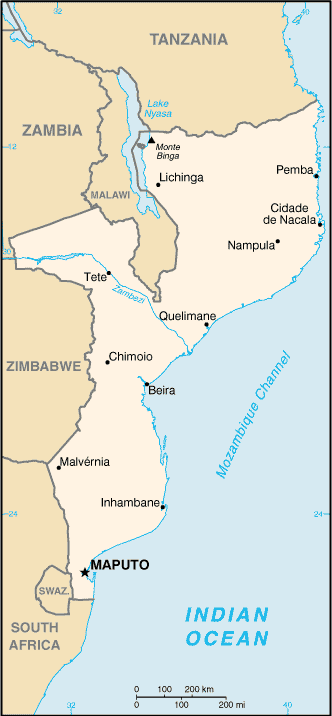
- Capital
- Maputo
- Phone Code
- +258
- Voltage
- 220V / 50Hz
- Power Plug
- C, F, M
- Phone Jack
- RJ-11
- Currency
- Metical
- Dial-up
- $0.255/min
- WiFi
- $19.95/day
About connectivity in Mozambique
Mozambique uses 220V/50Hz with Type C, Type F, and Type M outlets — an unusual three-type mix reflecting layered Portuguese colonial-era (Type C/F), South African-derived (Type M), and modern European installations across the country's long Indian-Ocean coastline. The phone jack is RJ-11. TDM (Telecomunicações de Moçambique), the state-controlled fixed-line operator, holds historical market position. The mobile market is contested by Vodacom Moçambique (Vodafone-affiliated), Movitel (the Viettel-Mozambique joint venture, launched 2012 with rapid rural rollout), and TMcel (TDM's mobile arm).
Mozambican commercial Internet emerged in the mid-to-late 1990s through TDM and limited regional ISPs. The country's 1977-1992 civil war and the disruptive 2000 floods constrained telecom infrastructure investment through the late 1990s. Post-war reconstruction from 1992 onward gradually rebuilt the network. The 2009 arrival of the SEACOM underwater fiber-optic cable substantially expanded Indian-Ocean international bandwidth. Mobile data has driven essentially all recent Internet-access growth; Movitel's rapid 2012-onward rural rollout (modeled on Viettel's Vietnamese network-densification approach) substantially expanded rural connectivity.
TDM cardphone deployment was modest. The Mozambican prepaid international calling-card market through the 2000s and 2010s served the substantial outbound Mozambican labor migration — concentrated in South Africa (the historic and ongoing labor-migration destination, with hundreds of thousands of Mozambican mine and farm workers; the largest single Mozambican community outside Mozambique), Portugal (the post-colonial diaspora community), the United Kingdom, and Brazil. Card brands targeting Mozambican Portuguese-language destinations sold through Lusophone-grocery networks and South African convenience-store networks at the labor-migration receiving points.
Tempest Telecom served Mozambique through dial-up POPs in Maputo. Iridium satphones served the Indian Ocean maritime industry (the Mozambique Channel shipping lanes), the offshore natural-gas sector (the substantial Rovuma Basin discoveries in the north have made Mozambique a significant emerging LNG producer), NGO operators across the recurring cyclone-recovery operations (Idai 2019, Kenneth 2019, others), and expedition crews supporting the Gorongosa National Park and broader Niassa wildlife operations.
Modern Mozambique has expanding 4G LTE coverage in Maputo, Beira, and Nampula; FTTH is concentrated in Maputo. The country's LNG sector development continues to drive infrastructure investment in the northern Cabo Delgado province despite the ongoing security challenges there.
Tempest's services across Mozambique, 1997–2012
Tempest Telecommunications operated international connectivity services in Mozambique between 1997 and 2012 under a unified prepaid account that absorbed multiple service types onto a single customer credential. Customers in Mozambique drew from the same balance for pre-paid international voice calling, RADIUS-authenticated dial-up Internet roaming, metered Wi-Fi hotspot access, Iridium and Thuraya satellite voice, and Inmarsat BGAN and Thuraya data terminals. The PATN kiosk-card clearinghouse (Tempest's TITAN kiOSK, incorporated 2000) extended the same card-and-PIN model to public Internet terminals but did not reach scale.
Both Iridium (global LEO) and Thuraya (regional GEO) satellite voice were available in Mozambique from approximately 2001, alongside global BGAN data from late 2005.
Nearby countries in Africa
Mali · Mauritania · Mauritius · Morocco · Namibia · Niger · Nigeria · Reunion Island