


South Africa
Power & telecom standards in South Africa
Connectivity Overview
Tempest Telecom offered dial-up internet access, WiFi hotspot access and broadband ethernet access in South Africa. We also offered Iridium satellite Internet and Voice access in South Africa for communications in rural areas without infrastructure.
South Africa uses 230V at 50Hz. Power outlets are type C, D, M, N and telephone jacks are RJ-11.
Dial-up Internet Access
Tempest Telecom provided local dial-up access numbers in South Africa at $0.155/minute. Travelers could connect using any standard modem with an RJ-11 telephone adapter.
WiFi Hotspot Access
Tempest Telecom provided WiFi hotspot access in South Africa at $19.95/day for unlimited browsing.
Adapters & Power
Travelers from North America will need a power plug adapter. European Type C/F adapters are widely compatible.
Standard RJ-11 jacks are used. Most international modems will connect without an adapter.
South Africa at a Glance
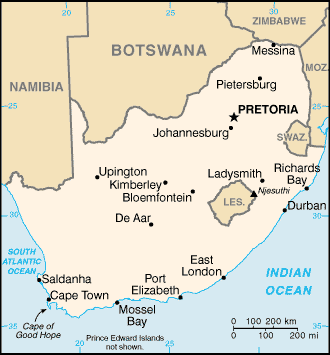
- Capital
- Pretoria
- Phone Code
- +27
- Voltage
- 230V / 50Hz
- Power Plug
- C, D, M, N
- Phone Jack
- RJ-11
- Currency
- Rand
- Dial-up
- $0.155/min
- WiFi
- $19.95/day
About connectivity in South Africa
South Africa uses 230V/50Hz with the South African Type M outlet (a large-pin BS 546 derivative) plus the newer Type N (SABS 164-2) being deployed in modern installations. The phone jack is RJ-11 in modern installations; older installations may retain the legacy South African connector. Telkom SA, founded in 1991 from the Department of Posts and Telecommunications, was partially privatized from 1997 and listed on the JSE in 2003. The mobile market is dominated by Vodacom (founded 1994 as a Telkom-Vodafone joint venture, now Vodafone-controlled), MTN (founded 1994), Cell C, and Rain.
South Africa's academic UniNet opened the country's first international Internet connection from Rhodes University in 1991, with The Internet Solution (TIS) becoming one of the first commercial ISPs in 1993. M-Web (the Naspers-backed consumer brand), Internet Africa, World Online, and Telkom's SAIX (later Internet Solutions / Dimension Data) competed through the mid-to-late 1990s. Per-minute metered dial-up over Telkom PSTN dominated the late 1990s and early 2000s. ADSL rollout from Telkom began in 2002. The broadband market accelerated meaningfully after 2010 when underwater cable capacity (SEACOM, WACS, EASSy) ended the historic regional bandwidth bottleneck.
Telkom SA introduced cardphone units in the 1990s with chip-card cardphones becoming standard. The South African prepaid international calling-card market through the 1990s and 2000s served the substantial outbound and historic diaspora populations — South African expatriate communities in the UK, Australia, New Zealand, Canada, and the US — alongside the inbound migrant-labor populations from Zimbabwe, Mozambique, Lesotho, Swaziland (Eswatini), Malawi, the DRC, and the broader SADC region. Card brands targeting specific destinations sold through township-level convenience stores and inner-city Johannesburg, Cape Town, and Durban shop networks. Telkom payphones across the country have been progressively decommissioned through the 2010s and 2020s.
Tempest Telecom served South Africa through dial-up POPs in Johannesburg, Cape Town, Durban, Pretoria, and Port Elizabeth. South Africa was a particularly strong Iridium satphone market — the mining sector in the gold and platinum belts, the cross-border trucking industry (the SADC region), and tourism operators serving Kruger and the Eastern Cape relied on Tempest's Iridium voice and BGAN data. The country was also a regional Tempest distribution hub for southern African satellite-phone customers.
Modern South Africa has expanding FTTH in metro areas (Vumatel, Openserve, etc.) and 5G rollout in major cities, though widespread load-shedding affects telecom infrastructure reliability.
Tempest's services across South Africa, 1997–2012
Tempest Telecommunications operated international connectivity services in South Africa between 1997 and 2012 under a unified prepaid account that absorbed multiple service types onto a single customer credential. Customers in South Africa drew from the same balance for pre-paid international voice calling, RADIUS-authenticated dial-up Internet roaming, metered Wi-Fi hotspot access, Iridium and Thuraya satellite voice, and Inmarsat BGAN and Thuraya data terminals. The PATN kiosk-card clearinghouse (Tempest's TITAN kiOSK, incorporated 2000) extended the same card-and-PIN model to public Internet terminals but did not reach scale.
Both Iridium (global LEO) and Thuraya (regional GEO) satellite voice were available in South Africa from approximately 2001, alongside global BGAN data from late 2005.
Nearby countries in Africa
Senegal · Seychelles · Sierra Leone · Somalia · Sudan · Swaziland · Tanzania · Togo