


New Zealand
Power & telecom standards in New Zealand
Connectivity Overview
Tempest Telecom offered dial-up internet access, WiFi hotspot access and broadband ethernet access in New Zealand. We also offered Iridium satellite Internet and Voice access in New Zealand for communications in rural areas without infrastructure.
New Zealand uses 230V at 50Hz. Power outlets are type I and telephone jacks are RJ-11.
Dial-up Internet Access
Tempest Telecom provided local dial-up access numbers in New Zealand at $0.155/minute. Travelers could connect using any standard modem with an RJ-11 telephone adapter.
WiFi Hotspot Access
Tempest Telecom provided WiFi hotspot access in New Zealand at $19.95/day for unlimited browsing.
Adapters & Power
Travelers from North America will need a power plug adapter. European Type C/F adapters are widely compatible.
Standard RJ-11 jacks are used. Most international modems will connect without an adapter.
New Zealand at a Glance
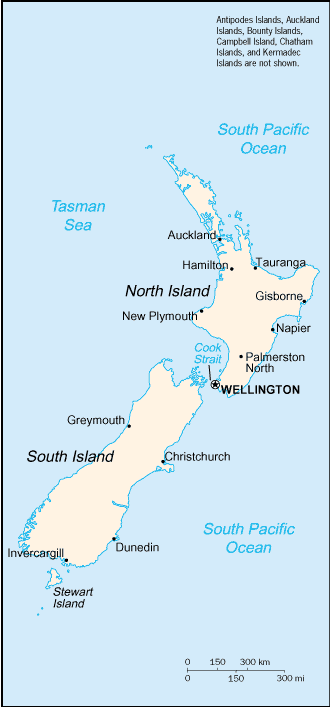
- Capital
- Wellington
- Phone Code
- +64
- Voltage
- 230V / 50Hz
- Power Plug
- I
- Phone Jack
- RJ-11
- Currency
- NZD
- Dial-up
- $0.155/min
- WiFi
- $19.95/day
About connectivity in New Zealand
New Zealand uses 230V/50Hz with the Type I plug shared with Australia. The phone jack is RJ-11, with older installations sometimes retaining the BT-style connector. The New Zealand Post Office was split in 1987 into NZ Post (postal), PostBank (banking), and Telecom New Zealand (telecom); Telecom NZ was privatized in 1990 in a sale to a Bell Atlantic / Ameritech consortium. Structural separation in 2011 split the network business as Chorus from the retail business renamed Spark in 2014. Vodafone NZ (now One NZ), 2degrees (founded 2009), and Orcon compete in the consumer market.
New Zealand's University of Waikato established the country's first international Internet connection in 1989, making NZ one of the earliest non-US Internet nodes in the Asia-Pacific region. Commercial dial-up began in 1992-1993 with Actrix, Voyager New Zealand, Internet Company of New Zealand (ICONZ), and Telecom NZ's Xtra (launched 1996). Per-minute metered access through Telecom NZ's PSTN dominated the late 1990s. ADSL rollout from Telecom NZ in 1999 began the broadband transition, although the country's historic structural-separation debate kept retail competition relatively muted until the 2011 Chorus split. The Ultra-Fast Broadband program, launched in 2009 and largely completed by 2022, drove near-universal fiber availability.
Telecom New Zealand introduced its Phonecard system in 1989, with cardphone units rolling out across Auckland, Wellington, Christchurch, and the regional centers. The Telecom NZ commemorative card collector market developed substantially through the 1990s and 2000s with thousands of distinct designs commissioned. The prepaid international calling-card market reflected New Zealand's immigration patterns — Samoan, Tongan, Niuean, Cook Islander, Fijian, Chinese, Indian, Korean, and South African communities all sustained per-destination card brands. Spark / Telecom NZ payphones, distinctive in yellow-and-blue branding, were largely retired through the 2010s.
Tempest Telecom served New Zealand through dial-up POPs in Auckland, Wellington, Christchurch, Hamilton, and Dunedin. The country's mountainous South Island terrain and remote subantarctic territories (Stewart Island, the Chathams) made it a strong Iridium satphone market for forestry, conservation, and tourism customers. Antarctic-bound expeditions departing Christchurch were also Tempest BGAN and Iridium subscribers.
Modern New Zealand has near-universal fiber coverage under the Ultra-Fast Broadband program, with 5G in major cities from Spark and Vodafone NZ.
Tempest's services across New Zealand, 1997–2012
Tempest Telecommunications operated international connectivity services in New Zealand between 1997 and 2012 under a unified prepaid account that absorbed multiple service types onto a single customer credential. Customers in New Zealand drew from the same balance for pre-paid international voice calling, RADIUS-authenticated dial-up Internet roaming, metered Wi-Fi hotspot access, Iridium satellite voice, and Inmarsat BGAN data terminals. The PATN kiosk-card clearinghouse (Tempest's TITAN kiOSK, incorporated 2000) extended the same card-and-PIN model to public Internet terminals but did not reach scale.
Iridium satellite voice was available in New Zealand from approximately 2001 (post-bankruptcy relaunch). Thuraya coverage did not extend to New Zealand; Inmarsat BGAN data terminals filled the broadband gap from late 2005.
Nearby countries in Oceania
Marshall Islands · Micronesia · Nauru · New Caledonia · Papua New Guinea · Solomon Islands · Tonga · Vanuatu