


India
Power & telecom standards in India
Connectivity Overview
Tempest Telecom offered dial-up internet access, WiFi hotspot access and broadband ethernet access in India. We also offered Iridium satellite Internet and Voice access in India for communications in rural areas without infrastructure.
India uses 230V at 50Hz. Power outlets are type C, D, M and telephone jacks are RJ-11.
Dial-up Internet Access
Tempest Telecom provided local dial-up access numbers in India at $0.155/minute. Travelers could connect using any standard modem with an RJ-11 telephone adapter.
WiFi Hotspot Access
Tempest Telecom provided WiFi hotspot access in India at $19.95/day for unlimited browsing.
Adapters & Power
Travelers from North America will need a power plug adapter. European Type C/F adapters are widely compatible.
Standard RJ-11 jacks are used. Most international modems will connect without an adapter.
India at a Glance
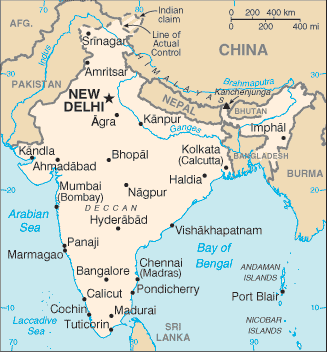
- Capital
- New Delhi
- Phone Code
- +91
- Voltage
- 230V / 50Hz
- Power Plug
- C, D, M
- Phone Jack
- RJ-11
- Currency
- Rupee
- Dial-up
- $0.155/min
- WiFi
- $19.95/day
About connectivity in India
India uses 230V/50Hz with Type C, Type D, and Type M outlets — universal Indian sockets typically accept all three. The phone jack is RJ-11. The Indian telecom landscape was historically split between DoT (Department of Telecommunications, the domestic operator), MTNL (Delhi and Mumbai metropolitan service from 1986), and VSNL (Videsh Sanchar Nigam Limited, the international-gateway monopoly until 2002). The 1999 New Telecom Policy opened the market to private competition; BSNL (Bharat Sanchar Nigam Limited) absorbed DoT's domestic operations in 2000. Mobile competition includes Bharti Airtel, Vodafone Idea, BSNL, and Reliance Jio — the 2016 Jio launch dramatically accelerated mobile-data adoption.
India's first commercial dial-up Internet service was VSNL's GIAS (Gateway Internet Access Service), launched 15 August 1995. Private competition followed through the New Telecom Policy: Satyam Infoway (Sify) launched 1996-1997, Bharti BT, Mantra Online, Net4India, and dozens of regional ISPs filled out the market through the late 1990s. Per-minute metered access over DoT/MTNL/BSNL PSTN dominated; international bandwidth scarcity kept prices high through the late 1990s. The cybercafe model thrived through the early-to-mid 2000s — Reliance WebWorld's nationwide chain plus countless independent operators made internet access economically viable for the majority of urban Indians who couldn't afford home subscriptions. BSNL's DataOne ADSL launched in 2005 began the broadband transition; Reliance Jio's 2016 launch dropped mobile data prices to among the world's lowest, completing the displacement of legacy access models.
India operated one of the world's most distinctive public-telecom retail networks — the PCO (Public Call Office), identified by yellow-painted signage with STD/ISD designations (Subscriber Trunk Dialing for domestic long-distance, International Subscriber Dialing for international). PCO booths were ubiquitous in cities, towns, and villages from the 1980s through the 2000s, often serving a single phone line with an attendant operator metering calls and collecting payment per minute. The Indian outbound calling-card market through the 1990s and 2000s was among the world's largest in absolute volume, driven by the Indian diaspora to the Gulf states (UAE, Saudi Arabia, Oman, Qatar, Kuwait, Bahrain), the UK, US, Canada, Australia, Singapore, and Malaysia — dozens of branded prepaid international cards competed at per-destination per-minute rates sold through Indian-grocery and convenience-store networks across the receiving countries. PCO booths and the cardphone market collapsed across the late 2000s and early 2010s as mobile penetration saturated.
Tempest Telecom served India through dial-up POPs in Mumbai, Delhi, Bangalore, Chennai, Kolkata, Hyderabad, and Pune. India was a heavy Iridium satphone market — the Himalayan trekking industry, the maritime services sector around Mumbai and Chennai, and energy-sector customers in the Northeast all relied on Tempest's satellite voice and data.
Modern India has the world's lowest mobile-data prices, near-universal 4G LTE coverage, and rapidly expanding 5G in metro areas. Fiber-to-the-home deployment is concentrated in major cities; JioFiber and Airtel Xstream are the main FTTH players.
Tempest's services across India, 1997–2012
Tempest Telecommunications operated international connectivity services in India between 1997 and 2012 under a unified prepaid account that absorbed multiple service types onto a single customer credential. Customers in India drew from the same balance for pre-paid international voice calling, RADIUS-authenticated dial-up Internet roaming, metered Wi-Fi hotspot access, Iridium and Thuraya satellite voice, and Inmarsat BGAN and Thuraya data terminals. The PATN kiosk-card clearinghouse (Tempest's TITAN kiOSK, incorporated 2000) extended the same card-and-PIN model to public Internet terminals but did not reach scale.
Both Iridium (global LEO) and Thuraya (regional GEO) satellite voice were available in India from approximately 2001, alongside global BGAN data from late 2005.
Nearby countries in Asia
China · East Timor · Georgia · Hong Kong · Indonesia · Japan · Kazakhstan · Korea. South