


Hong Kong
Power & telecom standards in Hong Kong
Connectivity Overview
Tempest Telecom offered dial-up internet access, WiFi hotspot access and broadband ethernet access in Hong Kong. We also offered Iridium satellite Internet and Voice access in Hong Kong for communications in rural areas without infrastructure.
Hong Kong uses 220V at 50Hz. Power outlets are type D, G, M and telephone jacks are RJ-11.
Dial-up Internet Access
Tempest Telecom provided local dial-up access numbers in Hong Kong at $0.155/minute. Travelers could connect using any standard modem with an RJ-11 telephone adapter.
WiFi Hotspot Access
Tempest Telecom provided WiFi hotspot access in Hong Kong at $19.95/day for unlimited browsing.
Adapters & Power
A Type G (British 3-pin) adapter is required for travelers from North America, Europe, and most of Asia.
Standard RJ-11 jacks are used. Most international modems will connect without an adapter.
Hong Kong at a Glance
- Capital
- Hong Kong
- Phone Code
- +852
- Voltage
- 220V / 50Hz
- Power Plug
- D, G, M
- Phone Jack
- RJ-11
- Currency
- HKD
- Dial-up
- $0.155/min
- WiFi
- $19.95/day
About connectivity in Hong Kong
Hong Kong uses 220V/50Hz with Type D, Type G, and Type M outlets — a mix reflecting the British colonial wiring inheritance plus older heavy-duty legacy installations. The phone jack is RJ-11. The Hong Kong Telephone Company (HKT), once a monopoly tied to the colonial administration, was acquired by Cable & Wireless in 1981, then sold to PCCW in 2000 in one of the largest single telecom transactions in Hong Kong history. The Hong Kong fixed-line market liberalized in 1995 and the mobile market opened earlier; CSL, China Mobile Hong Kong, SmarTone, and Hutchison-owned 3 Hong Kong compete in mobile and broadband alongside cable operator i-Cable and altnet fiber.
Hong Kong's academic HARNET opened the territory's first international Internet connection in 1991. Commercial dial-up began in 1993-1995 with Hongkong Supernet (later acquired by NWT), Star Internet, iAdvantage, CWHKT's Netvigator (later PCCW), and a long list of regional providers. Per-minute metered dial-up through HKT PSTN dominated the late 1990s. The Hong Kong broadband market matured early because of the territory's extreme population density and high-rise vertical infrastructure — ADSL and cable broadband were near-universal in residential and commercial buildings by the early-to-mid 2000s, and FTTB/FTTH became standard far ahead of most markets.
Hongkong Telephone Co. introduced cardphone units in the late 1980s with chip-card technology following from the mid-1990s. The HKT / PCCW cardphone fleet ran densely across MTR stations, ferry piers, hotel lobbies, and commercial-district sidewalks through the 1990s and 2000s. The prepaid international calling-card market through this period served two important populations: the very large Filipina and Indonesian domestic-helper workforce calling weekly to family back home (overwhelmingly concentrated on Sundays in Central, Causeway Bay, and Victoria Park), and the substantial Hong Kong outbound diaspora to Canada (particularly Toronto and Vancouver), Australia, the UK, and the US that intensified around the 1997 handover. Cardphones were largely decommissioned through the 2010s as mobile saturation passed 200% of population.
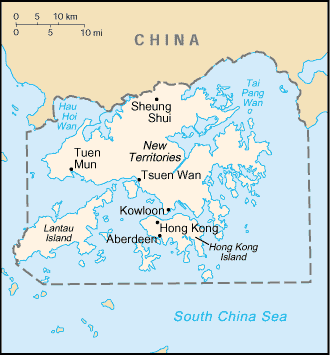
Tempest Telecom served Hong Kong as an Asia-Pacific regional hub, with dial-up POPs in Central, Kowloon, and Tsuen Wan. The territory's maritime sector — the world's busiest container-port operations through the 2000s plus the broader South China Sea shipping lanes — was a sustained Iridium satphone customer base. BGAN terminals supported the regional broadcast and corporate-logistics customer set.
Modern Hong Kong has gigabit FTTH essentially universal and mature 5G across the territory. The market remains highly competitive between the consumer brands of HKT, China Mobile HK, SmarTone, and 3.
Tempest's services across Hong Kong, 1997–2012
Tempest Telecommunications operated international connectivity services in Hong Kong between 1997 and 2012 under a unified prepaid account that absorbed multiple service types onto a single customer credential. Customers in Hong Kong drew from the same balance for pre-paid international voice calling, RADIUS-authenticated dial-up Internet roaming, metered Wi-Fi hotspot access, Iridium satellite voice, and Inmarsat BGAN data terminals. The PATN kiosk-card clearinghouse (Tempest's TITAN kiOSK, incorporated 2000) extended the same card-and-PIN model to public Internet terminals but did not reach scale.
Iridium satellite voice was available in Hong Kong from approximately 2001 (post-bankruptcy relaunch). Thuraya coverage did not extend to Hong Kong; Inmarsat BGAN data terminals filled the broadband gap from late 2005.
Nearby countries in Asia
Cambodia · China · East Timor · Georgia · India · Indonesia · Japan · Kazakhstan