


Kazakhstan
Power & telecom standards in Kazakhstan
Connectivity Overview
Tempest Telecom offered dial-up internet access, WiFi hotspot access and broadband ethernet access in Kazakhstan. We also offered Iridium satellite Internet and Voice access in Kazakhstan for communications in rural areas without infrastructure.
Kazakhstan uses 220V at 50Hz. Power outlets are type C, F and telephone jacks are RJ-11.
Dial-up Internet Access
Tempest Telecom provided local dial-up access numbers in Kazakhstan at $0.155/minute. Travelers could connect using any standard modem with an RJ-11 telephone adapter.
WiFi Hotspot Access
Tempest Telecom provided WiFi hotspot access in Kazakhstan at $19.95/day for unlimited browsing.
Adapters & Power
Travelers from North America will need a power plug adapter. European Type C/F adapters are widely compatible.
Standard RJ-11 jacks are used. Most international modems will connect without an adapter.
Kazakhstan at a Glance
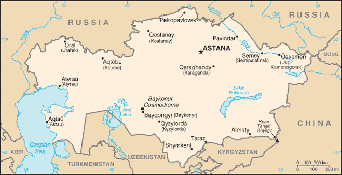
- Capital
- Astana
- Phone Code
- +7
- Voltage
- 220V / 50Hz
- Power Plug
- C, F
- Phone Jack
- RJ-11
- Currency
- Tenge
- Dial-up
- $0.155/min
- WiFi
- $19.95/day
About connectivity in Kazakhstan
Kazakhstan uses 220V/50Hz with Type C and Type F outlets, consistent with European/post-Soviet norms. The phone jack is RJ-11. Kazakhtelecom, the post-1991 successor to the Soviet-era Kazakh SSR PTT operations, was partially privatized through the 2000s and remains majority state-controlled. The mobile market is dominated by Tele2/Altel (the 2016 Kcell-Altel merged operator), Beeline Kazakhstan (Veon's subsidiary), and Mobile Telecom Service (formerly Kcell).
Kazakhstan's academic KazRENA network provided early Internet connectivity from the mid-1990s. Commercial dial-up began through 1995-1997 with Nursat (an early dominant Kazakh ISP), Bilim Telecom, Asylkanat, KazNet, and a long list of regional providers. Per-minute metered dial-up through Kazakhtelecom PSTN dominated the late 1990s. ADSL rollout from Kazakhtelecom began in 2003-2004 and broadband adoption accelerated through the 2010s. The country's vast territory (one of the world's ten largest by area) and sparse rural population make terrestrial broadband coverage uneconomic outside major cities, with mobile and satellite supplementing fixed infrastructure.
Kazakhtelecom introduced cardphone units in the 1990s with chip-card cardphones becoming standard. The Kazakh prepaid international calling-card market through the 2000s and 2010s served the very large Kazakh diaspora — particularly the historic ethnic-German (the post-1991 Aussiedler repatriation), Russian (the largest single ethnic group outside Kazakhstan), Korean (Koryo-saram, the post-WWII deportation community), and Polish populations — plus substantial Kazakh outbound labor migration to Russia and South Korea. Kazakhtelecom payphone fleets across Almaty, Astana (now Nur-Sultan / Astana again after a 2022 rename reversal), and the regional centers have been progressively decommissioned through the 2010s.
Tempest Telecom served Kazakhstan through dial-up POPs in Almaty and Astana. The country's vast energy sector — particularly the Tengiz and Karachaganak oil-and-gas fields in the western Caspian region — was a heavyweight Iridium satphone customer base, with multinational consortium operators (Chevron, ExxonMobil, Eni, Shell, CNPC) all running satellite voice and BGAN data through Tempest contracts. The Tian Shan and Altai mountain expedition customer base added further satellite demand.
Modern Kazakhstan has expanding FTTH in Almaty, Astana, and the regional capitals with 5G rollout beginning in major cities. Mobile coverage is good in populated areas, less so across the steppe interior.
Tempest's services across Kazakhstan, 1997–2012
Tempest Telecommunications operated international connectivity services in Kazakhstan between 1997 and 2012 under a unified prepaid account that absorbed multiple service types onto a single customer credential. Customers in Kazakhstan drew from the same balance for pre-paid international voice calling, RADIUS-authenticated dial-up Internet roaming, metered Wi-Fi hotspot access, Iridium and Thuraya satellite voice, and Inmarsat BGAN and Thuraya data terminals. The PATN kiosk-card clearinghouse (Tempest's TITAN kiOSK, incorporated 2000) extended the same card-and-PIN model to public Internet terminals but did not reach scale.
Both Iridium (global LEO) and Thuraya (regional GEO) satellite voice were available in Kazakhstan from approximately 2001, alongside global BGAN data from late 2005.
Nearby countries in Asia
Hong Kong · India · Indonesia · Japan · Korea. South · Kyrgyzstan · Laos · Macau