


Korea. South
Power & telecom standards in Korea. South
Connectivity Overview
Tempest Telecom offered dial-up internet access, WiFi hotspot access, toll-free dial-up access and broadband ethernet access in Korea. South. We also offered Iridium satellite Internet and Voice access in Korea. South for communications in rural areas without infrastructure.
Korea. South uses 220V at 60Hz. Power outlets are type C, F and telephone jacks are RJ-11.
Dial-up Internet Access
Tempest Telecom provided local dial-up access numbers in Korea. South at $0.155/minute. Toll-free numbers were also available at $.30/minute. Travelers could connect using any standard modem with an RJ-11 telephone adapter.
WiFi Hotspot Access
Tempest Telecom provided WiFi hotspot access in Korea. South at $19.95/day for unlimited browsing.
Adapters & Power
Travelers from North America will need a power plug adapter. European Type C/F adapters are widely compatible.
Standard RJ-11 jacks are used. Most international modems will connect without an adapter.
Korea. South at a Glance
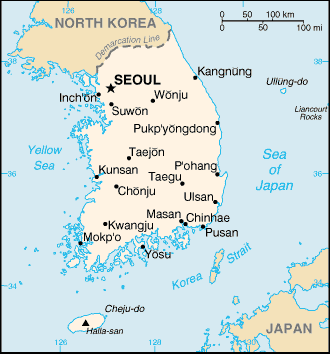
- Capital
- Seoul
- Phone Code
- +82
- Voltage
- 220V / 60Hz
- Power Plug
- C, F
- Phone Jack
- RJ-11
- Currency
- Won
- Dial-up
- $0.155/min
- WiFi
- $19.95/day
About connectivity in Korea. South
South Korea (Republic of Korea) uses 220V/60Hz — unique in the world for combining the European 220V level with the North American 60Hz frequency. Outlets are Type C and Type F. The phone jack is RJ-11. KT (originally the Korea Telecom Authority, established 1981 from the Ministry of Communications, fully privatized in 2002), SK Telecom, and LG U+ dominate the carrier market.
Korea's pre-Internet online services era was unusually dynamic. Hitel (KT's dial-up videotex), Chollian (Korea PC Telecom), Nownuri (Naray Information & Communication), and Unitel (Samsung SDS) built large subscriber bases throughout the late 1980s and early 1990s — closed-network online services analogous to Compuserve and AOL but with substantial Korean-language content ecosystems. Commercial Internet emerged through KORNET (Korea Telecom, 1994), Hanaro Telecom, and Onse Telecom. The defining moment was Hanaro Telecom's 1999 launch of xDSL services with aggressively low pricing — combined with the Korean government's dense apartment-building (apatu) urban structure, this triggered the fastest national broadband rollout the world had seen, with Korea overtaking the US in broadband penetration per capita by 2001. Consumer dial-up was effectively dead by 2003.
Korea Telecom introduced its Korea Telecom Card cardphone system in the late 1980s, with cardphones rolling out densely across Seoul, Busan, Incheon, Daegu, and the regional commercial centers. Magnetic-stripe initially, with chip-card cardphones following from the mid-1990s. The Korean commemorative phonecard collector market was active through the cardphone era. The prepaid international calling-card market through the 2000s served the global Korean diaspora — Korean-American (particularly Los Angeles and the New York Metropolitan Area), Korean-Canadian, Korean-Australian, Korean-Japanese (Zainichi), and the Korean-Chinese (Joseonjok) populations — alongside the Vietnamese, Filipino, Thai, and Chinese migrant-worker communities in Korea. Cardphone fleets were largely decommissioned through the 2010s as mobile penetration saturated and KT pivoted resources to 4G/5G rollout.
Tempest Telecom served South Korea through dial-up POPs in Seoul, Busan, Incheon, and Daegu. WiFi hotspot access at $19.95/day expanded as Seoul Metro, KTX high-speed rail, and major hotel chains deployed wireless — South Korea was one of the earliest broadband-leadership markets globally. Iridium satphones served maritime customers (Korean shipping fleets) and the meaningful number of Korean engineers/contractors operating overseas.
Modern South Korea has the world's most mature 5G deployment and gigabit-class FTTH essentially universal. The country pioneered consumer broadband through the 2000s and remains a leader in next-generation network standards.
Tempest's services across Korea. South, 1997–2012
Tempest Telecommunications operated international connectivity services in Korea. South between 1997 and 2012 under a unified prepaid account that absorbed multiple service types onto a single customer credential. Customers in Korea. South drew from the same balance for pre-paid international voice calling, RADIUS-authenticated dial-up Internet roaming, metered Wi-Fi hotspot access, Iridium satellite voice, and Inmarsat BGAN data terminals. The PATN kiosk-card clearinghouse (Tempest's TITAN kiOSK, incorporated 2000) extended the same card-and-PIN model to public Internet terminals but did not reach scale.
Iridium satellite voice was available in Korea. South from approximately 2001 (post-bankruptcy relaunch). Thuraya coverage did not extend to Korea. South; Inmarsat BGAN data terminals filled the broadband gap from late 2005.
Nearby countries in Asia
India · Indonesia · Japan · Kazakhstan · Kyrgyzstan · Laos · Macau · Malaysia