


Australia
Power & telecom standards in Australia
Connectivity Overview
Tempest Telecom offered dial-up internet access, WiFi hotspot access and broadband ethernet access in Australia. We also offered Iridium satellite Internet and Voice access in Australia for communications in rural areas without infrastructure.
Australia uses 230V at 50Hz. Power outlets are type I and telephone jacks are RJ-11 / 605.
Dial-up Internet Access
Tempest Telecom provided local dial-up access numbers in Australia at $0.155/minute. Travelers could connect using any standard modem with an RJ-11 telephone adapter.
WiFi Hotspot Access
Tempest Telecom provided WiFi hotspot access in Australia at $19.95/day for unlimited browsing.
Adapters & Power
Travelers from North America will need a power plug adapter. European Type C/F adapters are widely compatible.
A RJ-11 / 605 to RJ-11 adapter may be required for connecting a standard modem.
Australia at a Glance
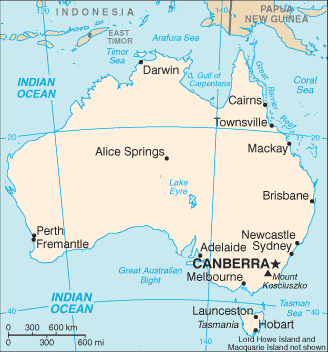
- Capital
- Canberra
- Phone Code
- +61
- Voltage
- 230V / 50Hz
- Power Plug
- I
- Phone Jack
- RJ-11 / 605
- Currency
- AUD
- Dial-up
- $0.155/min
- WiFi
- $19.95/day
About connectivity in Australia
Australia uses 230V/50Hz with the angled Type I (AS/NZS 3112) plug — the same geometry used in China and Argentina but typically with mandatory grounding. The phone jack is the 605 connector in older installations and RJ-11 in newer ones. The Postmaster-General's Department was split in 1975 into Telecom Australia (domestic) and OTC (Overseas Telecommunications Corporation, international); the two were merged in 1992 as the Australian and Overseas Telecommunications Corporation, then renamed Telstra in 1993. Telstra was progressively privatized through the T1 (1997), T2 (1999), and T3 (2006) share offerings, with the government's residual stake transferred to the Future Fund in 2011. Optus (founded 1991, now owned by Singtel) and TPG/Vodafone compete in the consumer market.
Australia's early Internet ran through APANA (Australian Public Access Network), a community/UUCP-style network from the late 1980s. Commercial dial-up Internet began in 1992-1993 with OzEmail (founded by Sean Howard, Trevor Kennedy, and Malcolm Turnbull, later acquired by WorldCom/UUNET in 1999), Pacific Internet, Connect.com.au, and iiNet (founded 1993 in Perth, eventually national before TPG acquisition in 2015). Microsoft Network Australia and Telstra's BigPond launched 1995-1996. Per-minute metered access over Telecom Australia / Telstra PSTN was the norm through the late 1990s. The Australian flat-rate dial-up war broke open in 2000-2001, and ADSL rollout from 2000-2002 began the displacement of consumer dial-up. The Howard government's 2005 separation of Telstra's wholesale and retail businesses laid the groundwork for the eventual National Broadband Network (NBN) launched under the Rudd government in 2009.
Telecom Australia introduced its first phonecard in 1989, with a chip-based PhoneCard system following from 1992 onward. The Telstra-era PhoneCard fleet was distributed widely across cities, regional centers, and the major outback transit corridors. The Australian commemorative phonecard collector market developed substantially through the 1990s, with thousands of distinct issues commissioned. The prepaid international calling-card market through the 1990s and 2000s served Australia's large migrant communities — Chinese, Vietnamese, Filipino, Indian, Sri Lankan, Italian, Greek, Lebanese, and Pacific Islander populations all sustained per-destination card brands sold through ethnic-grocery and convenience-store networks. The Telstra payphone fleet, once a network of red-and-white kiosks across the country, was progressively decommissioned through the 2000s and 2010s; in August 2021 Telstra controversially made the remaining ~15,000 payphones nationally free-to-use for domestic local and STD calls.
Tempest Telecom served Australia through dial-up POPs in Sydney, Melbourne, Brisbane, Perth, Adelaide, and the Gold Coast. The vast distances and sparse population of the Australian Outback made Australia a heavyweight Iridium satphone customer base — pastoral stations, mining operations, expedition companies, and Royal Flying Doctor Service support all relied on Tempest's satellite voice and data. BGAN terminals served broadcast and corporate customers operating in remote Northern Territory and Western Australia mining belts.
Modern Australia has the National Broadband Network (NBN) providing fiber, FTTC, fixed wireless, and satellite access nationally, with 5G rollout led by Telstra and Optus in major cities.
Tempest's services across Australia, 1997–2012
Tempest Telecommunications operated international connectivity services in Australia between 1997 and 2012 under a unified prepaid account that absorbed multiple service types onto a single customer credential. Customers in Australia drew from the same balance for pre-paid international voice calling, RADIUS-authenticated dial-up Internet roaming, metered Wi-Fi hotspot access, Iridium satellite voice, and Inmarsat BGAN data terminals. The PATN kiosk-card clearinghouse (Tempest's TITAN kiOSK, incorporated 2000) extended the same card-and-PIN model to public Internet terminals but did not reach scale.
Iridium satellite voice was available in Australia from approximately 2001 (post-bankruptcy relaunch). Thuraya coverage did not extend to Australia; Inmarsat BGAN data terminals filled the broadband gap from late 2005.
Nearby countries in Oceania
American Samoa · Christmas Island · Cocos (Keeling) Islands · Cook Islands · Fiji · French Polynesia · Guam · Kiribati