


Japan
Power & telecom standards in Japan
Connectivity Overview
Tempest Telecom offered dial-up internet access, WiFi hotspot access, toll-free dial-up access and broadband ethernet access in Japan. We also offered Iridium satellite Internet and Voice access in Japan for communications in rural areas without infrastructure.
Japan uses 100V at 50/60Hz. Power outlets are type A, B and telephone jacks are RJ-11.
Dial-up Internet Access
Tempest Telecom provided local dial-up access numbers in Japan at $0.155/minute. Toll-free numbers were also available at $.30/minute. Travelers could connect using any standard modem with an RJ-11 telephone adapter.
WiFi Hotspot Access
Tempest Telecom provided WiFi hotspot access in Japan at $19.95/day for unlimited browsing.
Adapters & Power
North American (Type A/B) plugs are compatible. An adapter may not be needed for US travelers.
Standard RJ-11 jacks are used. Most international modems will connect without an adapter.
Japan at a Glance
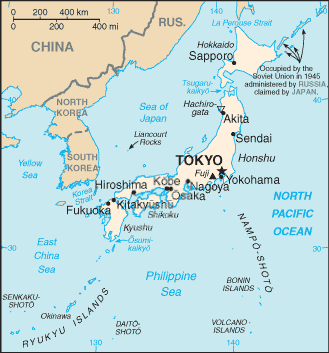
- Capital
- Tokyo
- Phone Code
- +81
- Voltage
- 100V / 50/60Hz
- Power Plug
- A, B
- Phone Jack
- RJ-11
- Currency
- Yen
- Dial-up
- $0.155/min
- WiFi
- $19.95/day
About connectivity in Japan
Japan is the only major country running on 100V — Eastern Japan at 50Hz, Western Japan at 60Hz, with the divide running roughly along the Fujikawa River through central Honshu. Outlets are Type A and Type B, the North American flat-pin standard (though Japanese Type A is symmetrical, not polarised). The phone jack is RJ-11. NTT (Nippon Telegraph and Telephone), privatized in 1985 and structurally split in 1999 into NTT East, NTT West, NTT Docomo, and NTT Communications, remains the dominant carrier, alongside KDDI (au), SoftBank, and the more recent Rakuten Mobile.
Japan's online-services era predated the public Internet. Nifty-Serve (a Fujitsu-Nissho Iwai joint venture, launched commercially in 1987) and NEC's PC-VAN (1986) built large subscriber bases on closed online platforms throughout the late 1980s and early 1990s — the Japanese equivalents of the closed online services that dominated the United States (Compuserve, AOL) and South Korea (Hitel, Chollian, Nownuri) in the same era. IIJ (Internet Initiative Japan) opened Japan's first commercial Internet gateway in 1992-1993. NTT's OCN consumer Internet service launched in 1996 and rapidly became the country's largest dial-up ISP. The truly disruptive moment came in 2001 when SoftBank's Yahoo! BB introduced extremely aggressive flat-rate ADSL pricing, triggering a price war that drove Japan from one of the world's slower broadband markets to one of the fastest within five years. Consumer dial-up faded rapidly across the early 2000s.
Japan was historically the world's most card-driven phone-call market. NTT introduced the terehon kaado (テレホンカード) in 1982 — magnetic-stripe prepaid cards that became one of the most prolific commemorative-collectible markets in any consumer category. Businesses, schools, professional sports teams, anime and manga properties, regional tourism boards, and advertising campaigns all commissioned custom Telephone Card designs; the dedicated reference catalogue runs to tens of thousands of distinct issues. Cards were available in vending machines on every Japan Railways platform alongside drinks and snacks. Japan, almost uniquely among developed economies, has maintained a meaningful public payphone network — the 2011 Tōhoku earthquake reaffirmed NTT's green kōshū denwa (公衆電話) payphones as critical disaster-redundancy infrastructure when cellular networks failed under load. Modest payphone density continues in train stations, public buildings, and earthquake-preparedness sites.
Tempest Telecom served Japan through dial-up POPs in Tokyo, Osaka, Nagoya, Fukuoka, and Sapporo, with metered access at $0.155/minute and toll-free options at $0.30/minute through KDDI's international gateway. WiFi hotspot access at $19.95/day became significant as JR (Japan Railways) rolled out station and Shinkansen WiFi, and as Japan's hotel chains and Narita/Haneda airport facilities deployed wireless. Tempest's Iridium 9505A handsets served business customers traveling to remote Hokkaido and offshore Pacific island operations, with voice and data minutes drawing from the same unified prepaid balance as the customer's dial-up and Wi-Fi usage.
Modern Japan has nearly universal fiber-to-the-home (NTT FLET'S, KDDI au Hikari, others) and mature 5G nationwide. The iconic green NTT public payphone survives in low-density placement — one of the few developed economies maintaining a meaningful public payphone network for emergency redundancy.
Tempest's services across Japan, 1997–2012
Tempest Telecommunications operated international connectivity services in Japan between 1997 and 2012 under a unified prepaid account that absorbed multiple service types onto a single customer credential. Customers in Japan drew from the same balance for pre-paid international voice calling, RADIUS-authenticated dial-up Internet roaming, metered Wi-Fi hotspot access, Iridium satellite voice, and Inmarsat BGAN data terminals. The PATN kiosk-card clearinghouse (Tempest's TITAN kiOSK, incorporated 2000) extended the same card-and-PIN model to public Internet terminals but did not reach scale.
Iridium satellite voice was available in Japan from approximately 2001 (post-bankruptcy relaunch). Thuraya coverage did not extend to Japan; Inmarsat BGAN data terminals filled the broadband gap from late 2005.
Nearby countries in Asia
Georgia · Hong Kong · India · Indonesia · Kazakhstan · Korea. South · Kyrgyzstan · Laos