


Laos
Power & telecom standards in Laos
Connectivity Overview
Tempest Telecom offered dial-up internet access, WiFi hotspot access and broadband ethernet access in Laos. We also offered Iridium satellite Internet and Voice access in Laos for communications in rural areas without infrastructure.
Laos uses 230V at 50Hz. Power outlets are type A, B, C, E, F and telephone jacks are RJ-11.
Dial-up Internet Access
Tempest Telecom provided local dial-up access numbers in Laos at $0.255/minute. Travelers could connect using any standard modem with an RJ-11 telephone adapter.
WiFi Hotspot Access
Tempest Telecom provided WiFi hotspot access in Laos at $19.95/day for unlimited browsing.
Adapters & Power
North American (Type A/B) plugs are compatible. An adapter may not be needed for US travelers.
Standard RJ-11 jacks are used. Most international modems will connect without an adapter.
Laos at a Glance
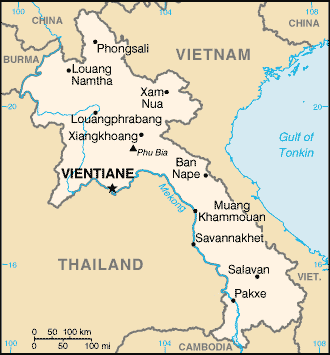
- Capital
- Vientiane
- Phone Code
- +856
- Voltage
- 230V / 50Hz
- Power Plug
- A, B, C, E, F
- Phone Jack
- RJ-11
- Currency
- Kip
- Dial-up
- $0.255/min
- WiFi
- $19.95/day
About connectivity in Laos
Laos uses 230V/50Hz with Type A, Type B, Type C, Type E, and Type F outlets — an unusual five-type mix reflecting layered French colonial-era wiring (Type C/E/F), post-1975 Soviet-Vietnamese influence, and modern American-standard tourism-zone installations. The phone jack is RJ-11. The Lao telecom sector is state-controlled through Lao Telecom (a joint venture with the Lao government and Thai partners), with Unitel (a Viettel-Lao joint venture), ETL Mobile, and Beeline Lao competing in mobile.
Lao commercial Internet emerged in 2001 through Lao Telecom, with state-controlled access through the early 2000s. International bandwidth was historically routed via Thailand and Vietnam. Mobile data has driven essentially all of Laos's recent Internet-access growth; Unitel's aggressive rural rollout (modeled on Viettel's Vietnamese network-densification approach) substantially expanded coverage through the 2010s. Lao Internet is subject to government content controls and periodic shutdowns during political tension.
Lao cardphone deployment was modest. The Lao prepaid international calling-card market through the 2000s and 2010s served the substantial outbound Lao diaspora — concentrated in Thailand (the historic and ongoing labor-migration destination across the Mekong River border, with hundreds of thousands of Lao workers in Bangkok and the northeastern Thai provinces), the United States (the post-1975 refugee community, particularly in California, Minnesota, and the Pacific Northwest), France (the colonial-era diaspora community), and Australia.
Tempest Telecom served Laos through dial-up POPs in Vientiane. The Mekong River fishing-and-trading industry, the Plain of Jars archaeological-research customer base, NGO operators working unexploded-ordnance clearance operations (Laos remains one of the most heavily bombed countries per capita from the Vietnam War era), and tourism operators across Luang Prabang and Vang Vieng all sustained Iridium and BGAN customer demand.
Modern Laos has expanding 4G LTE coverage in Vientiane and the regional centers; FTTH is concentrated in the capital. The country's topography and continuing political environment shape ongoing infrastructure investment.
Tempest's services across Laos, 1997–2012
Tempest Telecommunications operated international connectivity services in Laos between 1997 and 2012 under a unified prepaid account that absorbed multiple service types onto a single customer credential. Customers in Laos drew from the same balance for pre-paid international voice calling, RADIUS-authenticated dial-up Internet roaming, metered Wi-Fi hotspot access, Iridium satellite voice, and Inmarsat BGAN data terminals. The PATN kiosk-card clearinghouse (Tempest's TITAN kiOSK, incorporated 2000) extended the same card-and-PIN model to public Internet terminals but did not reach scale.
Iridium satellite voice was available in Laos from approximately 2001 (post-bankruptcy relaunch). Thuraya coverage did not extend to Laos; Inmarsat BGAN data terminals filled the broadband gap from late 2005.
Nearby countries in Asia
Japan · Kazakhstan · Korea. South · Kyrgyzstan · Macau · Malaysia · Maldives · Mongolia