


Mongolia
Power & telecom standards in Mongolia
Connectivity Overview
Tempest Telecom offered dial-up internet access, WiFi hotspot access and broadband ethernet access in Mongolia. We also offered Iridium satellite Internet and Voice access in Mongolia for communications in rural areas without infrastructure.
Mongolia uses 220V at 50Hz. Power outlets are type C, E and telephone jacks are RJ-11.
Dial-up Internet Access
Tempest Telecom provided local dial-up access numbers in Mongolia at $0.255/minute. Travelers could connect using any standard modem with an RJ-11 telephone adapter.
WiFi Hotspot Access
Tempest Telecom provided WiFi hotspot access in Mongolia at $19.95/day for unlimited browsing.
Adapters & Power
Travelers from North America will need a power plug adapter. European Type C/F adapters are widely compatible.
Standard RJ-11 jacks are used. Most international modems will connect without an adapter.
Mongolia at a Glance
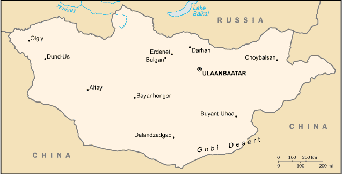
- Capital
- Ulaanbaatar
- Phone Code
- +976
- Voltage
- 220V / 50Hz
- Power Plug
- C, E
- Phone Jack
- RJ-11
- Currency
- Tugrik
- Dial-up
- $0.255/min
- WiFi
- $19.95/day
About connectivity in Mongolia
Mongolia uses 220V/50Hz with Type C and Type E outlets — the European/post-Soviet standard. The phone jack is RJ-11. Mongolia Telecom, the post-1995 successor to the state operator, was partially privatized through the 2000s. The mobile market is contested by MobiCom Corporation (founded 1995 as Mongolia's first mobile operator, a Newcom-led venture), Unitel (founded 2005), G-Mobile, and Skytel.
Mongolia's academic and commercial Internet emerged in 1995-1996 through MagicNet, Datacom, and several regional ISPs. Per-minute metered dial-up through Mongolia Telecom PSTN dominated the late 1990s. The country's vast territory (~1.5 million square kilometers with only ~3.5 million population — one of the lowest population densities in the world) makes terrestrial broadband uneconomic outside Ulaanbaatar and the regional aimag capitals; satellite and mobile data infrastructure carry most of the country's Internet access. The 2010s saw aggressive 3G/4G rollout that dramatically expanded rural connectivity.
Mongolian cardphone deployment was modest. The prepaid international calling-card market through the 2000s and 2010s served the substantial outbound Mongolian labor migration — concentrated in South Korea (the largest Mongolian community outside Mongolia and China's Inner Mongolia, particularly in Seoul where Mongolian workers concentrate in service sectors), Japan, Kazakhstan, Russia, the United States, Germany, and Australia. Card brands targeting Mongolian destinations sold through small networks in the receiving countries.
Tempest Telecom served Mongolia through dial-up POPs in Ulaanbaatar. The country's vast Gobi Desert, the Altai Mountains, and the broader steppe-and-nomadic-herder customer base made Mongolia a meaningful Iridium satphone market — the mining sector (particularly Oyu Tolgoi copper-gold mine and the Tavan Tolgoi coal operations), the cashmere-herding cooperatives, archaeological-research operators across the broader Mongol heritage sites, and expedition crews supporting Gobi traversal operations all sustained satellite demand.
Modern Mongolia has expanding 4G LTE coverage with FTTH concentrated in Ulaanbaatar. The country's topography and population dispersion continue to make satellite and mobile infrastructure central to broader-than-metropolitan connectivity.
Tempest's services across Mongolia, 1997–2012
Tempest Telecommunications operated international connectivity services in Mongolia between 1997 and 2012 under a unified prepaid account that absorbed multiple service types onto a single customer credential. Customers in Mongolia drew from the same balance for pre-paid international voice calling, RADIUS-authenticated dial-up Internet roaming, metered Wi-Fi hotspot access, Iridium and Thuraya satellite voice, and Inmarsat BGAN and Thuraya data terminals. The PATN kiosk-card clearinghouse (Tempest's TITAN kiOSK, incorporated 2000) extended the same card-and-PIN model to public Internet terminals but did not reach scale.
Both Iridium (global LEO) and Thuraya (regional GEO) satellite voice were available in Mongolia from approximately 2001, alongside global BGAN data from late 2005.
Nearby countries in Asia
Laos · Macau · Malaysia · Maldives · Nepal · Pakistan · Philippines · Singapore