


Philippines
Power & telecom standards in Philippines
Connectivity Overview
Tempest Telecom offered dial-up internet access, WiFi hotspot access and broadband ethernet access in Philippines. We also offered Iridium satellite Internet and Voice access in Philippines for communications in rural areas without infrastructure.
Philippines uses 220V at 60Hz. Power outlets are type A, B, C and telephone jacks are RJ-11.
Dial-up Internet Access
Tempest Telecom provided local dial-up access numbers in Philippines at $0.155/minute. Travelers could connect using any standard modem with an RJ-11 telephone adapter.
WiFi Hotspot Access
Tempest Telecom provided WiFi hotspot access in Philippines at $19.95/day for unlimited browsing.
Adapters & Power
North American (Type A/B) plugs are compatible. An adapter may not be needed for US travelers.
Standard RJ-11 jacks are used. Most international modems will connect without an adapter.
Philippines at a Glance
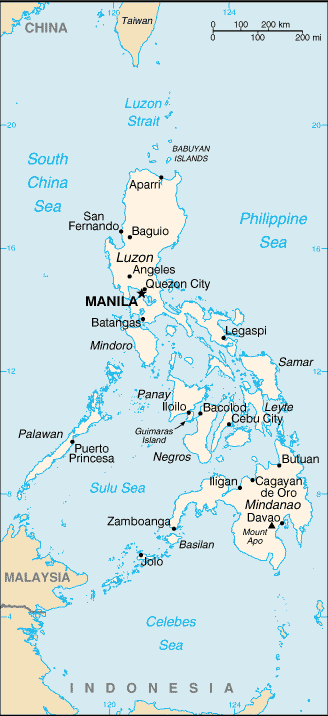
- Capital
- Manila
- Phone Code
- +63
- Voltage
- 220V / 60Hz
- Power Plug
- A, B, C
- Phone Jack
- RJ-11
- Currency
- Peso
- Dial-up
- $0.155/min
- WiFi
- $19.95/day
About connectivity in Philippines
The Philippines uses 220V/60Hz with Type A, Type B, and Type C outlets — the country's American-influenced electrical infrastructure (a colonial legacy) combined with European-standard adoption in modern installations. The phone jack is RJ-11. PLDT (Philippine Long Distance Telephone Company, founded 1928 under American colonial administration) held a near-monopoly on Philippine fixed-line telecom for decades. The 1995 Public Telecommunications Policy Act opened mobile competition, with Smart Communications (now part of PLDT), Globe Telecom, and DITO Telecommunity (third operator, launched 2021 as China Telecom partner) dominating the modern mobile market.
The Philippines academic ASTI (Advanced Science and Technology Institute) opened the country's first international Internet connection in March 1994 from the Department of Science and Technology. Commercial dial-up emerged in 1994-1995 with Mosaic Communications, Philonline, MozCom, NetGenesis, and a long list of regional ISPs. Per-minute metered dial-up through PLDT PSTN dominated the late 1990s. PLDT's SmartBro mobile-broadband service from the mid-2000s helped offset the country's historically weak fixed-line broadband; mobile data dominates Philippine Internet access today, with the fiber rollout (PLDT's Home Fibr, Converge ICT, Globe at Home) accelerating only since the mid-2010s.
PLDT introduced cardphone units in the 1990s with chip-card cardphones becoming standard, though the cardphone market was modest in scale — mobile prepaid airtime quickly became the dominant prepaid market in the Philippines, with PLDT's Smart Money mobile-payment system from the early 2000s anticipating the broader mobile-money pattern that took hold across Asia and Africa over the next decade. The Philippine prepaid international calling-card market through the 1990s, 2000s, and 2010s was among the world's largest, driven by the very large Overseas Filipino Worker (OFW) population — an estimated 10+ million Filipinos work and live abroad at any given time, concentrated in Saudi Arabia, the UAE, Hong Kong (the Sunday Statue Square gathering of Filipina domestic helpers is a defining Hong Kong sociological feature), Singapore, Malaysia, Japan, Italy, the United States, and Canada. Card brands targeting Philippine destinations sold through dense Filipino-grocery and convenience-store networks in receiving countries.
Tempest Telecom served the Philippines through dial-up POPs in Manila, Cebu, and Davao. The Philippine archipelago's 7,000+ islands made the country a meaningful Iridium satphone market — maritime industries across the Sulu Sea, Mindanao archeological work, NGO operators across the typhoon-recovery customer base, and offshore-energy contractors in Palawan all sustained satellite voice and BGAN data demand.
Modern Philippines has aggressive 5G rollout from Smart, Globe, and DITO in Metro Manila, Cebu, and other major cities. FTTH from PLDT, Converge, and Globe is expanding rapidly but lagged the regional curve substantially through the 2010s.
Tempest's services across Philippines, 1997–2012
Tempest Telecommunications operated international connectivity services in Philippines between 1997 and 2012 under a unified prepaid account that absorbed multiple service types onto a single customer credential. Customers in Philippines drew from the same balance for pre-paid international voice calling, RADIUS-authenticated dial-up Internet roaming, metered Wi-Fi hotspot access, Iridium satellite voice, and Inmarsat BGAN data terminals. The PATN kiosk-card clearinghouse (Tempest's TITAN kiOSK, incorporated 2000) extended the same card-and-PIN model to public Internet terminals but did not reach scale.
Iridium satellite voice was available in Philippines from approximately 2001 (post-bankruptcy relaunch). Thuraya coverage did not extend to Philippines; Inmarsat BGAN data terminals filled the broadband gap from late 2005.
Nearby countries in Asia
Maldives · Mongolia · Nepal · Pakistan · Singapore · Sri Lanka · Taiwan · Tajikistan