


Saudi Arabia
Power & telecom standards in Saudi Arabia
Connectivity Overview
Tempest Telecom offered dial-up internet access, WiFi hotspot access and broadband ethernet access in Saudi Arabia. We also offered Iridium satellite Internet and Voice access in Saudi Arabia for communications in rural areas without infrastructure.
Saudi Arabia uses 220V at 60Hz. Power outlets are type A, B, G and telephone jacks are RJ-11.
Dial-up Internet Access
Tempest Telecom provided local dial-up access numbers in Saudi Arabia at $0.155/minute. Travelers could connect using any standard modem with an RJ-11 telephone adapter.
WiFi Hotspot Access
Tempest Telecom provided WiFi hotspot access in Saudi Arabia at $19.95/day for unlimited browsing.
Adapters & Power
North American (Type A/B) plugs are compatible. An adapter may not be needed for US travelers.
Standard RJ-11 jacks are used. Most international modems will connect without an adapter.
Saudi Arabia at a Glance
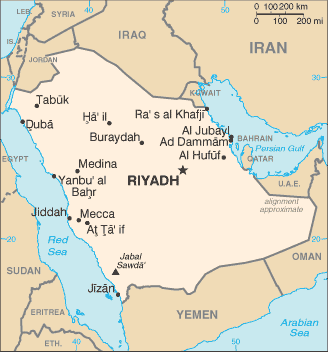
- Capital
- Riyadh
- Phone Code
- +966
- Voltage
- 220V / 60Hz
- Power Plug
- A, B, G
- Phone Jack
- RJ-11
- Currency
- Riyal
- Dial-up
- $0.155/min
- WiFi
- $19.95/day
About connectivity in Saudi Arabia
Saudi Arabia uses 220V/60Hz (unusual frequency for a 220V country) with Type A, Type B, and Type G outlets. The phone jack is RJ-11. STC (Saudi Telecom Company), corporatized in 1998 from the Ministry of Posts, Telegraphs and Telephones and partially privatized from 2002, dominates the market. Mobily (Etihad Etisalat, launched 2005) and Zain Saudi Arabia (launched 2008) compete in the mobile and broadband markets. The Communications, Space & Technology Commission (CST) regulates.
Saudi Arabia's academic KFUPM (King Fahd University of Petroleum and Minerals) opened the country's first international Internet connection in 1994, with public commercial Internet not following until 1999 — an unusually controlled rollout designed to allow time to build out the content-filtering infrastructure (the King Abdulaziz City for Science and Technology / KACST proxy regime). Per-minute metered dial-up through STC PSTN was the norm through the early 2000s. STC's ADSL service rolled out from 2002-2003 and broadband adoption accelerated through the 2010s under the Vision 2030 telecom-infrastructure investment program. 4G LTE and 5G rollouts have been aggressive in the major cities.
STC introduced cardphone units in the 1990s with chip-card cardphones standardizing through the late 1990s. The Saudi prepaid international calling-card market through the 1990s, 2000s, and 2010s was among the largest in the world by absolute call volume, driven by the country's very large expatriate workforce — Pakistani, Indian, Bangladeshi, Sri Lankan, Filipino, Indonesian, Sudanese, Egyptian, Yemeni, Eritrean, and Syrian migrant labor populations sustained per-destination card brands sold through grocery stores and dedicated calling-card shops in labor districts across Riyadh, Jeddah, Dammam, and Mecca. STC payphone units across the cities and along the Hajj pilgrimage routes were progressively decommissioned through the 2010s.
Tempest Telecom served Saudi Arabia through dial-up POPs in Riyadh, Jeddah, Dammam, and Mecca/Medina (with appropriate religious-pilgrimage compliance during Hajj seasons). Saudi Arabia was an enormous Iridium satphone customer base — Aramco operations, the broader oil-and-gas industry across the Eastern Province, expedition crews working the Empty Quarter (Rub' al Khali), and pilgrimage logistics all relied on Tempest's satellite voice and data.
Modern Saudi Arabia has aggressive 5G deployment under Vision 2030, with NEOM and other megaprojects driving next-generation network development.
Tempest's services across Saudi Arabia, 1997–2012
Tempest Telecommunications operated international connectivity services in Saudi Arabia between 1997 and 2012 under a unified prepaid account that absorbed multiple service types onto a single customer credential. Customers in Saudi Arabia drew from the same balance for pre-paid international voice calling, RADIUS-authenticated dial-up Internet roaming, metered Wi-Fi hotspot access, Iridium and Thuraya satellite voice, and Inmarsat BGAN and Thuraya data terminals. The PATN kiosk-card clearinghouse (Tempest's TITAN kiOSK, incorporated 2000) extended the same card-and-PIN model to public Internet terminals but did not reach scale.
Both Iridium (global LEO) and Thuraya (regional GEO) satellite voice were available in Saudi Arabia from approximately 2001, alongside global BGAN data from late 2005.
Nearby countries in Middle East
Kuwait · Lebanon · Oman · Qatar · Syria · Turkey · United Arab Emirates · Yemen