


Kuwait
Power & telecom standards in Kuwait
Connectivity Overview
Tempest Telecom offered dial-up internet access, WiFi hotspot access and broadband ethernet access in Kuwait. We also offered Iridium satellite Internet and Voice access in Kuwait for communications in rural areas without infrastructure.
Kuwait uses 240V at 50Hz. Power outlets are type C, G and telephone jacks are RJ-11.
Dial-up Internet Access
Tempest Telecom provided local dial-up access numbers in Kuwait at $0.155/minute. Travelers could connect using any standard modem with an RJ-11 telephone adapter.
WiFi Hotspot Access
Tempest Telecom provided WiFi hotspot access in Kuwait at $19.95/day for unlimited browsing.
Adapters & Power
A Type G (British 3-pin) adapter is required for travelers from North America, Europe, and most of Asia.
Standard RJ-11 jacks are used. Most international modems will connect without an adapter.
Kuwait at a Glance
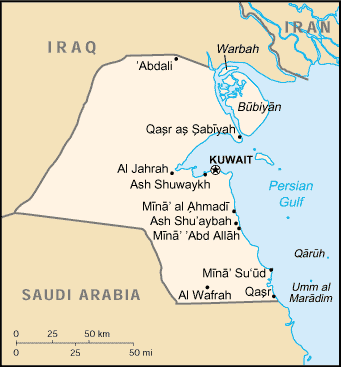
- Capital
- Kuwait City
- Phone Code
- +965
- Voltage
- 240V / 50Hz
- Power Plug
- C, G
- Phone Jack
- RJ-11
- Currency
- Dinar
- Dial-up
- $0.155/min
- WiFi
- $19.95/day
About connectivity in Kuwait
Kuwait uses 240V/50Hz with Type C and Type G outlets — a legacy of British colonial wiring standards from the pre-1961 Protectorate era. The phone jack is RJ-11. The Kuwaiti telecom sector is contested by Zain Kuwait (founded 1983 as MTC, Kuwait's first mobile operator, rebranded Zain in 2007), Ooredoo Kuwait (the post-Wataniya Telecom Qatari Ooredoo subsidiary), and STC Kuwait (the Saudi Telecom subsidiary, formerly Viva). The Communications and Information Technology Regulatory Authority (CITRA) regulates.
Kuwait's commercial Internet emerged in 1992 through Kuwait Telecommunication Company (KTC, the state operator) as the sole licensed ISP through the late 1990s. The 1990-1991 Iraqi invasion and Gulf War disrupted Kuwaiti telecom infrastructure substantially, with the immediate post-war period focused on reconstruction. Multiple private ISPs were licensed from the early 2000s. ADSL rollout from KTC and competitors began in 2002 and broadband adoption accelerated through the 2010s. Mobile data dominates current Internet access; Kuwait has one of the highest mobile penetration rates in the world per capita.
KTC introduced cardphone units in the 1990s with chip-card cardphones becoming standard. The Kuwaiti prepaid international calling-card market through the 2000s and 2010s was substantial per-capita, driven by the very large expatriate workforce that comprises approximately 70% of Kuwait's ~4.5 million population. South Asian (Indian, Pakistani, Bangladeshi, Sri Lankan, Nepalese), Filipino, Egyptian, Syrian, and Lebanese migrant-labor populations sustained per-destination card brands sold through dense expatriate-shop networks across Kuwait City and the regional governorates.
Tempest Telecom served Kuwait through dial-up POPs in Kuwait City. The post-1990-91 reconstruction period generated substantial customer demand from defense contractors, NGO operators, and broadcast journalists; subsequent ongoing operations in support of the broader regional security framework continued through the 2000s and 2010s. The offshore oil-and-gas sector (Kuwait holds approximately 6% of the world's proven oil reserves, with substantial Burgan Field operations) added further satellite-voice and BGAN data customer demand.
Modern Kuwait has expanding FTTH coverage in Kuwait City with mature 4G LTE / 5G nationally. The country's small geographic footprint and concentrated urbanization allow for relatively dense fixed-line coverage where deployed.
Tempest's services across Kuwait, 1997–2012
Tempest Telecommunications operated international connectivity services in Kuwait between 1997 and 2012 under a unified prepaid account that absorbed multiple service types onto a single customer credential. Customers in Kuwait drew from the same balance for pre-paid international voice calling, RADIUS-authenticated dial-up Internet roaming, metered Wi-Fi hotspot access, Iridium and Thuraya satellite voice, and Inmarsat BGAN and Thuraya data terminals. The PATN kiosk-card clearinghouse (Tempest's TITAN kiOSK, incorporated 2000) extended the same card-and-PIN model to public Internet terminals but did not reach scale.
Both Iridium (global LEO) and Thuraya (regional GEO) satellite voice were available in Kuwait from approximately 2001, alongside global BGAN data from late 2005.
Nearby countries in Middle East
Iran · Iraq · Israel · Jordan · Lebanon · Oman · Qatar · Saudi Arabia