


Jordan
Power & telecom standards in Jordan
Connectivity Overview
Tempest Telecom offered dial-up internet access, WiFi hotspot access and broadband ethernet access in Jordan. We also offered Iridium satellite Internet and Voice access in Jordan for communications in rural areas without infrastructure.
Jordan uses 230V at 50Hz. Power outlets are type B, C, D, F, G, J and telephone jacks are RJ-11.
Dial-up Internet Access
Tempest Telecom provided local dial-up access numbers in Jordan at $0.155/minute. Travelers could connect using any standard modem with an RJ-11 telephone adapter.
WiFi Hotspot Access
Tempest Telecom provided WiFi hotspot access in Jordan at $19.95/day for unlimited browsing.
Adapters & Power
North American (Type A/B) plugs are compatible. An adapter may not be needed for US travelers.
Standard RJ-11 jacks are used. Most international modems will connect without an adapter.
Jordan at a Glance
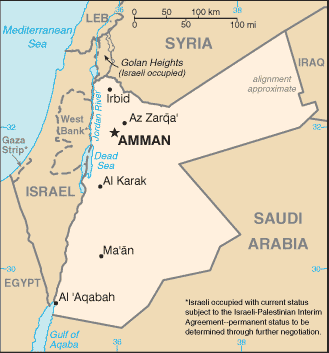
- Capital
- Amman
- Phone Code
- +962
- Voltage
- 230V / 50Hz
- Power Plug
- B, C, D, F, G, J
- Phone Jack
- RJ-11
- Currency
- Dinar
- Dial-up
- $0.155/min
- WiFi
- $19.95/day
About connectivity in Jordan
Jordan uses 230V/50Hz with Type B, Type C, Type D, Type F, Type G, and Type J outlets — an unusual six-type mix reflecting layered British Mandate-era, post-independence, and modern installations. The phone jack is RJ-11, with some legacy buildings retaining the Jordanian connector. Jordan Telecom (JT), the post-1995 successor to the state Telecommunications Corporation, was partially acquired by France Télécom / Orange in 2000 with majority Orange ownership from 2006. The mobile market is contested between Orange Jordan, Zain Jordan (the post-2003 rebrand of Fastlink), and Umniah.
Jordan's academic NIC (National Information Center) opened the country's first international Internet connection in the mid-1990s. Commercial dial-up emerged in 1996-1997 with Jordan Telecom's Index service, Cyberia Jordan, NETS, NOL, and a long list of regional providers. Per-minute metered dial-up through JT PSTN was the norm through the late 1990s and early 2000s. ADSL rollout from Jordan Telecom and competitors began in 2003-2004. Mobile data and 4G LTE have driven most of the country's Internet-access growth since the 2010s.
Cardphone deployment in Jordan was modest in scale compared to larger regional peers, with mobile prepaid airtime becoming the dominant prepaid market. The Jordanian prepaid international calling-card market through the 2000s served the substantial Palestinian-Jordanian diaspora calling family across the West Bank, Gaza, the Gulf states, the United States, and Latin America — Jordan hosts one of the world's largest Palestinian populations (an estimated 2+ million Palestinian-origin Jordanians, plus successive waves of Palestinian refugees). The country's very large Iraqi (post-2003 displacement) and Syrian (post-2011 displacement) refugee populations also sustained per-destination card brands sold through neighborhood shops across Amman, Zarqa, Irbid, and the broader Jordan Valley. Jordan Telecom payphone fleets have been progressively decommissioned through the 2010s.
Tempest Telecom served Jordan through dial-up POPs in Amman and Aqaba. Iridium satphones served the desert and Wadi Rum expedition customer base, the Red Sea maritime industry around Aqaba, archaeological and tourism operators around Petra, and humanitarian customers operating in the Iraqi, Palestinian, and Syrian refugee-camp environments.
Modern Jordan has expanding FTTH coverage in Amman and the regional centers with 4G LTE essentially universal and 5G rollout beginning in major cities.
Tempest's services across Jordan, 1997–2012
Tempest Telecommunications operated international connectivity services in Jordan between 1997 and 2012 under a unified prepaid account that absorbed multiple service types onto a single customer credential. Customers in Jordan drew from the same balance for pre-paid international voice calling, RADIUS-authenticated dial-up Internet roaming, metered Wi-Fi hotspot access, Iridium and Thuraya satellite voice, and Inmarsat BGAN and Thuraya data terminals. The PATN kiosk-card clearinghouse (Tempest's TITAN kiOSK, incorporated 2000) extended the same card-and-PIN model to public Internet terminals but did not reach scale.
Both Iridium (global LEO) and Thuraya (regional GEO) satellite voice were available in Jordan from approximately 2001, alongside global BGAN data from late 2005.
Nearby countries in Middle East
Bahrain · Iran · Iraq · Israel · Kuwait · Lebanon · Oman · Qatar