


Iraq
Power & telecom standards in Iraq
Connectivity Overview
Tempest Telecom offered satellite-only service in Iraq. Iridium satellite Internet and Voice access was available for communications in rural areas without infrastructure.
Iraq uses 230V at 50Hz. Power outlets are type C, D, G and telephone jacks are RJ-11.
Dial-up Internet Access
Dial-up access was not available in Iraq. Satellite Internet was the recommended alternative.
WiFi Hotspot Access
WiFi hotspot access was not available through Tempest in Iraq.
Adapters & Power
A Type G (British 3-pin) adapter is required for travelers from North America, Europe, and most of Asia.
Standard RJ-11 jacks are used. Most international modems will connect without an adapter.
Iraq at a Glance
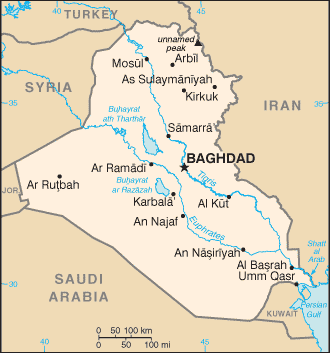
- Capital
- Baghdad
- Phone Code
- +964
- Voltage
- 230V / 50Hz
- Power Plug
- C, D, G
- Phone Jack
- RJ-11
- Currency
- Dinar
- Dial-up
- N/A
- WiFi
- N/A
About connectivity in Iraq
Iraq uses 230V/50Hz with Type C, Type D, and Type G outlets — a mix reflecting layered British colonial-era (Type D/G from the Mandate period), post-1958 European-standard, and modern installations. The phone jack is RJ-11. The Iraqi telecom sector was rebuilt almost from scratch following the 2003 US-led invasion that toppled the Saddam Hussein regime — pre-2003 fixed-line operations through the Iraqi Telecommunications and Post Company (ITPC) were limited and tightly controlled. The post-2003 mobile market was contested by Asiacell, Korek Telecom, and Zain Iraq (originally MTC Atheer), with rapid rollout transforming Iraqi connectivity through the 2000s.
Iraq's pre-2003 commercial Internet access was extremely limited, with state-controlled cybercafes and government-monitored access through Uruk Net providing the only available channels. Post-2003 Internet liberalization came rapidly, with multiple ISPs (Earthlink Telecommunications Iraq, Newroz Telecom in Kurdistan, AsiaCell's data services) entering through 2003-2005. The 2003-2011 occupation period and subsequent post-2014 ISIS conflict period repeatedly disrupted Iraqi telecom infrastructure, with the Kurdistan Regional Government's operations in Erbil, Sulaymaniyah, and Duhok operating under different regulatory frameworks than federal Iraq. Mobile data dominates current Internet access, with periodic Internet shutdowns during political tension.
Iraqi cardphone deployment was limited under the Saddam era and only modestly expanded post-2003. The Iraqi prepaid international calling-card market through the 2000s and 2010s served the very large post-2003 Iraqi diaspora — concentrated in Sweden (one of the largest Iraqi communities in Europe, particularly in Södertälje which became known as "Little Baghdad"), Germany, the Netherlands, the United Kingdom, the United States (Detroit-area Chaldean community, Phoenix, San Diego), Jordan (which has hosted enormous Iraqi refugee populations across multiple displacement waves), and Iran. Card brands targeting Iraqi-Arabic, Kurdish, and Assyrian-Aramaic destinations sold through Middle Eastern grocery networks in the receiving countries.
Tempest Telecom served Iraq through dial-up POPs in Baghdad, Basra, and Erbil. The 2003-2011 occupation period and subsequent counterinsurgency operations generated enormous demand for Iridium and Thuraya satellite voice and BGAN data from international broadcast journalists (the Green Zone press corps), defense contractors (DynCorp, Blackwater/Academi, KBR), humanitarian operators across the displacement-camp customer base, and the oil-and-gas reconstruction logistics customer base across the southern Iraqi fields and the Kurdish region — all billed through the same unified prepaid account that handled the customer's voice and dial-up usage elsewhere.
Modern Iraq has expanding mobile-data coverage with 4G LTE in major cities; FTTH is concentrated in Baghdad and the Kurdistan Region cities. The country's post-conflict reconstruction continues to shape telecom-infrastructure investment.
Tempest's services across Iraq, 1997–2012
Tempest Telecommunications operated international connectivity services in Iraq between 1997 and 2012 under a unified prepaid account that absorbed multiple service types onto a single customer credential. Customers in Iraq drew from the same balance for pre-paid international voice calling, RADIUS-authenticated dial-up Internet roaming, metered Wi-Fi hotspot access, Iridium and Thuraya satellite voice, and Inmarsat BGAN and Thuraya data terminals. The PATN kiosk-card clearinghouse (Tempest's TITAN kiOSK, incorporated 2000) extended the same card-and-PIN model to public Internet terminals but did not reach scale.
Both Iridium (global LEO) and Thuraya (regional GEO) satellite voice were available in Iraq from approximately 2001, alongside global BGAN data from late 2005.
Nearby countries in Middle East
Bahrain · Iran · Israel · Jordan · Kuwait · Lebanon · Oman · Qatar