


Israel
Power & telecom standards in Israel
Connectivity Overview
Tempest Telecom offered dial-up internet access, WiFi hotspot access, toll-free dial-up access and broadband ethernet access in Israel. We also offered Iridium satellite Internet and Voice access in Israel for communications in rural areas without infrastructure.
Israel uses 230V at 50Hz. Power outlets are type C, H, M and telephone jacks are RJ-11.
Dial-up Internet Access
Tempest Telecom provided local dial-up access numbers in Israel at $0.155/minute. Toll-free numbers were also available at $.30/minute. Travelers could connect using any standard modem with an RJ-11 telephone adapter.
WiFi Hotspot Access
Tempest Telecom provided WiFi hotspot access in Israel at $19.95/day for unlimited browsing.
Adapters & Power
Travelers from North America will need a power plug adapter. European Type C/F adapters are widely compatible.
Standard RJ-11 jacks are used. Most international modems will connect without an adapter.
Israel at a Glance
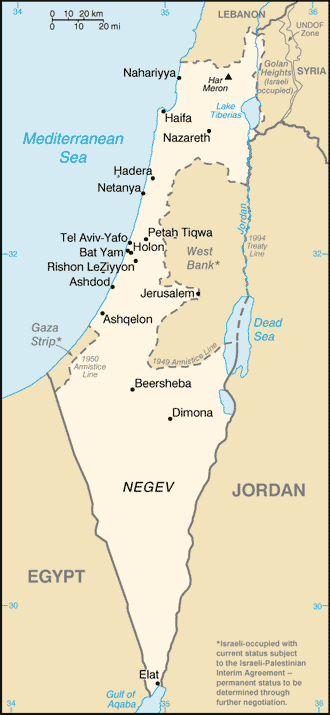
- Capital
- Jerusalem
- Phone Code
- +972
- Voltage
- 230V / 50Hz
- Power Plug
- C, H, M
- Phone Jack
- RJ-11
- Currency
- Shekel
- Dial-up
- $0.155/min
- WiFi
- $19.95/day
About connectivity in Israel
Israel uses 230V/50Hz with the Israeli Type H (SI 32) outlet — though most modern Israeli sockets are universal, accepting Type C Europlugs as well. The phone jack is RJ-11. Bezeq, founded in 1984 as the privatized fixed-line successor to the Israeli Postal Service's telecom operations, remains the dominant landline operator. Cellcom (1994), Pelephone (1986, originally a Bezeq-Motorola joint venture), and Partner Communications (1998, marketed as Orange Israel for many years) dominate mobile, alongside HOT Mobile (the cable operator's mobile arm).
Israel's academic ILAN (Israeli Academic Network) opened the country's first international Internet connection in 1989. Commercial dial-up began in 1992-1993 with NetVision (a long-running Israeli ISP), Internet Gold, Aquanet, and Bezeq International (Bezeq's consumer ISP). Per-minute metered dial-up through Bezeq PSTN dominated the late 1990s. ADSL rollout from Bezeq began in 2000, with cable broadband from HOT competing from 2001 onward. Israel has consistently ranked in the top tier of OECD broadband markets since the mid-2000s, with the country's technology sector driving sophisticated network-infrastructure investment.
Bezeq introduced its chip-card cardphone system in the early 1990s with the orange-and-blue Israeli payphone kiosks rolling out across Tel Aviv, Jerusalem, Haifa, Beersheba, and the regional centers. Israeli payphone units historically had a distinctive triangular plastic token (the asimon) used before the chip-card transition. The Israeli prepaid international calling-card market through the 1990s and 2000s reflected the country's unusually heavy international diaspora and migrant-labor calling patterns — outbound calling to North American, European, South African, Latin American, and Australian Jewish communities, and inbound calling for the substantial Filipino, Thai, Nepalese, Chinese, and African migrant-labor populations. Bezeq payphone fleets across the country have been progressively decommissioned through the 2010s.
Tempest Telecom served Israel through dial-up POPs in Tel Aviv, Jerusalem, Haifa, and Beersheba. The Negev Desert, the Judean Desert, and maritime operations in the Eastern Mediterranean were significant Iridium satphone markets — agricultural research stations, kibbutz operations in remote areas, and the broader Israeli technology sector's international travel needs all drove Tempest service usage.
Modern Israel has dense FTTH coverage in metro areas and mature 5G from the major operators.
Tempest's services across Israel, 1997–2012
Tempest Telecommunications operated international connectivity services in Israel between 1997 and 2012 under a unified prepaid account that absorbed multiple service types onto a single customer credential. Customers in Israel drew from the same balance for pre-paid international voice calling, RADIUS-authenticated dial-up Internet roaming, metered Wi-Fi hotspot access, Iridium and Thuraya satellite voice, and Inmarsat BGAN and Thuraya data terminals. The PATN kiosk-card clearinghouse (Tempest's TITAN kiOSK, incorporated 2000) extended the same card-and-PIN model to public Internet terminals but did not reach scale.
Both Iridium (global LEO) and Thuraya (regional GEO) satellite voice were available in Israel from approximately 2001, alongside global BGAN data from late 2005.
Nearby countries in Middle East
Bahrain · Iran · Iraq · Jordan · Kuwait · Lebanon · Oman · Qatar