


Lebanon
Power & telecom standards in Lebanon
Connectivity Overview
Tempest Telecom offered dial-up internet access, WiFi hotspot access and broadband ethernet access in Lebanon. We also offered Iridium satellite Internet and Voice access in Lebanon for communications in rural areas without infrastructure.
Lebanon uses 220V at 50Hz. Power outlets are type A, B, C, D, G and telephone jacks are RJ-11.
Dial-up Internet Access
Tempest Telecom provided local dial-up access numbers in Lebanon at $0.155/minute. Travelers could connect using any standard modem with an RJ-11 telephone adapter.
WiFi Hotspot Access
Tempest Telecom provided WiFi hotspot access in Lebanon at $19.95/day for unlimited browsing.
Adapters & Power
North American (Type A/B) plugs are compatible. An adapter may not be needed for US travelers.
Standard RJ-11 jacks are used. Most international modems will connect without an adapter.
Lebanon at a Glance
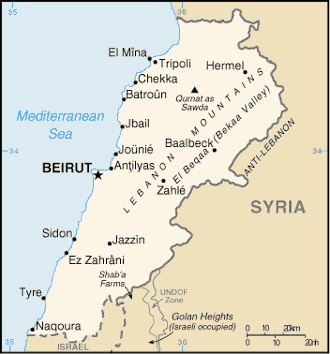
- Capital
- Beirut
- Phone Code
- +961
- Voltage
- 220V / 50Hz
- Power Plug
- A, B, C, D, G
- Phone Jack
- RJ-11
- Currency
- Pound
- Dial-up
- $0.155/min
- WiFi
- $19.95/day
About connectivity in Lebanon
Lebanon uses 220V/50Hz with Type A, Type B, Type C, Type D, and Type G outlets — an unusual five-type mix reflecting layered French Mandate-era, British, Levantine, and modern installations. The phone jack is RJ-11. Ogero, the state-owned fixed-line operator inheriting the Ministry of Posts and Telecommunications infrastructure, handles landlines and international gateway. The mobile market operates under an unusual state-owned-and-managed structure: Alfa (managed by Orange under a management contract) and Touch (managed by Zain under a management contract) are both state-owned with the carriers operating under government oversight.
Lebanon's academic connectivity began in the early-to-mid 1990s through the American University of Beirut and other institutions. Commercial dial-up emerged through 1995-1996 with IDM, Cyberia, Sodetel, and a long list of regional providers. The 2006 Lebanon-Israel war damaged backbone infrastructure significantly. The 2019-onward Lebanese economic and currency crisis — with the Lebanese pound losing more than 95% of its dollar value — has severely disrupted telecom infrastructure investment and consumer affordability; recurring power-grid failures have made even mobile-network operation extraordinarily difficult, with operators running generators continuously and rationing tower coverage in some periods.
Cardphone deployment in Lebanon was relatively limited compared to peer Levantine economies, with mobile prepaid airtime becoming the dominant prepaid market well before cardphones reached comparable scale. The Lebanese prepaid international calling-card market through the 1990s, 2000s, and 2010s was enormous in proportion to the country's resident population (~5 million) because of the historically vast Lebanese diaspora: an estimated 14+ million people of Lebanese descent live abroad, concentrated in Brazil (the largest Lebanese diaspora community in the world, ~6-7 million people of Lebanese origin), Argentina, the United States (Detroit, Brooklyn, Los Angeles, Houston), Australia (Sydney), Canada (Montreal, Toronto), France, Germany, the Gulf states, and West Africa (the Lebanese trader networks across Senegal, Côte d'Ivoire, Sierra Leone, and Nigeria). Card brands targeting Lebanese destinations sold through Lebanese-Arabic grocery and convenience-store networks across receiving countries.
Tempest Telecom served Lebanon through dial-up POPs in Beirut. Iridium satphones served the broadcast and humanitarian customer base across the recurring Lebanese conflict periods, plus the Bekaa Valley agricultural sector and the Cedars mountain operations.
Modern Lebanon has degraded telecom infrastructure relative to historic peer economies due to the post-2019 currency collapse and recurring power-supply failures. Mobile data coverage remains the most reliable Internet-access channel for most Lebanese households.
Tempest's services across Lebanon, 1997–2012
Tempest Telecommunications operated international connectivity services in Lebanon between 1997 and 2012 under a unified prepaid account that absorbed multiple service types onto a single customer credential. Customers in Lebanon drew from the same balance for pre-paid international voice calling, RADIUS-authenticated dial-up Internet roaming, metered Wi-Fi hotspot access, Iridium and Thuraya satellite voice, and Inmarsat BGAN and Thuraya data terminals. The PATN kiosk-card clearinghouse (Tempest's TITAN kiOSK, incorporated 2000) extended the same card-and-PIN model to public Internet terminals but did not reach scale.
Both Iridium (global LEO) and Thuraya (regional GEO) satellite voice were available in Lebanon from approximately 2001, alongside global BGAN data from late 2005.
Nearby countries in Middle East
Iraq · Israel · Jordan · Kuwait · Oman · Qatar · Saudi Arabia · Syria