


Iran
Power & telecom standards in Iran
Connectivity Overview
Tempest Telecom offered satellite-only service in Iran. Iridium satellite Internet and Voice access was available for communications in rural areas without infrastructure.
Iran uses 220V at 50Hz. Power outlets are type C, F and telephone jacks are RJ-11.
Dial-up Internet Access
Dial-up access was not available in Iran. Satellite Internet was the recommended alternative.
WiFi Hotspot Access
WiFi hotspot access was not available through Tempest in Iran.
Adapters & Power
Travelers from North America will need a power plug adapter. European Type C/F adapters are widely compatible.
Standard RJ-11 jacks are used. Most international modems will connect without an adapter.
Iran at a Glance
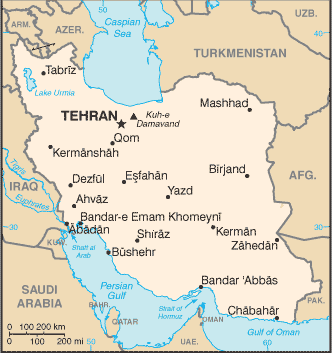
- Capital
- Tehran
- Phone Code
- +98
- Voltage
- 220V / 50Hz
- Power Plug
- C, F
- Phone Jack
- RJ-11
- Currency
- Rial
- Dial-up
- N/A
- WiFi
- N/A
About connectivity in Iran
Iran uses 220V/50Hz with Type C and Type F outlets. The phone jack is RJ-11. TCI (Telecommunications Company of Iran), the post-1971 successor to the Iranian Ministry of Posts, Telegraph and Telephone, was partially privatized in 2009 under the Etemad Mobin consortium. Mobile competition includes MCI Hamrah-e Aval (TCI's subsidiary, founded 1994 as the country's first GSM operator), Irancell (the MTN Iran joint venture founded 2005), and RighTel (the third operator, launched 2011). The Communications Regulatory Authority and the Supreme Council of Cyberspace shape Iranian telecom policy, with sanctions and content-filtering frameworks central to the operational environment.
Iran's academic IPM (Institute for Research in Fundamental Sciences) opened the country's first international Internet connection in 1992 from Tehran. Commercial dial-up began in 1995-1996 with NDA Rayaneh and a small number of state-licensed ISPs. Per-minute metered dial-up through TCI PSTN dominated the late 1990s. The Iranian Internet has been heavily filtered since the early 2000s, with the National Information Network (NIN, the country's domestic intranet) and the Filternet content-control framework defining the access environment. ADSL rolled out from 2002-2003. Sanctions regimes since 2010 (and especially post-2018 under expanded US sanctions) have constrained international bandwidth investment and equipment imports significantly.
TCI introduced cardphone units in the 1990s with chip-card cardphones becoming standard. The Iranian prepaid international calling-card market through the 1990s, 2000s, and 2010s served the very large post-1979 Iranian outbound diaspora — concentrated in Los Angeles (often called "Tehrangeles", hosting one of the world's largest Iranian populations outside Iran), the broader United States, Canada (particularly Toronto and Vancouver), the United Kingdom, Germany, France, Sweden, and Australia. Card brands targeting Iranian-Persian-language destinations sold through Iranian-grocery and convenience-store networks in the receiving countries. TCI payphone fleets across Tehran, Isfahan, Shiraz, and the major regional cities have been progressively decommissioned through the 2010s and 2020s.
Tempest Telecom served Iran through dial-up POPs in Tehran and Isfahan. The country's vast oil-and-gas sector, archaeological-research customer base (Persepolis and other UNESCO sites), and the broader Caspian and Persian Gulf maritime industries were a meaningful Iridium satphone market. Tempest service in Iran was complicated through extended periods by sanctions compliance and licensing requirements, with operations often routed via regional gateway partners.
Modern Iran has expanding mobile-data coverage with 4G LTE across populated areas; 5G rollout has been constrained by sanctions-affected equipment supply. Fixed-line FTTH is concentrated in Tehran and the major provincial capitals.
Tempest's services across Iran, 1997–2012
Tempest Telecommunications operated international connectivity services in Iran between 1997 and 2012 under a unified prepaid account that absorbed multiple service types onto a single customer credential. Customers in Iran drew from the same balance for pre-paid international voice calling, RADIUS-authenticated dial-up Internet roaming, metered Wi-Fi hotspot access, Iridium and Thuraya satellite voice, and Inmarsat BGAN and Thuraya data terminals. The PATN kiosk-card clearinghouse (Tempest's TITAN kiOSK, incorporated 2000) extended the same card-and-PIN model to public Internet terminals but did not reach scale.
Both Iridium (global LEO) and Thuraya (regional GEO) satellite voice were available in Iran from approximately 2001, alongside global BGAN data from late 2005.
Nearby countries in Middle East
Bahrain · Iraq · Israel · Jordan · Kuwait · Lebanon · Oman · Qatar