


Egypt
Power & telecom standards in Egypt
Connectivity Overview
Tempest Telecom offered dial-up internet access, WiFi hotspot access and broadband ethernet access in Egypt. We also offered Iridium satellite Internet and Voice access in Egypt for communications in rural areas without infrastructure.
Egypt uses 220V at 50Hz. Power outlets are type C, F and telephone jacks are RJ-11.
Dial-up Internet Access
Tempest Telecom provided local dial-up access numbers in Egypt at $0.155/minute. Travelers could connect using any standard modem with an RJ-11 telephone adapter.
WiFi Hotspot Access
Tempest Telecom provided WiFi hotspot access in Egypt at $19.95/day for unlimited browsing.
Adapters & Power
Travelers from North America will need a power plug adapter. European Type C/F adapters are widely compatible.
Standard RJ-11 jacks are used. Most international modems will connect without an adapter.
Egypt at a Glance
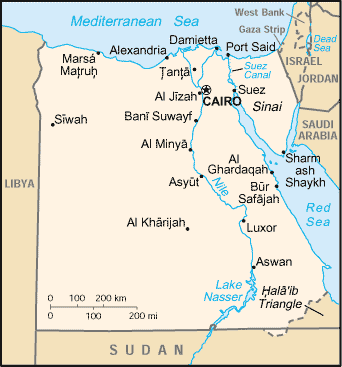
- Capital
- Cairo
- Phone Code
- +20
- Voltage
- 220V / 50Hz
- Power Plug
- C, F
- Phone Jack
- RJ-11
- Currency
- Pound
- Dial-up
- $0.155/min
- WiFi
- $19.95/day
About connectivity in Egypt
Egypt uses 220V/50Hz with Type C and Type F outlets. The phone jack is RJ-11. Telecom Egypt (consumer brand WE since 2017) traces its lineage to the Egyptian Telecommunications Authority. The mobile market is contested between Vodafone Egypt, Orange Egypt (formerly MobiNil), Etisalat Misr, and WE Telecom Egypt (Telecom Egypt's own mobile brand launched 2017). The National Telecommunications Regulatory Authority (NTRA) regulates.
Egypt's academic ENSTINET (Egyptian National Scientific and Technical Information Network) provided early Internet connectivity from the early 1990s. Commercial dial-up emerged through 1995-1996 with Internet Egypt, Soficom, Gega Net, and a long list of regional ISPs operating over Telecom Egypt PSTN lines. The Free Internet initiative launched in January 2002 made dial-up access free (the user paid only the standard local-call rate, with the call revenue then split between Telecom Egypt and the ISPs) — this dramatically expanded Egyptian Internet penetration. ADSL service followed in the mid-2000s. Mobile data and 4G LTE have driven most of the country's Internet-access growth since the 2010s.
Telecom Egypt introduced cardphone units in the 1990s with chip-card cardphones standardizing through the late 1990s. The Egyptian prepaid international calling-card market through the 1990s and 2000s served the substantial Egyptian diaspora — an estimated 10+ million Egyptians live and work abroad, concentrated in the Gulf states (Saudi Arabia, UAE, Kuwait, Qatar), Libya (historically, before the 2011 civil war), Jordan, the United States, Canada, the UK, France, Italy, and Australia. Card brands targeting Egyptian-Arabic destinations sold through neighborhood shops in Cairo, Alexandria, and the Delta provincial centers, plus through Egyptian-grocery networks in the receiving countries. Telecom Egypt payphone units across the major cities have been progressively decommissioned through the 2010s.
Tempest Telecom served Egypt through dial-up POPs in Cairo, Alexandria, Sharm El Sheikh, and Hurghada (the Red Sea tourism hub). Egypt was a strong Iridium satphone market for the Red Sea maritime and diving industries, Suez Canal shipping operations, archaeological expeditions in Upper Egypt and the Western Desert, and Sinai expedition crews. The Sinai region in particular was a heavy BGAN terminal market for media and broadcast crews.
Modern Egypt has expanding 4G LTE coverage with 5G rollout beginning in major cities; FTTH deployment is concentrated in Cairo and Alexandria.
Tempest's services across Egypt, 1997–2012
Tempest Telecommunications operated international connectivity services in Egypt between 1997 and 2012 under a unified prepaid account that absorbed multiple service types onto a single customer credential. Customers in Egypt drew from the same balance for pre-paid international voice calling, RADIUS-authenticated dial-up Internet roaming, metered Wi-Fi hotspot access, Iridium and Thuraya satellite voice, and Inmarsat BGAN and Thuraya data terminals. The PATN kiosk-card clearinghouse (Tempest's TITAN kiOSK, incorporated 2000) extended the same card-and-PIN model to public Internet terminals but did not reach scale.
Both Iridium (global LEO) and Thuraya (regional GEO) satellite voice were available in Egypt from approximately 2001, alongside global BGAN data from late 2005.
Nearby countries in Africa
Comoros · Congo · Congo. Democratic Republic of the · Djibouti · Equatorial Guinea · Eritrea · Ethiopia · Gabon