


Ethiopia
Power & telecom standards in Ethiopia
Connectivity Overview
Tempest Telecom offered satellite-only service in Ethiopia. Iridium satellite Internet and Voice access was available for communications in rural areas without infrastructure.
Ethiopia uses 220V at 50Hz. Power outlets are type C, E, F, L and telephone jacks are RJ-11.
Dial-up Internet Access
Dial-up access was not available in Ethiopia. Satellite Internet was the recommended alternative.
WiFi Hotspot Access
WiFi hotspot access was not available through Tempest in Ethiopia.
Adapters & Power
Travelers from North America will need a power plug adapter. European Type C/F adapters are widely compatible.
Standard RJ-11 jacks are used. Most international modems will connect without an adapter.
Ethiopia at a Glance
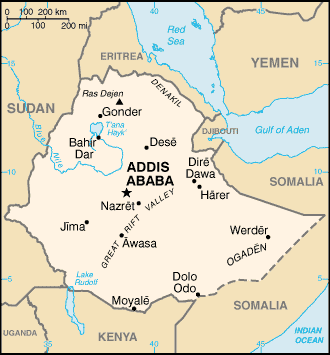
- Capital
- Addis Ababa
- Phone Code
- +251
- Voltage
- 220V / 50Hz
- Power Plug
- C, E, F, L
- Phone Jack
- RJ-11
- Currency
- Birr
- Dial-up
- N/A
- WiFi
- N/A
About connectivity in Ethiopia
Ethiopia uses 220V/50Hz with Type C, Type E, Type F, and Type L outlets — an unusual four-type mix reflecting layered Italian (Type L from the brief 1936-1941 occupation), French-via-other-Africa, and modern European-standard installations. The phone jack is RJ-11. Ethio Telecom, the descendant of the imperial-era postal-telegraph operations through multiple post-1974 nationalizations, held an absolute state monopoly on Ethiopian telecom until 2022, when Safaricom Ethiopia (a Kenyan Safaricom-led consortium including Vodafone, Sumitomo, and CDC Group) launched commercial mobile service as the first private competitor. Ethio Telecom's own partial-privatization process is ongoing.
Ethiopia's academic connectivity began through limited research-network gateways in the late 1990s. Commercial Internet was authorized through Ethio Telecom only, with private ISPs not licensed under the historic monopoly framework. Per-minute metered dial-up through Ethio Telecom PSTN dominated the late 1990s and 2000s. Mobile data has driven essentially all of Ethiopia's recent Internet-access growth since 2010s 3G/4G rollout, with the 2022 Safaricom Ethiopia launch finally introducing meaningful retail competition. Internet access has been intermittently disrupted during the post-2020 Tigray conflict and broader civil unrest, with the government imposing periodic full or partial Internet shutdowns.
Ethio Telecom's cardphone deployment was limited compared to peer East African economies, with mobile prepaid airtime quickly becoming the dominant prepaid product. The Ethiopian prepaid international calling-card market through the 2000s and 2010s served the substantial Ethiopian diaspora — concentrated in the United States (the DC Metropolitan Area, particularly Silver Spring MD; Minneapolis-St. Paul; Seattle; Los Angeles; Atlanta), Saudi Arabia, the UAE, Sudan (historically), Italy (the historic post-WWII Eritrean-Ethiopian community), and the broader Gulf states' migrant-labor receiving countries. Card brands targeting Amharic, Tigrinya, and Oromo destinations sold through Ethiopian-restaurant-and-grocery networks in the receiving countries.
Tempest Telecom served Ethiopia through dial-up POPs in Addis Ababa. Iridium satphones served the very substantial NGO and humanitarian customer base operating across the country (recurring drought-and-famine response operations, refugee-camp coordination in the Somali and Eritrean border regions, post-2020 Tigray conflict humanitarian operations), archaeological-research operators working the Omo Valley and the Danakil Depression, and corporate logistics across the rapidly-expanding flower-export agricultural sector.
Modern Ethiopia has expanding mobile-data coverage with 4G LTE in major cities; the 2022 Safaricom Ethiopia entry is reshaping the previously-monopolistic market. Internet access remains subject to periodic government shutdowns during political tension.
Tempest's services across Ethiopia, 1997–2012
Tempest Telecommunications operated international connectivity services in Ethiopia between 1997 and 2012 under a unified prepaid account that absorbed multiple service types onto a single customer credential. Customers in Ethiopia drew from the same balance for pre-paid international voice calling, RADIUS-authenticated dial-up Internet roaming, metered Wi-Fi hotspot access, Iridium and Thuraya satellite voice, and Inmarsat BGAN and Thuraya data terminals. The PATN kiosk-card clearinghouse (Tempest's TITAN kiOSK, incorporated 2000) extended the same card-and-PIN model to public Internet terminals but did not reach scale.
Both Iridium (global LEO) and Thuraya (regional GEO) satellite voice were available in Ethiopia from approximately 2001, alongside global BGAN data from late 2005.
Nearby countries in Africa
Djibouti · Egypt · Equatorial Guinea · Eritrea · Gabon · Gambia · Ghana · Guinea