


United Arab Emirates
Power & telecom standards in United Arab Emirates
Connectivity Overview
Tempest Telecom offered dial-up internet access, WiFi hotspot access and broadband ethernet access in United Arab Emirates. We also offered Iridium satellite Internet and Voice access in United Arab Emirates for communications in rural areas without infrastructure.
United Arab Emirates uses 220V at 50Hz. Power outlets are type C, D, G and telephone jacks are RJ-11.
Dial-up Internet Access
Tempest Telecom provided local dial-up access numbers in United Arab Emirates at $0.155/minute. Travelers could connect using any standard modem with an RJ-11 telephone adapter.
WiFi Hotspot Access
Tempest Telecom provided WiFi hotspot access in United Arab Emirates at $19.95/day for unlimited browsing.
Adapters & Power
A Type G (British 3-pin) adapter is required for travelers from North America, Europe, and most of Asia.
Standard RJ-11 jacks are used. Most international modems will connect without an adapter.
United Arab Emirates at a Glance
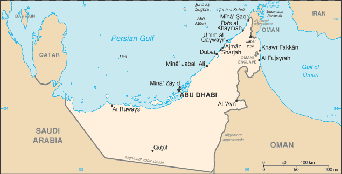
- Capital
- Abu Dhabi
- Phone Code
- +971
- Voltage
- 220V / 50Hz
- Power Plug
- C, D, G
- Phone Jack
- RJ-11
- Currency
- Dirham
- Dial-up
- $0.155/min
- WiFi
- $19.95/day
About connectivity in United Arab Emirates
The UAE uses 220V/50Hz with the British Type G outlet (a legacy of British colonial wiring standards) plus Type C and Type D in some installations. The phone jack is RJ-11. Etisalat (the Emirates Telecommunications Corporation, founded 1976) held a monopoly until 2007 when du (Emirates Integrated Telecommunications Company) launched as the second carrier. The mobile market is a state-supervised duopoly with intense retail competition at the consumer level.
The UAE's commercial Internet launched through Etisalat in 1995, with content access proxy-routed and filtered from the outset under the Telecommunications and Digital Government Regulatory Authority. Per-minute metered dial-up dominated the late 1990s. Etisalat's ADSL service rolled out from 2002-2003, and the country's aggressive Vision 2021 / Vision 2030 broadband-infrastructure spending drove some of the world's fastest FTTH penetration rates by the 2010s. The du-Etisalat duopoly competes on consumer broadband and mobile pricing within the regulated content-filtering framework.
Etisalat introduced its cardphone system in the late 1980s with chip-card cardphones following from the mid-1990s. The UAE became one of the world's most card-driven prepaid international calling markets — the country's extremely high proportion of expatriate migrant workers (estimated at 85-90% of the resident population, the highest such ratio of any major country) drove sustained per-destination prepaid card demand at enormous volume. South Asian (Indian, Pakistani, Bangladeshi, Sri Lankan, Nepalese), Filipino, Sudanese, Egyptian, Yemeni, Palestinian, Syrian, Iranian, Ethiopian, Eritrean, and broader Sub-Saharan African worker populations all sustained per-destination card brands sold through laundry shops, grocery stores, and dedicated phone-card kiosks across the labor-camp and inner-city districts of Dubai, Abu Dhabi, Sharjah, and the Northern Emirates. The Etisalat / du payphone fleet has been progressively decommissioned through the 2010s and 2020s.
Tempest Telecom served the UAE through dial-up POPs in Dubai, Abu Dhabi, and Sharjah, with WiFi hotspot access at $19.95/day across the dense hotel network and the dual major airports. The UAE was a particularly significant Iridium and Thuraya satphone customer base — Thuraya, headquartered in Abu Dhabi and launching commercial GEO service in 2001, was a particularly natural fit for UAE-based customers, and Tempest integrated Thuraya minutes into the same unified prepaid balance as Iridium. The offshore energy industry (ADNOC, etc.), the maritime services sector in the Strait of Hormuz, and expedition operators heading into Saudi Arabia's Empty Quarter all relied on Tempest's satellite voice plus BGAN data terminals.
Modern UAE has near-universal gigabit FTTH and mature 5G — Dubai and Abu Dhabi are consistently among the world's fastest broadband markets per Speedtest rankings.
Tempest's services across United Arab Emirates, 1997–2012
Tempest Telecommunications operated international connectivity services in United Arab Emirates between 1997 and 2012 under a unified prepaid account that absorbed multiple service types onto a single customer credential. Customers in United Arab Emirates drew from the same balance for pre-paid international voice calling, RADIUS-authenticated dial-up Internet roaming, metered Wi-Fi hotspot access, Iridium and Thuraya satellite voice, and Inmarsat BGAN and Thuraya data terminals. The PATN kiosk-card clearinghouse (Tempest's TITAN kiOSK, incorporated 2000) extended the same card-and-PIN model to public Internet terminals but did not reach scale.
Both Iridium (global LEO) and Thuraya (regional GEO) satellite voice were available in United Arab Emirates from approximately 2001, alongside global BGAN data from late 2005.
Nearby countries in Middle East
Kuwait · Lebanon · Oman · Qatar · Saudi Arabia · Syria · Turkey · Yemen