


Bangladesh
Power & telecom standards in Bangladesh
Connectivity Overview
Tempest Telecom offered dial-up internet access, WiFi hotspot access and broadband ethernet access in Bangladesh. We also offered Iridium satellite Internet and Voice access in Bangladesh for communications in rural areas without infrastructure.
Bangladesh uses 220V at 50Hz. Power outlets are type A, C, D, G, K and telephone jacks are RJ-11.
Dial-up Internet Access
Tempest Telecom provided local dial-up access numbers in Bangladesh at $0.255/minute. Travelers could connect using any standard modem with an RJ-11 telephone adapter.
WiFi Hotspot Access
Tempest Telecom provided WiFi hotspot access in Bangladesh at $19.95/day for unlimited browsing.
Adapters & Power
North American (Type A/B) plugs are compatible. An adapter may not be needed for US travelers.
Standard RJ-11 jacks are used. Most international modems will connect without an adapter.
Bangladesh at a Glance
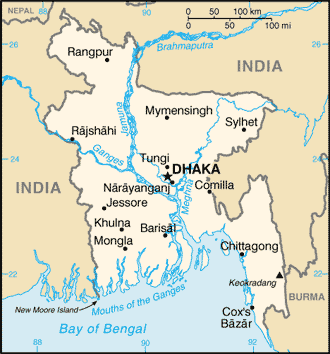
- Capital
- Dhaka
- Phone Code
- +880
- Voltage
- 220V / 50Hz
- Power Plug
- A, C, D, G, K
- Phone Jack
- RJ-11
- Currency
- Taka
- Dial-up
- $0.255/min
- WiFi
- $19.95/day
About connectivity in Bangladesh
Bangladesh uses 220V/50Hz with Type A, Type C, Type D, Type G, and Type K outlets — an unusual five-type mix reflecting layered British colonial, post-independence, and modern installations. The phone jack is RJ-11. BTCL (Bangladesh Telecommunications Company Limited, the post-2008 corporatized successor to the BTTB / Bangladesh Telegraph and Telephone Board) handles fixed-line and international gateway operations. The mobile market is dominated by Grameenphone (founded 1997 by social-entrepreneur Iqbal Quadir alongside Muhammad Yunus and Norway's Telenor, pioneering rural mobile telephony through Grameen Bank's microfinance customer base), Robi (Axiata), and Banglalink (Veon).
Bangladesh's academic BTTB-era research network provided limited Internet access from the mid-1990s. Commercial dial-up began in 1996 with ISN, AGNI Systems, BangIanet, BongoNet, and a wave of regional ISPs operating over BTTB PSTN lines. International bandwidth was historically constrained — the transformative development was Bangladesh's connection to the SEA-ME-WE-4 submarine cable in 2006, which dramatically expanded backbone capacity and dropped per-Mbps prices. ADSL adoption followed through the late 2000s. Mobile data dominates current Internet access, with the country's 4G LTE coverage rolling out rapidly through the 2010s and 5G deployment beginning in 2021.
BTCL / BTTB cardphone deployment was limited — the more important prepaid market in Bangladesh became mobile airtime rather than payphone cards, with mobile penetration leapfrogging fixed-line cardphone infrastructure. The Bangladeshi prepaid international calling-card market through the 2000s and 2010s served the very large outbound migrant-labor populations — an estimated 10+ million Bangladeshis work and live abroad, concentrated in the Gulf states (Saudi Arabia, UAE, Kuwait, Qatar, Bahrain, Oman), Malaysia, Singapore, Maldives, Italy, the United Kingdom (one of Britain's largest South Asian communities, particularly in Tower Hamlets and East London), the United States, and Canada. Card brands targeting Bangladesh-specific destinations sold through dense South Asian-grocery and convenience-store networks in receiving countries.
Tempest Telecom served Bangladesh through dial-up POPs in Dhaka. The Bay of Bengal maritime industries, the Chittagong Hill Tracts expedition customer base, and the recurring flood and cyclone humanitarian-response operations were a sustained Iridium satphone market.
Modern Bangladesh has very high mobile penetration via Grameenphone, Robi, and Banglalink, with FTTH coverage expanding in Dhaka and Chittagong. The country's telecom market is shaped substantially by the rural-mobile model pioneered by Grameenphone in the late 1990s and 2000s.
Tempest's services across Bangladesh, 1997–2012
Tempest Telecommunications operated international connectivity services in Bangladesh between 1997 and 2012 under a unified prepaid account that absorbed multiple service types onto a single customer credential. Customers in Bangladesh drew from the same balance for pre-paid international voice calling, RADIUS-authenticated dial-up Internet roaming, metered Wi-Fi hotspot access, Iridium and Thuraya satellite voice, and Inmarsat BGAN and Thuraya data terminals. The PATN kiosk-card clearinghouse (Tempest's TITAN kiOSK, incorporated 2000) extended the same card-and-PIN model to public Internet terminals but did not reach scale.
Both Iridium (global LEO) and Thuraya (regional GEO) satellite voice were available in Bangladesh from approximately 2001, alongside global BGAN data from late 2005.
Nearby countries in Asia
Afghanistan · Armenia · Azerbaijan · Bhutan · Brunei · Burma · Cambodia · China