


Cambodia
Power & telecom standards in Cambodia
Connectivity Overview
Tempest Telecom offered dial-up internet access, WiFi hotspot access and broadband ethernet access in Cambodia. We also offered Iridium satellite Internet and Voice access in Cambodia for communications in rural areas without infrastructure.
Cambodia uses 230V at 50Hz. Power outlets are type A, C, G and telephone jacks are RJ-11.
Dial-up Internet Access
Tempest Telecom provided local dial-up access numbers in Cambodia at $0.255/minute. Travelers could connect using any standard modem with an RJ-11 telephone adapter.
WiFi Hotspot Access
Tempest Telecom provided WiFi hotspot access in Cambodia at $19.95/day for unlimited browsing.
Adapters & Power
North American (Type A/B) plugs are compatible. An adapter may not be needed for US travelers.
Standard RJ-11 jacks are used. Most international modems will connect without an adapter.
Cambodia at a Glance
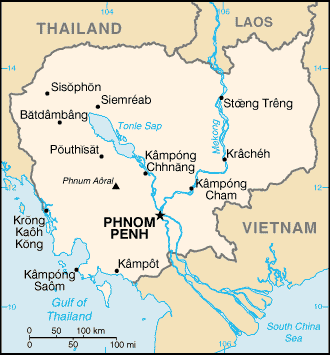
- Capital
- Phnom Penh
- Phone Code
- +855
- Voltage
- 230V / 50Hz
- Power Plug
- A, C, G
- Phone Jack
- RJ-11
- Currency
- Riel
- Dial-up
- $0.255/min
- WiFi
- $19.95/day
About connectivity in Cambodia
Cambodia uses 230V/50Hz with Type A, Type C, and Type G outlets — a mix reflecting French colonial-era wiring (Type C), post-1953 American influence (Type A), and modern British-standard tourism-zone installations. The phone jack is RJ-11. The Cambodian telecom sector was reconstructed almost from scratch following the Khmer Rouge era (1975-1979) and subsequent civil conflict; the post-1990s rebuild was led by a combination of state operators and aggressive foreign-investment-driven mobile rollout. The mobile market is dominated by Cellcard (Royal Group), Smart Axiata (Malaysian Axiata), and Metfone (the Vietnamese Viettel subsidiary).
Cambodia's commercial Internet emerged in 1996-1997 through Camnet (the state operator's consumer brand) and Big Pond Cambodia, with very limited capacity through the late 1990s. The 2000s rebuilding period saw substantial ISP entry and mobile-data adoption from 2010s 3G/4G rollout. Cambodia's combination of low fixed-line penetration and aggressive mobile-data rollout has produced a mobile-led Internet-access pattern; Metfone's Vietnamese parent Viettel has driven competitive pricing across the broader region.
Cambodian cardphone deployment was modest. The Cambodian prepaid international calling-card market through the 2000s and 2010s served the substantial Cambodian-American diaspora — concentrated in Long Beach California (one of the largest Cambodian communities outside Cambodia, the post-Khmer Rouge refugee resettlement), Lowell Massachusetts, and other US locations — plus the Cambodian-French (post-1975 refugee resettlement) and Cambodian-Australian populations. Card brands targeting Khmer-language destinations sold through Cambodian-grocery networks in the receiving countries.
Tempest Telecom served Cambodia through dial-up POPs in Phnom Penh. Iridium satphones served the Tonlé Sap fishing-industry customer base, archaeological-research operators working the Angkor Wat UNESCO heritage complex and the broader Siem Reap area, NGO operators across the post-conflict humanitarian customer base (Cambodia hosted enormous mine-action and demining operations through the 1990s and 2000s), and tourism operators across the developing tourism corridors.
Modern Cambodia has expanding 4G LTE coverage with 5G rollout beginning in Phnom Penh and Siem Reap. FTTH is concentrated in major cities; rural coverage relies on mobile-data infrastructure.
Tempest's services across Cambodia, 1997–2012
Tempest Telecommunications operated international connectivity services in Cambodia between 1997 and 2012 under a unified prepaid account that absorbed multiple service types onto a single customer credential. Customers in Cambodia drew from the same balance for pre-paid international voice calling, RADIUS-authenticated dial-up Internet roaming, metered Wi-Fi hotspot access, Iridium satellite voice, and Inmarsat BGAN data terminals. The PATN kiosk-card clearinghouse (Tempest's TITAN kiOSK, incorporated 2000) extended the same card-and-PIN model to public Internet terminals but did not reach scale.
Iridium satellite voice was available in Cambodia from approximately 2001 (post-bankruptcy relaunch). Thuraya coverage did not extend to Cambodia; Inmarsat BGAN data terminals filled the broadband gap from late 2005.
Nearby countries in Asia
Bangladesh · Bhutan · Brunei · Burma · China · East Timor · Georgia · Hong Kong