


Vietnam
Power & telecom standards in Vietnam
Connectivity Overview
Tempest Telecom offered dial-up internet access, WiFi hotspot access and broadband ethernet access in Vietnam. We also offered Iridium satellite Internet and Voice access in Vietnam for communications in rural areas without infrastructure.
Vietnam uses 220V at 50Hz. Power outlets are type A, C, G and telephone jacks are RJ-11.
Dial-up Internet Access
Tempest Telecom provided local dial-up access numbers in Vietnam at $0.255/minute. Travelers could connect using any standard modem with an RJ-11 telephone adapter.
WiFi Hotspot Access
Tempest Telecom provided WiFi hotspot access in Vietnam at $19.95/day for unlimited browsing.
Adapters & Power
North American (Type A/B) plugs are compatible. An adapter may not be needed for US travelers.
Standard RJ-11 jacks are used. Most international modems will connect without an adapter.
Vietnam at a Glance
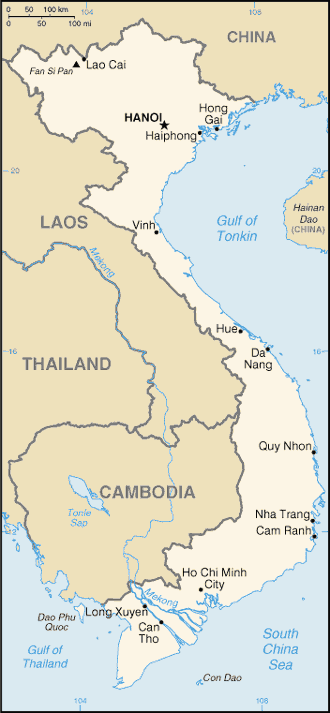
- Capital
- Hanoi
- Phone Code
- +84
- Voltage
- 220V / 50Hz
- Power Plug
- A, C, G
- Phone Jack
- RJ-11
- Currency
- Dong
- Dial-up
- $0.255/min
- WiFi
- $19.95/day
About connectivity in Vietnam
Vietnam uses 220V/50Hz with Type A, Type C, and Type G outlets — a mix reflecting historic French colonial wiring, later American influence in the South, and modern Chinese-and-European installation practices. The phone jack is RJ-11. VNPT (Vietnam Posts and Telecommunications Group, the post-1995 successor combining the postal and telecom operations), Viettel (the military-affiliated operator that has grown into the country's largest mobile carrier), MobiFone, and Vinaphone (VNPT's mobile brand) dominate the market. FPT Telecom is a substantial fixed-broadband and pay-TV competitor.
Vietnam's academic NetNam opened the country's first international Internet connection in 1994. Public commercial Internet was authorized in November 1997 in a controlled rollout, with VNPT's VDC (Vietnam Data Communications), FPT Telecom, Saigon Postel (Sphone), and Netnam-Vietnam Telecom International competing under regulated content frameworks. Per-minute metered dial-up over VNPT PSTN dominated the late 1990s. ADSL from VNPT/VDC and FPT rolled out from 2003-2004 with the broadband market growing rapidly through the 2010s. Mobile data dominates Vietnamese Internet access today, with extremely competitive pricing.
VNPT introduced cardphone units in the 1990s with chip-card cardphones becoming standard. The Vietnamese prepaid international calling-card market through the 1990s, 2000s, and into the 2010s served the very large outbound Vietnamese diaspora — Vietnamese-American (an estimated 2+ million people, the largest Vietnamese community outside Vietnam, concentrated in California, Texas, and the Pacific Northwest), Vietnamese-French (particularly in Paris), Vietnamese-Australian, Vietnamese-Canadian, and Vietnamese-German. Card brands targeting Vietnam-specific destinations were among the most actively-promoted ethnic-market products in US convenience-store networks through the 2000s. VNPT payphone fleets across Vietnam were largely decommissioned through the 2010s as mobile penetration saturated.
Tempest Telecom served Vietnam through dial-up POPs in Hanoi, Ho Chi Minh City (Saigon), and Da Nang. The South China Sea and Tonkin Gulf maritime industries, plus the broader Mekong Delta and Central Highlands operations, were a meaningful Iridium satphone market.
Modern Vietnam has aggressive 5G rollout from Viettel, MobiFone, and Vinaphone, with FTTH widely available in metropolitan areas at prices among the lowest in Asia.
Tempest's services across Vietnam, 1997–2012
Tempest Telecommunications operated international connectivity services in Vietnam between 1997 and 2012 under a unified prepaid account that absorbed multiple service types onto a single customer credential. Customers in Vietnam drew from the same balance for pre-paid international voice calling, RADIUS-authenticated dial-up Internet roaming, metered Wi-Fi hotspot access, Iridium satellite voice, and Inmarsat BGAN data terminals. The PATN kiosk-card clearinghouse (Tempest's TITAN kiOSK, incorporated 2000) extended the same card-and-PIN model to public Internet terminals but did not reach scale.
Iridium satellite voice was available in Vietnam from approximately 2001 (post-bankruptcy relaunch). Thuraya coverage did not extend to Vietnam; Inmarsat BGAN data terminals filled the broadband gap from late 2005.
Nearby countries in Asia
Afghanistan · Armenia · Azerbaijan · Bangladesh · Bhutan · Brunei · Burma · Cambodia