


Burma
Power & telecom standards in Burma
Connectivity Overview
Tempest Telecom offered satellite-only service in Burma. Iridium satellite Internet and Voice access was available for communications in rural areas without infrastructure.
Burma uses 230V at 50Hz. Power outlets are type C, D, F, G and telephone jacks are RJ-11.
Dial-up Internet Access
Dial-up access was not available in Burma. Satellite Internet was the recommended alternative.
WiFi Hotspot Access
WiFi hotspot access was not available through Tempest in Burma.
Adapters & Power
A Type G (British 3-pin) adapter is required for travelers from North America, Europe, and most of Asia.
Standard RJ-11 jacks are used. Most international modems will connect without an adapter.
Burma at a Glance
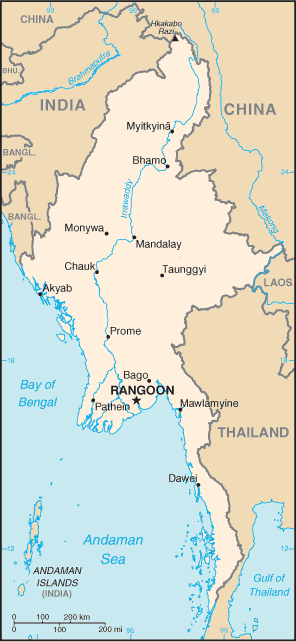
- Capital
- Naypyidaw
- Phone Code
- +95
- Voltage
- 230V / 50Hz
- Power Plug
- C, D, F, G
- Phone Jack
- RJ-11
- Currency
- Kyat
- Dial-up
- N/A
- WiFi
- N/A
About connectivity in Burma
Burma (Myanmar) uses 230V/50Hz with Type C, Type D, Type F, and Type G outlets — an unusual four-type mix reflecting layered British colonial (Type D/G from the Burma Province era), post-1948 European-standard (Type C/F), and modern installations. The phone jack is RJ-11. MPT (Myanma Posts and Telecommunications), the long-standing state operator, held an absolute monopoly on Burmese telecom until 2013, when the government liberalized the sector and licensed Ooredoo Myanmar (Qatari Ooredoo) and Telenor Myanmar as foreign-invested competitors. Mytel (a military-affiliated joint venture with Vietnamese Viettel) launched in 2018. The February 2021 military coup substantially disrupted the foreign-operator environment, with Telenor exiting in 2022.
Burma's commercial Internet history is among the most constrained anywhere — the country had essentially no public Internet access until the 2000s, with the early 2000s rollout limited to a small number of state-controlled cybercafes operating under tight content surveillance. The 2010-2011 political opening accelerated Internet liberalization, with mobile data becoming widely available after the 2013 telecom-sector liberalization. By 2015 Myanmar had one of the fastest mobile-penetration growth rates in the world. The post-2021 military coup has reversed substantial portions of the liberalization, with periodic Internet shutdowns and tight content controls re-imposed.
MPT's cardphone deployment was limited, with mobile prepaid airtime becoming the dominant prepaid product after 2013 liberalization. The Burmese prepaid international calling-card market through the 2010s served the very large Burmese outbound labor migration — an estimated 3+ million Burmese workers in Thailand (the largest single migrant population in Thailand), plus substantial communities in Malaysia, Singapore, South Korea, and Japan. Card brands targeting Burmese destinations sold through dense Burmese-grocery networks in the receiving countries, particularly along the Mae Sot border and in the Thai-Burmese migrant labor districts of Bangkok and Mahachai.
Tempest Telecom served Burma through dial-up POPs in Yangon. The country's closed pre-2011 political environment, plus US and EU sanctions through extended periods, complicated Tempest service throughout the operational era. Iridium satphones served the substantial NGO and humanitarian customer base (Cyclone Nargis 2008 response, ongoing Rakhine humanitarian operations, post-coup democracy-movement journalist customers), archaeological-research operators across the Bagan and Mrauk U sites, and the maritime industry in the Bay of Bengal.
Modern Burma has expanding 4G LTE coverage in major cities; the post-2021 coup political environment continues to constrain investment and operator participation.
Tempest's services across Burma, 1997–2012
Tempest Telecommunications operated international connectivity services in Burma between 1997 and 2012 under a unified prepaid account that absorbed multiple service types onto a single customer credential. Customers in Burma drew from the same balance for pre-paid international voice calling, RADIUS-authenticated dial-up Internet roaming, metered Wi-Fi hotspot access, Iridium satellite voice, and Inmarsat BGAN data terminals. The PATN kiosk-card clearinghouse (Tempest's TITAN kiOSK, incorporated 2000) extended the same card-and-PIN model to public Internet terminals but did not reach scale.
Iridium satellite voice was available in Burma from approximately 2001 (post-bankruptcy relaunch). Thuraya coverage did not extend to Burma; Inmarsat BGAN data terminals filled the broadband gap from late 2005.
Nearby countries in Asia
Azerbaijan · Bangladesh · Bhutan · Brunei · Cambodia · China · East Timor · Georgia