


Malaysia
Power & telecom standards in Malaysia
Connectivity Overview
Tempest Telecom offered dial-up internet access, WiFi hotspot access and broadband ethernet access in Malaysia. We also offered Iridium satellite Internet and Voice access in Malaysia for communications in rural areas without infrastructure.
Malaysia uses 240V at 50Hz. Power outlets are type G and telephone jacks are RJ-11.
Dial-up Internet Access
Tempest Telecom provided local dial-up access numbers in Malaysia at $0.155/minute. Travelers could connect using any standard modem with an RJ-11 telephone adapter.
WiFi Hotspot Access
Tempest Telecom provided WiFi hotspot access in Malaysia at $19.95/day for unlimited browsing.
Adapters & Power
A Type G (British 3-pin) adapter is required for travelers from North America, Europe, and most of Asia.
Standard RJ-11 jacks are used. Most international modems will connect without an adapter.
Malaysia at a Glance
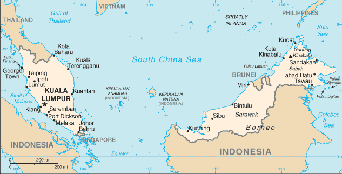
- Capital
- Kuala Lumpur
- Phone Code
- +60
- Voltage
- 240V / 50Hz
- Power Plug
- G
- Phone Jack
- RJ-11
- Currency
- Ringgit
- Dial-up
- $0.155/min
- WiFi
- $19.95/day
About connectivity in Malaysia
Malaysia uses 240V/50Hz with the British Type G outlet — a legacy of British colonial wiring standards. The phone jack is RJ-11. Telekom Malaysia (TM, the post-1987 successor to Jabatan Telekom Malaysia) was partially privatized through the 1990s and 2000s. The mobile market is dominated by Maxis, Celcom (the 2023 Celcom-Digi merger created CelcomDigi), U Mobile, and Telekom Malaysia's own Unifi Mobile.
Malaysia's academic JARING opened the country's first international Internet connection in 1992 through MIMOS (Malaysian Institute of Microelectronic Systems). Commercial dial-up began in 1995-1996 with TMnet (Telekom Malaysia's consumer ISP), Jaring (the former research network commercialized), Maxis Net, and Time dotCom. Per-minute metered dial-up through Telekom Malaysia PSTN was the norm. The MSC Malaysia (Multimedia Super Corridor) initiative launched in 1996 was the government's attempt to drive technology-sector growth around Putrajaya and Cyberjaya, with mixed results. ADSL from TMnet Streamyx launched in 2001-2002 and broadband adoption accelerated through the 2000s. The Unifi FTTH rollout from 2010 onward drove the modern broadband market.
Telekom Malaysia introduced cardphone units in 1989 with chip-card cardphones following from the mid-1990s. The Malaysian prepaid international calling-card market through the 1990s and 2000s served the substantial inbound migrant-labor populations from Indonesia (the largest single migrant community), the Philippines, Bangladesh, Nepal, Myanmar, and Vietnam, plus the smaller but high-volume outbound Malaysian diaspora to Singapore, Australia, the UK, the US, and the Middle East. The country's tri-ethnic demographic structure (Malay, Chinese, Indian) sustained per-destination card brands targeting all three diaspora networks. Telekom Malaysia payphone units across Kuala Lumpur, Penang, and Johor Bahru have been progressively decommissioned through the 2010s.
Tempest Telecom served Malaysia through dial-up POPs in Kuala Lumpur, Penang, Johor Bahru, and Kota Kinabalu (Sabah). The Malacca Strait maritime industry, the offshore oil-and-gas sector around Terengganu and Sarawak, and expedition operations into the Sabah and Sarawak rainforests were a sustained Iridium satphone market. The Cyberjaya / KL business corridor was a meaningful $19.95/day WiFi market.
Modern Malaysia has expanding FTTH from Unifi, Maxis Fibre, TIME, and altnet operators, with 5G rollout from the government-backed Digital Nasional Berhad single-network model.
Tempest's services across Malaysia, 1997–2012
Tempest Telecommunications operated international connectivity services in Malaysia between 1997 and 2012 under a unified prepaid account that absorbed multiple service types onto a single customer credential. Customers in Malaysia drew from the same balance for pre-paid international voice calling, RADIUS-authenticated dial-up Internet roaming, metered Wi-Fi hotspot access, Iridium and Thuraya satellite voice, and Inmarsat BGAN and Thuraya data terminals. The PATN kiosk-card clearinghouse (Tempest's TITAN kiOSK, incorporated 2000) extended the same card-and-PIN model to public Internet terminals but did not reach scale.
Both Iridium (global LEO) and Thuraya (regional GEO) satellite voice were available in Malaysia from approximately 2001, alongside global BGAN data from late 2005.
Nearby countries in Asia
Korea. South · Kyrgyzstan · Laos · Macau · Maldives · Mongolia · Nepal · Pakistan