


Pakistan
Power & telecom standards in Pakistan
Connectivity Overview
Tempest Telecom offered dial-up internet access, WiFi hotspot access and broadband ethernet access in Pakistan. We also offered Iridium satellite Internet and Voice access in Pakistan for communications in rural areas without infrastructure.
Pakistan uses 230V at 50Hz. Power outlets are type C, D, G, M and telephone jacks are RJ-11.
Dial-up Internet Access
Tempest Telecom provided local dial-up access numbers in Pakistan at $0.155/minute. Travelers could connect using any standard modem with an RJ-11 telephone adapter.
WiFi Hotspot Access
Tempest Telecom provided WiFi hotspot access in Pakistan at $19.95/day for unlimited browsing.
Adapters & Power
A Type G (British 3-pin) adapter is required for travelers from North America, Europe, and most of Asia.
Standard RJ-11 jacks are used. Most international modems will connect without an adapter.
Pakistan at a Glance
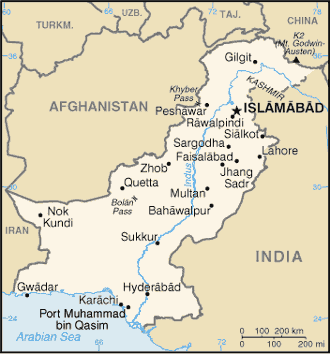
- Capital
- Islamabad
- Phone Code
- +92
- Voltage
- 230V / 50Hz
- Power Plug
- C, D, G, M
- Phone Jack
- RJ-11
- Currency
- Rupee
- Dial-up
- $0.155/min
- WiFi
- $19.95/day
About connectivity in Pakistan
Pakistan uses 230V/50Hz with Type C, Type D, Type G, and Type M outlets — a mix reflecting British colonial wiring (Type D/G/M) alongside more recent European-standard adoption. The phone jack is RJ-11. PTCL (Pakistan Telecommunication Company Limited, founded 1995 from the post-PT&T Pakistan Telecom Corporation) was partially privatized in 2006 in a sale to Etisalat (UAE). Jazz (the post-2017 Mobilink-Warid merger, now Veon-controlled), Telenor Pakistan (acquired by PTCL Group in 2024), Zong (China Mobile-owned), and Ufone (PTCL's own mobile brand) compete in the mobile market.
Pakistan's academic PERN (Pakistan Educational Research Network) provided early Internet connectivity from the mid-1990s. Commercial dial-up emerged in 1995-1996 with Net.pk (one of the earliest commercial Pakistani ISPs), Brain Net, Cyber.net, Multi.net, and a long list of regional ISPs. Per-minute metered dial-up through PTCL's monopoly PSTN at relatively high prices kept Pakistani Internet penetration low through the late 1990s. PTCL's ADSL service rolled out from 2003-2004 with broadband adoption accelerating through the late 2000s. The 2004 deregulation of mobile licensing (the Mobile Cellular Policy) drove rapid mobile-data adoption from the mid-2000s onward, and mobile data now dominates Pakistani Internet access.
PTCL introduced cardphone units in the 1990s, with chip-card cardphones following. The Pakistani prepaid international calling-card market through the 1990s, 2000s, and 2010s was among the world's largest by absolute volume, driven by the country's very large outbound migration: an estimated 4-6 million Pakistanis live and work in the Gulf states (Saudi Arabia, UAE, Kuwait, Qatar, Oman, Bahrain), the United Kingdom (one of Britain's largest South Asian communities, particularly concentrated in Birmingham, Bradford, Manchester, and East London), the United States (Houston, the New York Metropolitan Area, Chicago), Canada (Toronto), and Australia. Card brands targeting Pakistan-specific destinations from each receiving country sold through dense South Asian-grocery and convenience-store networks.
Tempest Telecom served Pakistan through dial-up POPs in Karachi, Lahore, Islamabad, and Peshawar. Iridium satphones served the energy-sector customer base in Balochistan (the offshore Sui gas field plus the broader gas-and-petrochemical infrastructure), expedition crews in the Gilgit-Baltistan and Karakoram regions, NGO operators across the former tribal areas (FATA), and humanitarian responders during recurring flood and earthquake events.
Modern Pakistan has aggressive mobile-data deployment with 4G LTE coverage in populated areas; fixed-line broadband remains underdeveloped relative to mobile, with FTTH concentrated in Karachi, Lahore, and Islamabad.
Tempest's services across Pakistan, 1997–2012
Tempest Telecommunications operated international connectivity services in Pakistan between 1997 and 2012 under a unified prepaid account that absorbed multiple service types onto a single customer credential. Customers in Pakistan drew from the same balance for pre-paid international voice calling, RADIUS-authenticated dial-up Internet roaming, metered Wi-Fi hotspot access, Iridium and Thuraya satellite voice, and Inmarsat BGAN and Thuraya data terminals. The PATN kiosk-card clearinghouse (Tempest's TITAN kiOSK, incorporated 2000) extended the same card-and-PIN model to public Internet terminals but did not reach scale.
Both Iridium (global LEO) and Thuraya (regional GEO) satellite voice were available in Pakistan from approximately 2001, alongside global BGAN data from late 2005.
Nearby countries in Asia
Malaysia · Maldives · Mongolia · Nepal · Philippines · Singapore · Sri Lanka · Taiwan