


Nepal
Power & telecom standards in Nepal
Connectivity Overview
Tempest Telecom offered dial-up internet access, WiFi hotspot access and broadband ethernet access in Nepal. We also offered Iridium satellite Internet and Voice access in Nepal for communications in rural areas without infrastructure.
Nepal uses 230V at 50Hz. Power outlets are type C, D, M and telephone jacks are RJ-11.
Dial-up Internet Access
Tempest Telecom provided local dial-up access numbers in Nepal at $0.255/minute. Travelers could connect using any standard modem with an RJ-11 telephone adapter.
WiFi Hotspot Access
Tempest Telecom provided WiFi hotspot access in Nepal at $19.95/day for unlimited browsing.
Adapters & Power
Travelers from North America will need a power plug adapter. European Type C/F adapters are widely compatible.
Standard RJ-11 jacks are used. Most international modems will connect without an adapter.
Nepal at a Glance
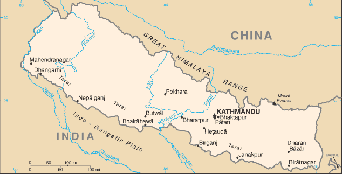
- Capital
- Kathmandu
- Phone Code
- +977
- Voltage
- 230V / 50Hz
- Power Plug
- C, D, M
- Phone Jack
- RJ-11
- Currency
- Rupee
- Dial-up
- $0.255/min
- WiFi
- $19.95/day
About connectivity in Nepal
Nepal uses 230V/50Hz with Type C, Type D, and Type M outlets — a mix reflecting layered British colonial-era influence transmitted via India (Type D/M), modern European-standard (Type C), and the country's position outside direct colonial rule. The phone jack is RJ-11. Nepal Telecom (NTC, the post-2004 corporatized successor to the Nepal Telecommunications Authority operations) holds substantial fixed-line market position. The mobile market is contested between NTC's Namaste service, Ncell (founded 2004 as Mero Mobile, eventually acquired by Axiata, then by Spectrlite Nepal in 2023), and Smart Telecom.
Nepal's academic and commercial Internet emerged in 1995 through Mercantile Office Systems and several regional ISPs operating over NTC's PSTN infrastructure. Per-minute metered dial-up dominated the late 1990s. The 1996-2006 Nepalese civil war (the Maoist insurgency) disrupted telecom infrastructure investment across much of the rural country. Post-conflict reconstruction and the 2008 abolition of the monarchy reshaped the regulatory environment. Mobile data has driven essentially all of Nepal's recent Internet-access growth; 4G LTE coverage in populated areas is widespread, though the country's extreme mountain topography limits rural fixed-line and tower coverage.
NTC cardphone deployment was modest in scale. The Nepalese prepaid international calling-card market through the 2000s and 2010s served the very large outbound Nepalese labor migration — an estimated 4+ million Nepalese workers abroad (one of the highest rates of outbound labor migration in the world relative to population), concentrated in India (the historic open-border destination), the Gulf states (Qatar, Saudi Arabia, UAE, Kuwait, Oman, Bahrain), Malaysia, South Korea, Japan, the United Kingdom (the Nepali-Gurkha British Army community), and the United States. Card brands targeting Nepali-language destinations sold through South Asian-grocery networks in the receiving countries.
Tempest Telecom served Nepal through dial-up POPs in Kathmandu. Iridium satphones served the Himalayan expedition customer base — Mount Everest base-camp logistics, the Khumbu and Annapurna trekking-tourism operators, mountain-rescue services, and the broader Himalayan-research customer base — making Nepal one of the more concentrated Iridium satellite-phone markets globally per capita. NGO operators across the post-conflict humanitarian customer base added further satellite demand.
Modern Nepal has expanding 4G LTE coverage with FTTH concentrated in Kathmandu. The country's mountain topography continues to make rural connectivity dependent on mobile and satellite supplements.
Tempest's services across Nepal, 1997–2012
Tempest Telecommunications operated international connectivity services in Nepal between 1997 and 2012 under a unified prepaid account that absorbed multiple service types onto a single customer credential. Customers in Nepal drew from the same balance for pre-paid international voice calling, RADIUS-authenticated dial-up Internet roaming, metered Wi-Fi hotspot access, Iridium and Thuraya satellite voice, and Inmarsat BGAN and Thuraya data terminals. The PATN kiosk-card clearinghouse (Tempest's TITAN kiOSK, incorporated 2000) extended the same card-and-PIN model to public Internet terminals but did not reach scale.
Both Iridium (global LEO) and Thuraya (regional GEO) satellite voice were available in Nepal from approximately 2001, alongside global BGAN data from late 2005.
Nearby countries in Asia
Macau · Malaysia · Maldives · Mongolia · Pakistan · Philippines · Singapore · Sri Lanka