


Thailand
Power & telecom standards in Thailand
Connectivity Overview
Tempest Telecom offered dial-up internet access, WiFi hotspot access and broadband ethernet access in Thailand. We also offered Iridium satellite Internet and Voice access in Thailand for communications in rural areas without infrastructure.
Thailand uses 220V at 50Hz. Power outlets are type A, B, C, F and telephone jacks are RJ-11.
Dial-up Internet Access
Tempest Telecom provided local dial-up access numbers in Thailand at $0.155/minute. Travelers could connect using any standard modem with an RJ-11 telephone adapter.
WiFi Hotspot Access
Tempest Telecom provided WiFi hotspot access in Thailand at $19.95/day for unlimited browsing.
Adapters & Power
North American (Type A/B) plugs are compatible. An adapter may not be needed for US travelers.
Standard RJ-11 jacks are used. Most international modems will connect without an adapter.
Thailand at a Glance
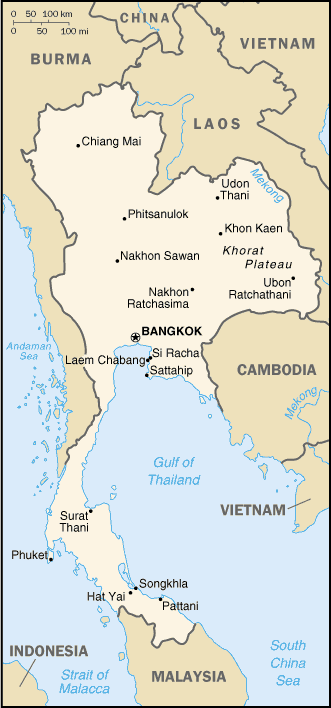
- Capital
- Bangkok
- Phone Code
- +66
- Voltage
- 220V / 50Hz
- Power Plug
- A, B, C, F
- Phone Jack
- RJ-11
- Currency
- Baht
- Dial-up
- $0.155/min
- WiFi
- $19.95/day
About connectivity in Thailand
Thailand uses 220V/50Hz with Type A, Type B, Type C, and Type F outlets — a mix reflecting historic American influence (Type A/B) alongside more recent European-standard adoption. The phone jack is RJ-11. TOT (Telephone Organization of Thailand, founded 1954) and CAT Telecom (Communications Authority of Thailand) merged in 2021 to form National Telecom (NT). AIS, dtac (Total Access Communication, now folded into True under the 2023 True-dtac merger), and True Move H dominate mobile and broadband.
Thailand's academic ThaiSarn opened the country's first international Internet connection in 1992 through the National Electronics and Computer Technology Center (NECTEC). Commercial dial-up began in 1995-1996 with Loxinfo (one of the earliest, founded by the Loxley conglomerate), Internet KSC, CS Internet, Asia Net, and AsiaInfonet. Per-minute metered dial-up through TOT PSTN was the norm. ADSL rolled out from TOT and TT&T in the early 2000s and consumer dial-up faded across the mid-2000s. The Thai broadband market has been unusually mobile-led since the 2010s, with 4G LTE and 5G providing meaningful broadband substitution for many households.
TOT and CAT introduced cardphone systems in the early 1990s with chip-card units becoming standard from the mid-1990s. The Thai prepaid international calling-card market through the 1990s and 2000s served the substantial Thai outbound diaspora to the US (particularly Los Angeles and the Pacific Northwest), Germany, the UK, Sweden, Norway, and Australia, alongside the very large inbound migrant-labor populations from Myanmar (an estimated 3+ million Burmese workers), Cambodia, and Laos calling home. Card brands targeting Burmese, Khmer, and Lao destinations were particularly active sold through inner-city Bangkok, Mae Sot, and Chiang Rai shop networks. Thai payphone fleets across the major cities were progressively decommissioned through the 2010s.
Tempest Telecom served Thailand through dial-up POPs in Bangkok, Phuket, Chiang Mai, and Pattaya, with WiFi at $19.95/day across the dense hotel networks in the major tourism zones. The Andaman and Gulf maritime industries, plus the broader Southeast Asian shipping lanes, were a sustained Iridium satphone market.
Modern Thailand has aggressive FTTH and 5G coverage from AIS, True, and National Telecom, with mobile data prices among the lowest in Southeast Asia.
Tempest's services across Thailand, 1997–2012
Tempest Telecommunications operated international connectivity services in Thailand between 1997 and 2012 under a unified prepaid account that absorbed multiple service types onto a single customer credential. Customers in Thailand drew from the same balance for pre-paid international voice calling, RADIUS-authenticated dial-up Internet roaming, metered Wi-Fi hotspot access, Iridium and Thuraya satellite voice, and Inmarsat BGAN and Thuraya data terminals. The PATN kiosk-card clearinghouse (Tempest's TITAN kiOSK, incorporated 2000) extended the same card-and-PIN model to public Internet terminals but did not reach scale.
Both Iridium (global LEO) and Thuraya (regional GEO) satellite voice were available in Thailand from approximately 2001, alongside global BGAN data from late 2005.
Nearby countries in Asia
Philippines · Singapore · Sri Lanka · Taiwan · Tajikistan · Turkmenistan · Uzbekistan · Vietnam